





Summarize with AI

March 6, 2026
6
Min reading

Do you know what a “gas factory” is? This expression, well known to the French, generally refers to a very complex project or system. Sometimes even too complex for its use and benefits.
This expression dates back to the 19th century.E century, when city gas production plants occupied a significant part of industrial basins. These industrial complexes processed hard coal or Coal by various processes, which allowed the extraction of gas that could be used in French homes.
As we will see in this article, gas has undergone several evolutions over time. Whether in terms of the method of production, extraction or even in the composition of the gas itself.
The energy transition which has already been under way in France for more than a decade, pushes us to look for environmentally friendly means of production. It turns out that the latest development concerns natural gas.
Biogas could contribute to meeting our CO emissions goals2 while allowing gas to be consumed. What are the advantages of biogas and its role in the energy transition?
From the 19thE century in Europe, gas-fired plants were massively introduced into the European industrial landscape. Ce City gas is produced during the transformation of hard coal (coal) into coke. The process in question was carried out by gasification of coal.
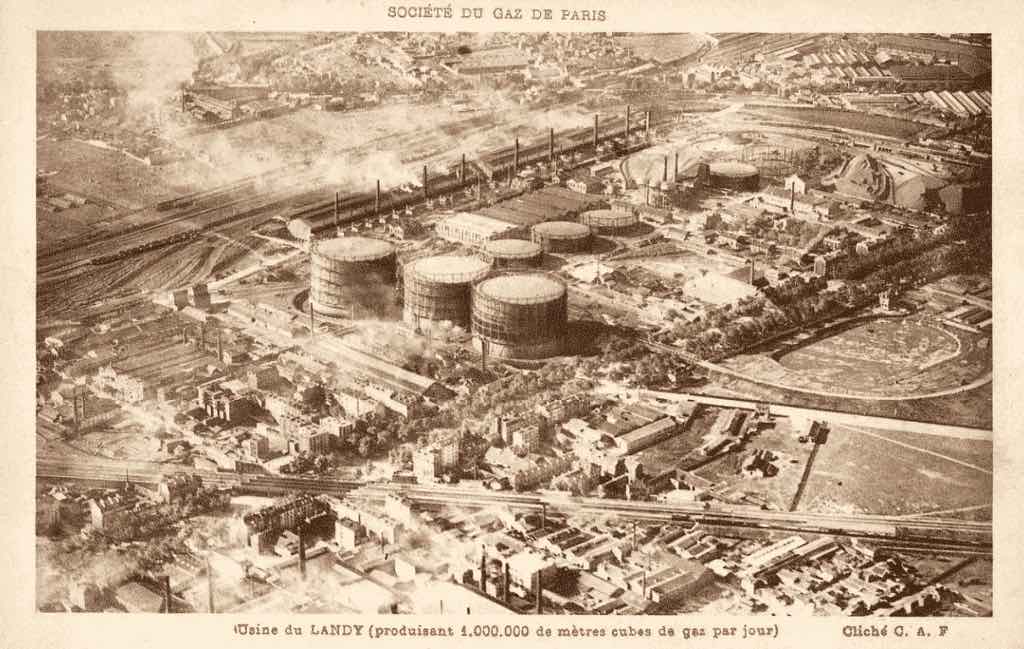
Landy factory, city gas — Source: Wikipedia
In fact, Coal gas was first of all a means of lighting for French homes until the end of the 19th centuryE century. These factories will deeply mark the French industrial landscape in several regions (North, East of France). Working conditions are very difficult there, with serious consequences on the health of workers.
Electricity will then appear and will thus replace the use of city gas for lighting.
Otherwise, city gas remained useful for other domestic uses until the 1960s. At that time, natural gas would gradually replace it.
Gradually, we went from using city gas that was difficult to extract, and less calorific, to exploiting natural gas. It is therefore the exploitation of natural gas fields contained in porous rocks basements.
This gas is composed of methane and has a higher calorific value than city gas. It is also used in power generation. Today it is one of main energy sources in the world.
Exporting countries (Russia, Algeria, Kuwait...) transport their liquefied gas (LNG) in boats specialized for this purpose (LNG carriers) around the world.
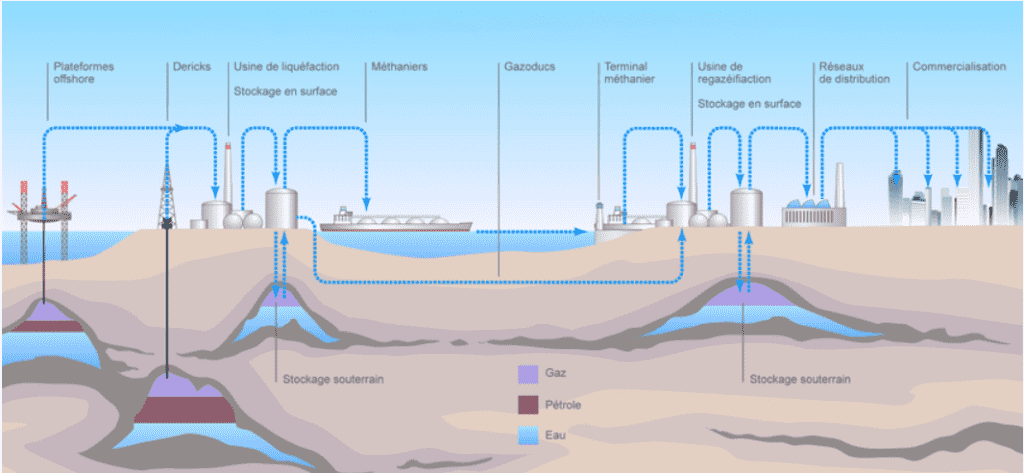
Diagram of the natural gas value chain — Source: Wikipedia
However, natural gas is a fossil energy. That is to say, its exploitation depends on limited resources, which emit greenhouse gases. Its use is therefore problematic in terms of energy transition.
This is how we understand the importance of exploiting a calorific resource such as gas, which is as efficient but environmentally friendly.
Over the years of research, processes for creating and using renewable gas have developed. This work gave rise to the biogas : in other words a gas resulting from the fermentation of organics such as agricultural or household waste in a place deprived of oxygen.
We therefore store these organic materials in a digester in order to artificially trigger the fermentation process. This process creates a gas that is mainly composed of methane and carbon dioxide.
La methanization is a process that already exists in its natural state when the necessary conditions are met. In particular, we see this phenomenon appear mainly in swamp Or the rice fields where organic materials degrade slowly.
As surprising as it may seem, the main advantage of this green energy source is that it mainly requires wastes. Indeed, we can imagine that a farm wants above all to get rid of this agricultural waste.
The methanization process does not emit greenhouse gases, unlike the production of electricity from coal, for example. This is a major asset in the pursuit of our environmental goals.
As part of the European program” Fit for 55 ”, the objective is to reduce CO emissions to 55%2 by 2030 (compared to 1990). Biogas (or biomethane) can be one of the most interesting sources of energy in this fight.
It should be noted that France is behind schedule on this objective. Indeed, the coronavirus pandemic contributed to a fall in emissions in 2020, however, as soon as the economic recovery began, its emissions jumped by almost 9%. This was observed by the reference technical center for air pollution and climate change (Citepa).
Today, thanks to biogas, it is possible to produce energy (and therefore in fine not to remove it from the national network) from its own waste. This is not only good for the planet, but it also has definite advantages from an economic point of view.
Biogas makes it possible to reuse organic matter that is doomed to disappear. So there is a dimension of the circular economy very beneficial to the whole of society. The whole of society benefits from this process, because its waste is reused wisely and does not require subsequent management (burial, destruction, etc.).
In addition, agricultural installations can reduce their dependence on the gas network, and therefore their exposure to price changes.

Source: Gaz Mobility
Recently we saw that electricity and gas prices can explode in no time. As a reminder, Electricity prices have more than quadrupled in a few months. Producing your own green gas makes it possible to avoid (for the quantity of gas produced) national gas producers.
As we have described, it is possible to use waste to produce gas (we then speak of waste methanization). It may be Of household rubbish or even sludges treatment plants, of residues from the food industry...
Once this gas is obtained, it can be compressed or made liquid. In this way, it can power various vehicles: trucks, buses, coaches, light vehicles, etc.
Currently, its liquid version is reserved for heavy vehicles, it allows in particular greater autonomy (than its compressed version). We are then getting closer to the distances covered by diesel vehicles.
When we use natural gas (and not biogas), called CNG, to power a combustion engine, we are already reducing CO emissions.2 compared to petroleum products (gasoline or diesel). However, with the BioNGV (of the biogas used in mobility) we almost completely reduce The carbon impact to use.
This is simply explained because CO2 which is absorbed by the methanized organic waste compensates for that actually released by the use of the vehicle.
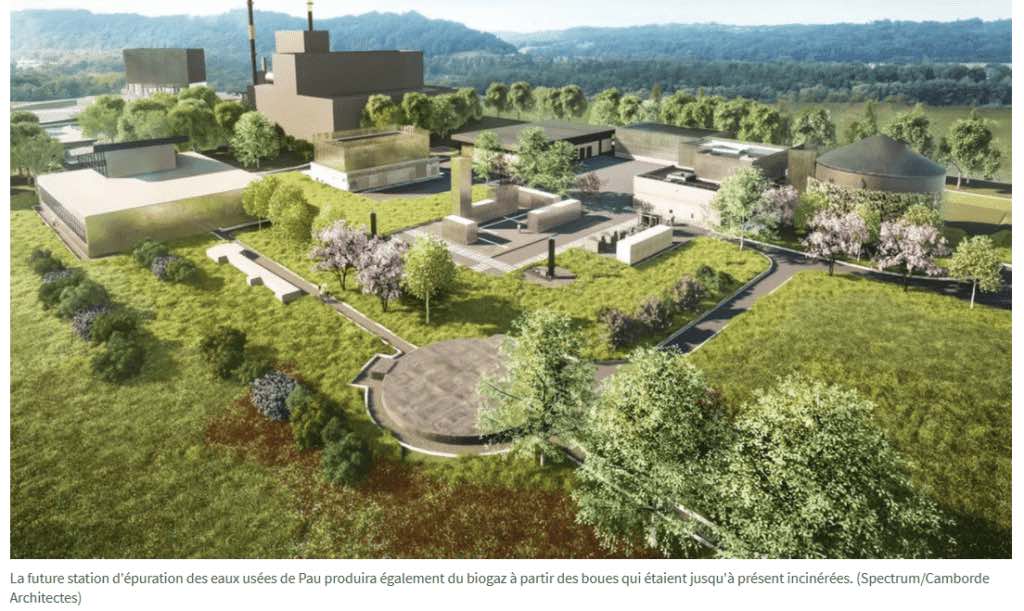
Local authorities and road freight and passenger transport professionals will undoubtedly develop this activity in the years to come. For example, we can cite the agglomeration of Pau which, in Lescar (64), has launched a methanization project supposed to recover wastewater sludge from treatment plants.
In conclusion, we can say that biogas (or biomethane) is a Future energy in our fight against global warming. However, this gives rise to new issues that should not be hidden.
Indeed, green mobility (based on biogas) requires very dangerous manipulations, for example. Filling the tanks of a vehicle running on BioNGV is not without risks. Specific equipment is necessary; its democratization among French citizens may be slowed down because of these precautionary measures.
To go further, do not hesitate to read our article to know everything about The history of natural gas in France.
In a few clicks, organize an exchange with one of our experts.


weekly newsletter subscribers

4.9

.png)

The range E @sy is available in four pricing structures to adapt to each risk profile:
Les caves coopératives de taille ETI ou grande entreprise peuvent être soumises à l'audit énergétique réglementaire (norme NF EN 16247). Sirenergies n'a ni la compétence ni l'accréditation pour réaliser cet audit : nous vous orientons vers un bureau d'études partenaire accrédité, et vous accompagnons en amont sur vos achats et en aval sur le pilotage.
Yes. The supplier guarantees an offer 100% renewable via the official Guarantees of Origin (GO) mechanism.
For the most demanding companies, the offer GREENVOLT+ ensures very low carbon intensity electricity, sourced exclusively from independent French producers (hydraulic, wind, solar).
L'augmentation s'explique par la revalorisation de l'Accise sur le gaz à 16,39 €/MWh et la hausse de 3,41 % du tarif de transport (ATRT 8).
S'y ajoute l'entrée en vigueur des Certificats de Production de Biogaz (CPB), un nouveau coût réglementaire pour soutenir le biométhane.
Face à ces évolutions, Sirenergies vous accompagne dans l'achat de gaz naturel pour sécuriser vos prix malgré la volatilité du marché.