





Summarize with AI

March 6, 2026
5
Min reading
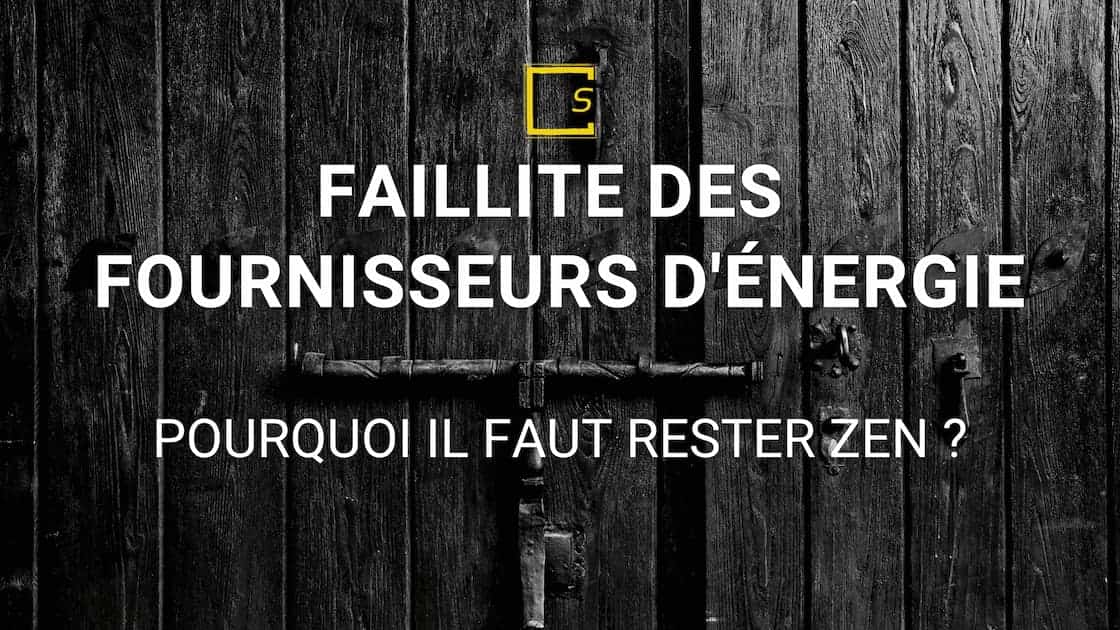
First of all, maybe you've recently heard of The bankruptcy of some energy suppliers. Indeed, the electricity and gas markets have experienced an unprecedented increase over the past year. It is therefore logical that some actors are experiencing difficulties.
The main examples come from Great Britain. Indeed, across the Channel, more than 21 suppliers have gone bankrupt since the summer of 2021. As a result, individual customers are even affected by these events.
In France, the situation is radically different. There are not as many financial failures in the energy sector, but the risk does exist. No need to panic, at SirEnergies we explain to you the reasons for these events.
First, we will explain to you the reasons why a supplier can go bankrupt. Next, we'll see what the real risks are for customers. There are several solutions to protect yourself from this, this article will be an opportunity for us to discuss them.
To begin with, it is necessary to recall the structure of the electricity markets in France and Europe.
There are stock exchanges on which different actors exchange volumes of energy: on the one hand, the supply with energy producers, sellers; on the other hand, consumers/suppliers as well as other buyers.
To honor the delivery of electricity to their customers, suppliers therefore have several choices (counterparties) in order to supply themselves.
For small customers (individuals or very small businesses), generally the supplier will offer a price list which is based on price averages on long-term markets. This price list will mostly be valid over time (over several days/weeks).
The more important the customer is (in terms of volume of electricity consumption), the more the supplier will have to reduce the validity of its offer. Indeed, it is risky to let electricity prices “run” on wholesale markets without securing them.
Supplier procurement policies can therefore be multiple and depend on several factors such as price levels, customer volume or even the season.
As in any financial market, many parameters must be taken into account in order to build your strategy.
As electricity prices are volatile and there are many products, it is essential to put in place a risk strategy.

For example, it is common for some suppliers to opt for a security policy in terms of “sourcing”. This means that they rush to buy the volumes of electricity on the markets for their customers at the time the contract is concluded. In this way, they secure their supply and ensure that they can deliver to their customers on time.
On the other hand, some suppliers with a greater appetite for risk can afford to wait a while before buying the corresponding volumes, hoping for a drop in market prices. This strategy can be very risky during episodes of price surges like the ones we are experiencing today..
However, when prices are low, this strategy is widely adopted by suppliers, for example during the years 2015-2016.
As a reminder, historical suppliers and alternative operators are responsible for the consumption of their customers to the network operator. We invite you to read our article on the balance manager system.
The consequences are quite simple to imagine: if suppliers make the choice to wait and do not buy volumes right away, on the day of delivery their customers will actually consume. These suppliers will be responsible for these consumptions..
If the company's cash flow is not sufficient at that time, the risk of bankruptcy appears. However, it should be remembered that most suppliers make sure they have a viable long-term strategy. They also offer deals that they are able to provide.
As we at SirEnergies like to point out, the electricity market involves three players: the customer, the supplier and the network operator.
The relationship between the customer and the supplier is rather financial. Indeed, it is The network manager which ensures the physical delivery of electricity to the customer. The Risk of cuts is therefore quite limited: a supplier that goes bankrupt will first find a solution in order to transfer its customers.
It is almost impossible for an individual or professional customer to suffer a power outage in France because their supplier goes bankrupt. Before this deadline, the supplier will take measures to warn its customers.
This situation should not last too long; however, before a power outage occurs, the customer will be notified in advance.
The Energy Regulatory Commission (CRE), by its deliberation no. 2021-315, proposes to set up a emergency provider. In the event of bankruptcy, this backup provider will be obliged to take back the “abandoned” customers.
This device is not yet active today. The CRE nevertheless sent precise specifications to the Ministry of Ecological Transition. The rates applied in these emergency contracts are still under discussion.
This is obviously not a long-term solution, because the pricing conditions will depend on short-term markets. Rather, the idea is to ensure the transition while waiting for customers to reorganize.
It is certain that the main risk facing a customer is still to end up with a transitory contract at too high a price. This is a fairly limited risk insofar as this contract is transitory.
The real risk faced by a customer during these events is to see their rates suddenly increased to face possible financial difficulties.
This remedy can be used for residential customers while electricity contracts for professionals are concluded for a specific period of time.
In reality, there is only one method to protect yourself against these risks: be careful when negotiating the energy contract.
It is essential to be accompanied by a professional during this exercise, first of all in order to obtain an attractive price that is consistent with market prices. But also, because the role of broker is also to bring you his expertise of the sector.
There are around thirty suppliers in France, it is easy to know their reputation and financial strength.
Your broker's expertise is not limited to a thorough knowledge of price mechanisms, but extends to the knowledge of the various suppliers.
You are a venture and do you feel lost in the jungle of natural gas and electricity offers? Are you wondering what is the best energy contract for your business?
SirEnergies offers you an offer adapted to the specificity of your business, regardless of your size.
Click below for more information:
In a few clicks, organize an exchange with one of our experts.

weekly newsletter subscribers

4.9

.png)

Le prix Forward est fixé à l'avance (sécurité budgétaire), tandis que le prix Spot varie heure par heure selon le marché (opportunité mais risque élevé).
La Multiannual Energy Programming (PPE) is the strategic management tool for France's energy policy. Established by the 2015 law on energy transition for green growth (LTECV), it serves as a compass for the State, communities and businesses.
Concretely, the PPE sets the priorities for action of the public authorities for the management of all forms of energy on the national territory. It covers a period of ten years, divided into two periods of five years, and must be revised periodically to adapt to technological and economic developments.
It deals with major topics such as:
It is crucial not to confuse it with National Low Carbon Strategy (SNBC). While SNBC sets carbon budgets (the ceilings for greenhouse gas emissions by sector), the PPE determines the technical and energy resources to achieve them.
En 2025, la France a atteint un solde exportateur net de 92,3 TWh, battant le précédent record de 2024 (89 TWh).
Tertiary companies are concerned by taxes such as TICFE or TICGN. Sirenergies checks the accuracy of invoices, identifies possible exemptions, and helps correct errors to sustainably reduce costs.
Ce record de 92,3 TWh s'explique par la conjonction de trois facteurs :
Ce seuil est jugé élevé par rapport aux prévisions actuelles du marché. Si le prix de l'électricité reste en dessous de 78 €/MWh, les entreprises ne bénéficieront d'aucune redistribution. Cela signifie que la protection promise par la réforme pourrait être inexistante dans un marché baissier, d'où l'importance de stratégies de sourcing agiles et d'outils de monitoring comme Pilott.
Oui, elle est considérée comme une énergie renouvelable à faibles émissions de gaz à effet de serre.
De plus, l'eau ne subit aucune transformation chimique durant le cycle de production et réintègre son milieu naturel en aval.
Cependant, la construction de barrages nécessite des mesures pour protéger les écosystèmes (débit minimum, passes à poissons).
One invoice consists of several elements: consumption, supplier share, taxes and contributions. The analysis of each line makes it possible to identify possible errors and to check the consistency with the signed contract.
L'abondance de production française tire les prix du marché de gros vers le bas.
En vertu du mécanisme de l'Ordre de Mérite (Merit Order), les centrales les moins coûteuses (nucléaire, renouvelables) couvrent la demande plus souvent, évinçant les centrales à gaz ou charbon plus onéreuses.
Cela multiplie les épisodes de prix bas, voire négatifs, sur le marché spot.
These are signals sent by RTE during periods of tension on the electrical network. The Sirenergies tool informs you in real time to anticipate your uses.
Yes. The supplier guarantees an offer 100% renewable via the official Guarantees of Origin (GO) mechanism.
For the most demanding companies, the offer GREENVOLT+ ensures very low carbon intensity electricity, sourced exclusively from independent French producers (hydraulic, wind, solar).
Non. L'IA traite la donnée (data processing), mais l'analyste apporte la compréhension du contexte (market sentiment) et la prise de décision stratégique.
Farms are subject to taxes such as TICFE or TICGN. Sirenergies verifies their application, identifies cases of exemption and accompanies the procedures to reduce the tax burden.
In 2025, the supplier had a NPS (Net Promoter Score) of +16 and a note of 4,17/5.
Satisfaction is based on a “zero solicitation” model and 100% in-house customer service in Toulon, guaranteeing proximity and responsiveness that cannot be found with major historical suppliers.
Some businesses may obtain a partial or total exemption from the TICFE or the TICGN, depending on their activity and energy intensity. The support of an expert makes it possible to identify the eligibility criteria and to put together the file.
The industry is concerned by TICFE, TICGN and other contributions that may represent an important part of invoices. Sirenergies identifies cases of exemption and accompanies the procedures to benefit from them.
C'est l'indicateur d'efficacité d'un appareil électrique ; il représente le ratio entre la puissance active (utile) et la puissance apparente (totale).
Absolument. La réforme des heures creuses vise à absorber la surproduction solaire en milieu de journée. Les créneaux d'heures creuses se déplacent progressivement vers la plage 11h00 – 17h00, notamment en été. C'est une opportunité majeure pour les sites industriels ou tertiaires capables de flexibilité.
Conseil stratégique :
L'impact dépendra des prix de marché. Le mécanisme prévoit une redistribution si les prix dépassent 78 €/MWh. Cependant, si les cours restent bas (actuellement autour de 60 €/MWh), le dispositif ne s'activera pas. La facture sera alors indexée à 100% sur les prix de marché, rendant le choix du fournisseur et du moment d'achat critiques.
Un appel d’offres permet de mettre en concurrence plusieurs fournisseurs d’électricité et de gaz afin d’obtenir des conditions contractuelles optimisées. C’est une démarche transparente qui permet de choisir l’offre la plus adaptée aux besoins budgétaires et techniques de l’organisation.
Car les marchés dépendent de facteurs exogènes imprévisibles (géopolitique, météo soudaine, politique) que les modèles basés sur l'historique ne peuvent pas anticiper, tout comme on ne prédit pas le Loto.
Exceeding capacity leads to financial penalties and can impact the size of the contract. Adjust the correctly subscribed power makes it possible to avoid these additional costs.
La fin de l'ARENH (Accès Régulé à l'Électricité Nucléaire Historique) marque l'arrêt de la fourniture d'électricité à prix fixe garanti (42 €/MWh).
Dès le 1er janvier 2026, les entreprises sont exposées aux prix de marché, mais deux nouveaux mécanismes de régulation prennent le relais, bien que leur logique soit différente :
Conseil stratégique : Ne comptez pas sur le VNU pour réduire votre facture en 2026 si les marchés restent stables. Auditez vos contrats dès maintenant pour intégrer une part de prix fixe ou explorer des "Power Purchase Agreements" (PPA) pour sécuriser vos coûts sur le long terme.
La Vente de Nucléaire Universelle (VNU) est le nouveau mécanisme de régulation des prix de l'électricité en France. Contrairement à l'ARENH, il ne s'agit plus d'un volume fixe à prix réduit, mais d'une redistribution financière des revenus excédentaires d'EDF aux consommateurs, basée sur les prix de marché et les coûts de production du nucléaire historique.
This makes it possible to choose the right time to contract, secure your budgets and anticipate increases.
Le dispositif ARENH a laissé place au VNU (Versement Nucléaire Universel).
Ce changement structurel expose davantage les entreprises aux prix de gros, rendant la gestion des risques plus complexe qu'auparavant.
Il devient alors indispensable de définir une stratégie d'achat d'électricité avec Sirenergies pour lisser l'impact de la volatilité des marchés sur votre budget.
C'est le levier le plus rapide pour obtenir des résultats visibles. L'éclairage représente environ 40 % de la consommation d'électricité d'une commune.
Passer au LED avec pilotage intelligent permet de réduire la facture de 50 à 80 %, avec un retour sur investissement (ROI) rapide, souvent estimé à 2 ou 3 ans.
Sourcing consists in identifying and analysing the offers of several electricity and gas suppliers. This approach makes it possible to obtain contracts adapted to the consumption profile and budgetary constraints of the company.
The range E @sy is available in four pricing structures to adapt to each risk profile:
Parce que la puissance souscrite en kVA détermine le prix de l'abonnement et que tout dépassement peut entraîner des surcoûts importants.
Le processus repose sur l'utilisation de la force de l'eau (énergie cinétique) issue des courants, des chutes d'eau ou des dénivelés. Le fonctionnement suit trois étapes clés :
Tertiary companies must manage their energy costs while guaranteeing the comfort of users (offices, shops, services). Consumption is often linked to heating, air conditioning and lighting, which requires precise monitoring to avoid budgetary excesses.
Le transport (RTE) correspond aux "autoroutes" de l’électricité. Il s’agit de transporter de très grandes quantités d'énergie sur de longues distances, depuis les centrales de production (nucléaires, barrages, parcs éoliens offshore) vers les régions de consommation.
La distribution (Enedis) s'apparente aux "routes départementales" et aux rues. Elle récupère l'électricité à la sortie du réseau de transport pour la livrer directement chez le client final, en abaissant la tension pour qu'elle soit utilisable par vos appareils.
The subscribed power must be calculated according to the consumption profile and uses (heating, industrial processes, tertiary equipment). One fine analysis makes it possible to ensure the adequacy between real need and contract.
The central objective of PPE 3 is to engage France towards carbon neutrality by 2050 by breaking the country's historical dependence on fossil fuels.
Today, approximately 60% of final energy consumption in France still relies on imported oil and natural gas. PPE 3 aims to radically reverse this trend by setting an ambitious target: to reach 60% of carbon-free energies in final consumption by 2030.
To achieve this, PPE 3 pursues three major sub-objectives:
Instauré en 2017, ce dispositif répond à un enjeu de sécurité nationale.
L'électricité ne se stockant pas à grande échelle, le réseau doit être capable de répondre instantanément à la demande, même lors des pics de froid hivernaux. Le mécanisme incite financièrement les producteurs à maintenir leurs centrales disponibles et les entreprises à réduire leur consommation (effacement) lors de ces périodes critiques.
The €/MWh is a price unit used in wholesale markets, while kWh is the unit visible on your bills.
Chaque modèle d'IA répond à un besoin spécifique du cycle d'achat :
L'expertise humaine reste néanmoins indispensable.
Among the taxes include TICFE, TICGN, CTA, CJA and TURPE. They represent a significant part of the bill and vary according to consumption profiles. Understanding them well is essential to optimize costs.
Communities are subject to taxes such as TICFE or TICGN. Sirenergies analyzes invoices, identifies exemption possibilities and fixes possible errors to reduce the tax burden.
Le kVA mesure la capacité maximale que votre compteur peut supporter à un instant T, tandis que le kWh mesure la quantité d'énergie consommée sur une durée.