





Summarize with AI

January 27, 2026
8
Min reading

Photovoltaics, wind, hydroelectricity: you know these renewable energies. But have you ever heard of tidal energy?
In France, this source of low-carbon electricity is symbolized by the pioneer factory in La Rance. With its 24 turbines and 240 MW installed, it has long been the most powerful tidal power plant in the world. Since 2011, it has been superseded by the Shiwa factory in South Korea.
Tidal energy is still confidential. However, this renewable and local source of electricity has real potential to help get out of dependence on fossil fuels.
What are the advantages of tidal energy? Why is its global development still limited? What is the status of innovations in this field? Spotlight on this little-known renewable energy.
To produce electricity, a tidal power plant uses the movements of the tide. More specifically, it operates the Tidal range, it is the difference in level between the high seas and the low seas.
A tidal power plant consists of a weir built on an estuary in order to create a natural basin on the land side. Les turbines are installed under the sea.
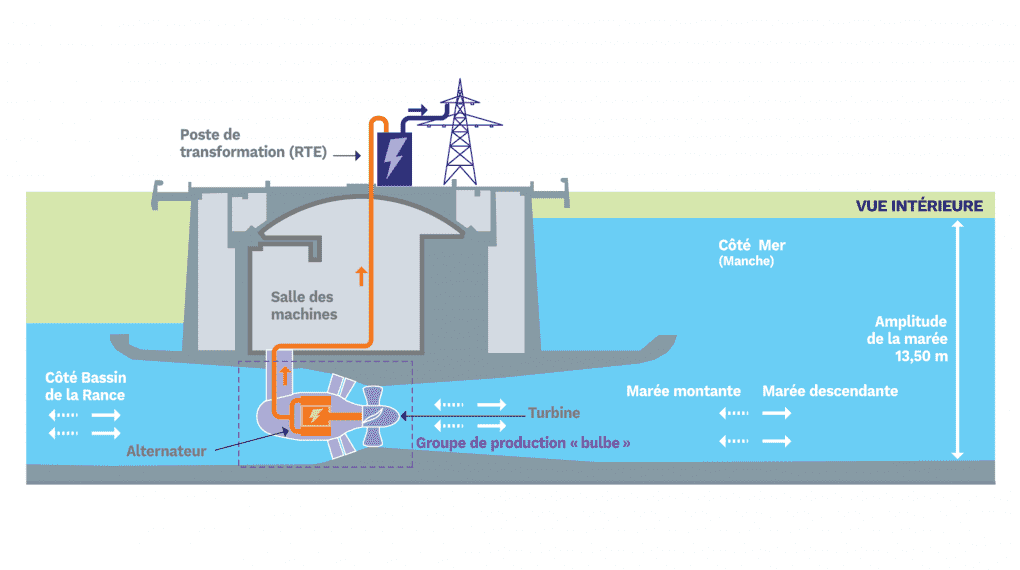
Operation of a tidal power plant — Source: EDF
Visually, tidal sites are not as spectacular as their cousins, The big hydroelectric dams. In the landscape, the Breton factory in La Rance is above all a bridge connecting the two sides of the estuary.
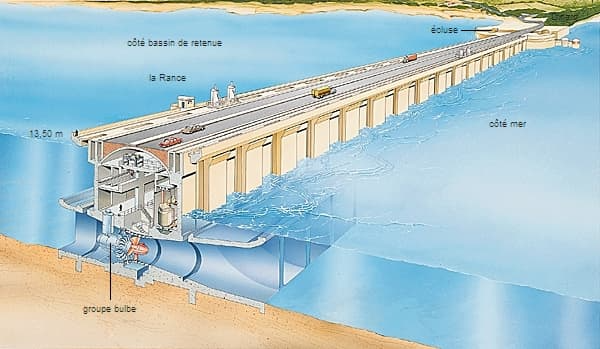
Rance tidal power plant — Source: Larousse
Tidal power plants work in two ways:
Globally, the potential for the production of tidal energy is estimated at 380 TWh/year. This represents around 1.3% of global electricity production, which was 28,510 TWh in 2022.
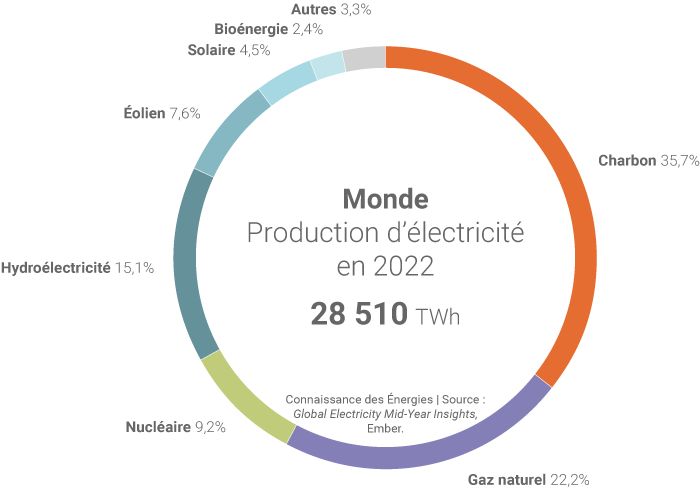
Source: Energy Knowledge
Certainly, this production potential may seem low compared to the potential of others. renewable energy sources. In 2022, solar generated 1,283 TWh, wind 2,167 TWh, and hydroelectricity 4,305 TWh.
But in terms of consumption, the figure is far from being negligible. 380 TWh/year is the Electricity consumption of 170 million inhabitants living like a French person (1). (1) Average electricity consumption in France per year and per inhabitant: 2,223 kWh according to data.gouv.fr data
The future is at energy mix. Each renewable and local electricity production solution offers a complementary opportunity to reduce dependence on fossil fuels. Tidal energy is one of them.
What is more renewable, local and inexhaustible than the ocean? Tidal energy has many other advantages: its reliability, its predictability and its environmental balance.
The tides are a natural phenomenon. They appeared with the creation of the oceans. Certainly, their amplitude varies. Certainly, they are Intermittent.
On average, tidal power plants only produce 25% of the time. But for billions of years, their movement is perpetual. The sea rises and falls, without interruption, once or twice a day, under the effect of the attraction of the Moon and the Sun.
Our ancestors were not wrong. The Romans had already identified the energetic potential of tidal forces. The first tide mills appeared under their era before flourishing in the Middle Ages on the banks of the Channel and the ocean coast.
The tides are predictable in the very long term. They depend on constant factors : the topography of waters and coasts and the trajectories and inclinations of the stars and the Earth.
Through the repeated observation of astral movements, scientists have developed a mathematical formula that precisely calculates schedules and heights future tides. It is thus possible to anticipate production peaks but also yield decreases, depending on the amplitude of the tides.
There is no data specific to tidal energy. However, we can refer to data from Hydraulic power. These two energies emit few greenhouse gases. If the construction of dams releases CO2, they remain sustainable low carbon energies.
This observation is evident from the assessment carried out by ADEME. The Energy Transition Agency assesses greenhouse gas emissions from hydraulics at 6 g CO equivalent2/kWh compared to 14.1 g for onshore wind, 15.6 g for offshore wind or even 44 g for photovoltaic energy.
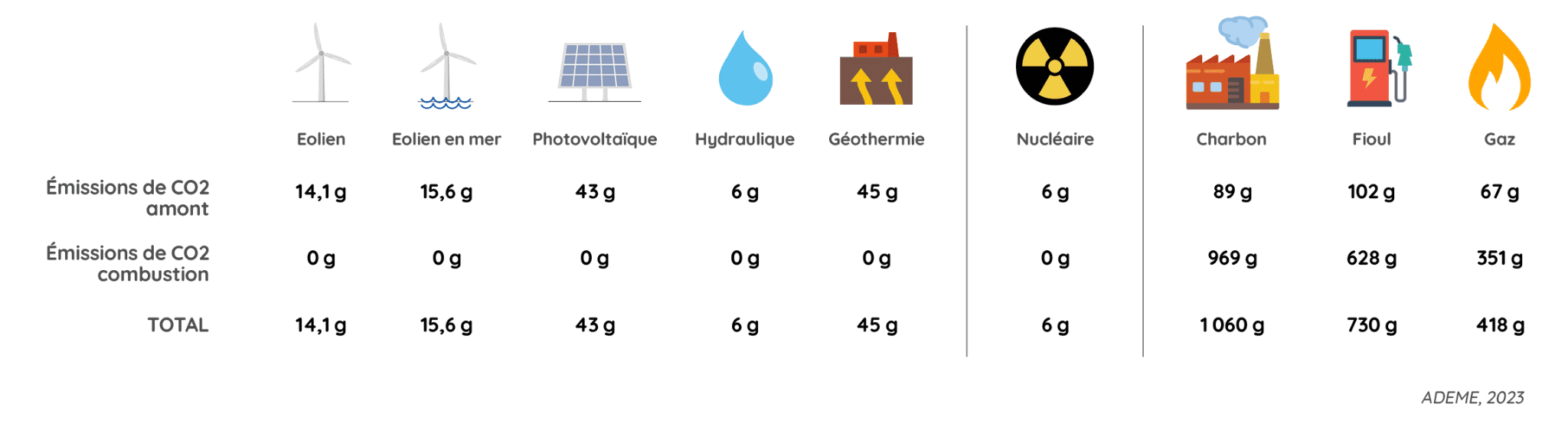
Source: ADEME, 2023
The black spot of tidal energy in the short term? The ecosystem imbalance created by the construction of tidal power plants. However, the example of the Rance dam proves thatIn the long term, the environmental balance is positive.
The construction of the tidal power plant was not without an impact on marine biodiversity. With the estuary drying up for three years, animal and plant species disappeared.
But after about ten years, recolonization was observed. New species have developed with scallop shells at their head. A new ecosystem is blossoming today, thanks to maintaining a continuous water level of at least 5 meters high in the estuary.
Like any energy, fossil or renewable, tidal energy has limits. What are the main challenges? High infrastructure costs, geographic constraints and siltation.
The construction of a tidal power plant requires heavy investments. The Shiwa power plant in South Korea cost around 220 million euros in 2011. The investment in the Rance factory is estimated at 800 million euros (equivalent).
Maintenance and operating costs are difficult to understand. EDF does not distribute data relating to its Breton factory. The figures announced vary between 120 and 185 €/kWh. They would be three times higher than those of nuclear power.
On the other hand, the operating life of a tidal power plant could exceed 100 years. A duration that opens a wide amortization window for investments.
There are few tidal power plants in the world. The reason? Very restrictive geographical conditions.
Tidal energy requires high amplitude and regular tides, of at least 5 meters, and ideally between 10 and 15 meters. For example, the level rises to 13 to 14 meters on the Rance site.
Also, the construction of the dam and the turbines requires a depth from 10 to 25 meters under the sea and a rocky ground. And all of this must be combined in the estuary of a river.
Nearby, the available buildable land must allow the installation of buildings for the operation of the factory, with the risk of cutting into agricultural land.
In France, only one site has the necessary tide height: Mont-Saint-Michel Bay. In other words, the project was quickly abandoned in this exceptional place, which is a UNESCO World Heritage Site.
If biodiversity succeeds in renewing itself, tidal power plants have a major environmental impact upstream of dams: sediment deposit, not cleaned by the regular movement of the tides.
In the Rance estuary, no less than 50,000 cubic meters are deposited each year. The consequences are multiple. Sediments hinder fish migration and species reproduction, make river navigation difficult and weaken banks. There is only one solution: extract the slime regularly, with associated costs of several million euros.
The potential of tidal energy remains little exploited. Today, tidal power plants in the world represent just over 500 MW of power, compared to the production potential of 380 TWh. But developing tidal energy requires innovation to remove constraints.
The Rance power plant is thethe only tidal engine site in France. Inaugurated in 1966, it produces around 500 GWh each year, which is the annual electricity consumption of a city of 225,000 inhabitants. It is 17% of the energy produced in Brittany.
Around the world, the number of power plants in operation can be counted on one hand. The most efficient factory is located in Shiwa, South Korea. With 254 MW of installed capacity, it exceeded the production capacity of the French site in 2011.
The other factories have capacities that are incomparable to the French and South Korean giants. The Annapolis plant in Canada has a capacity of 20 MW. The Chinese site in Jiangxia has a capacity of 4 MW, while in Russia, the power plant on Kislaia Bay has a ceiling of 1.7 MW.
In the 2010s, numerous projects focused on “artificial lagoon”. An artificial lake of shallow depth, the lagoon was supposed to replace the natural storage basin.
The idea was to fill the lagoon at high tide and then empty it using airlocks equipped with turbines. Nevertheless, this model has proved to be very expensive and has a high environmental impact. It was abandoned successively by all the countries that had launched the experiment, Canada, Russia, India and England (Swansea).
Today, The future of tidal energy looks to the sea. A kind of underwater wind turbine, a tidal turbine produces electricity by exploiting tidal currents at sea. The United Kingdom is a pioneer in this field with the SeaGen project. As early as 2008, the Strangford Lough tidal turbines reached their maximum production capacity of 1.2 MW.
The Meygen 2 Project launched in 2015 in Scotland, aims to reach a production capacity of 400 MW. The first four 1.5 MW turbines went into production in 2018. In February 2023, the SAE company behind the project announced that the power plant had produced its first 50 GWh from offshore tidal energy.
Tidal energy is a local, reliable and predictable renewable energy. It offers new opportunities in global energy mix. However, its development suffers from its numerous geographical, financial and environmental constraints.
A new future seems to be emerging at sea where tidal turbines could exploit the strong currents created by the tides.
To go further, continue reading on The intermittency of hydraulic power.
In a few clicks, organize an exchange with one of our experts.


weekly newsletter subscribers

4.9

.png)

Yes. The supplier guarantees an offer 100% renewable via the official Guarantees of Origin (GO) mechanism.
For the most demanding companies, the offer GREENVOLT+ ensures very low carbon intensity electricity, sourced exclusively from independent French producers (hydraulic, wind, solar).
The €/MWh is a price unit used in wholesale markets, while kWh is the unit visible on your bills.
La réussite d'un projet collectif énergie repose sur trois piliers fondamentaux :
Les coopératives de taille ETI ou grande entreprise peuvent être soumises à l'audit énergétique réglementaire (norme NF EN 16247). Sirenergies n'a ni la compétence ni l'accréditation pour réaliser cet audit : nous vous orientons vers un bureau d'études partenaire accrédité, et vous accompagnons en amont sur vos achats et en aval sur le pilotage.
This makes it possible to choose the right time to contract, secure your budgets and anticipate increases.
Le dispositif ARENH a laissé place au VNU (Versement Nucléaire Universel).
Ce changement structurel expose davantage les entreprises aux prix de gros, rendant la gestion des risques plus complexe qu'auparavant.
Il devient alors indispensable de définir une stratégie d'achat d'électricité avec Sirenergies pour lisser l'impact de la volatilité des marchés sur votre budget.
Exceeding capacity leads to financial penalties and can impact the size of the contract. Adjust the correctly subscribed power makes it possible to avoid these additional costs.
Le processus repose sur l'utilisation de la force de l'eau (énergie cinétique) issue des courants, des chutes d'eau ou des dénivelés. Le fonctionnement suit trois étapes clés :
In 2025, the supplier had a NPS (Net Promoter Score) of +16 and a note of 4,17/5.
Satisfaction is based on a “zero solicitation” model and 100% in-house customer service in Toulon, guaranteeing proximity and responsiveness that cannot be found with major historical suppliers.
Le kVA mesure la capacité maximale que votre compteur peut supporter à un instant T, tandis que le kWh mesure la quantité d'énergie consommée sur une durée.
The industry is concerned by TICFE, TICGN and other contributions that may represent an important part of invoices. Sirenergies identifies cases of exemption and accompanies the procedures to benefit from them.
C'est le levier le plus rapide pour obtenir des résultats visibles. L'éclairage représente environ 40 % de la consommation d'électricité d'une commune.
Passer au LED avec pilotage intelligent permet de réduire la facture de 50 à 80 %, avec un retour sur investissement (ROI) rapide, souvent estimé à 2 ou 3 ans.
Sourcing consists in identifying and analysing the offers of several electricity and gas suppliers. This approach makes it possible to obtain contracts adapted to the consumption profile and budgetary constraints of the company.
Un appel d’offres permet de mettre en concurrence plusieurs fournisseurs d’électricité et de gaz afin d’obtenir des conditions contractuelles optimisées. C’est une démarche transparente qui permet de choisir l’offre la plus adaptée aux besoins budgétaires et techniques de l’organisation.
Farms are subject to taxes such as TICFE or TICGN. Sirenergies verifies their application, identifies cases of exemption and accompanies the procedures to reduce the tax burden.
One invoice consists of several elements: consumption, supplier share, taxes and contributions. The analysis of each line makes it possible to identify possible errors and to check the consistency with the signed contract.
L'abondance de production française tire les prix du marché de gros vers le bas.
En vertu du mécanisme de l'Ordre de Mérite (Merit Order), les centrales les moins coûteuses (nucléaire, renouvelables) couvrent la demande plus souvent, évinçant les centrales à gaz ou charbon plus onéreuses.
Cela multiplie les épisodes de prix bas, voire négatifs, sur le marché spot.
It allows you to prove your commitment to the energy transition and to meet regulatory requirements.
Oui, elle est considérée comme une énergie renouvelable à faibles émissions de gaz à effet de serre.
De plus, l'eau ne subit aucune transformation chimique durant le cycle de production et réintègre son milieu naturel en aval.
Cependant, la construction de barrages nécessite des mesures pour protéger les écosystèmes (débit minimum, passes à poissons).
Le calendrier 2026 impose deux échéances majeures :
Pour simplifier ces démarches, vous pouvez centraliser vos données de consommation avec la plateforme Pilott de Sirenergies, garantissant ainsi la conformité de vos rapports réglementaires.
To calculate Scope 2 emissions, use the following formula:
Energy quantity (kWh) × Emission factor (kg CO₂ e/kWh).
Use databases like ADEME for precision.
C'est l'indicateur d'efficacité d'un appareil électrique ; il représente le ratio entre la puissance active (utile) et la puissance apparente (totale).
Ce record de 92,3 TWh s'explique par la conjonction de trois facteurs :
Among the taxes include TICFE, TICGN, CTA, CJA and TURPE. They represent a significant part of the bill and vary according to consumption profiles. Understanding them well is essential to optimize costs.
Les caves coopératives de taille ETI ou grande entreprise peuvent être soumises à l'audit énergétique réglementaire (norme NF EN 16247). Sirenergies n'a ni la compétence ni l'accréditation pour réaliser cet audit : nous vous orientons vers un bureau d'études partenaire accrédité, et vous accompagnons en amont sur vos achats et en aval sur le pilotage.
Parce que la puissance souscrite en kVA détermine le prix de l'abonnement et que tout dépassement peut entraîner des surcoûts importants.
The range E @sy is available in four pricing structures to adapt to each risk profile:
Some businesses may obtain a partial or total exemption from the TICFE or the TICGN, depending on their activity and energy intensity. The support of an expert makes it possible to identify the eligibility criteria and to put together the file.
The subscribed power must be calculated according to the consumption profile and uses (heating, industrial processes, tertiary equipment). One fine analysis makes it possible to ensure the adequacy between real need and contract.
Tertiary companies are concerned by taxes such as TICFE or TICGN. Sirenergies checks the accuracy of invoices, identifies possible exemptions, and helps correct errors to sustainably reduce costs.
These are signals sent by RTE during periods of tension on the electrical network. The Sirenergies tool informs you in real time to anticipate your uses.
Communities are subject to taxes such as TICFE or TICGN. Sirenergies analyzes invoices, identifies exemption possibilities and fixes possible errors to reduce the tax burden.
Le transport (RTE) correspond aux "autoroutes" de l’électricité. Il s’agit de transporter de très grandes quantités d'énergie sur de longues distances, depuis les centrales de production (nucléaires, barrages, parcs éoliens offshore) vers les régions de consommation.
La distribution (Enedis) s'apparente aux "routes départementales" et aux rues. Elle récupère l'électricité à la sortie du réseau de transport pour la livrer directement chez le client final, en abaissant la tension pour qu'elle soit utilisable par vos appareils.
En 2025, la France a atteint un solde exportateur net de 92,3 TWh, battant le précédent record de 2024 (89 TWh).
Tertiary companies must manage their energy costs while guaranteeing the comfort of users (offices, shops, services). Consumption is often linked to heating, air conditioning and lighting, which requires precise monitoring to avoid budgetary excesses.