





Summarize with AI


Professional electromobility: the advantages of charging stations for your business
March 4, 2026
7
Min reading
In the context of the international crisis, fuel prices have soared in recent years. Is the electrification of your corporate vehicle fleet a solution to control your budget? The answer is yes.
Choose theprofessional electromobility, it is also a concrete commitment for energy transition And the sustainable mobility. With 126 million tons of CO2 in 2020, transport is responsible for 30% of emissions of greenhouse gases in France.
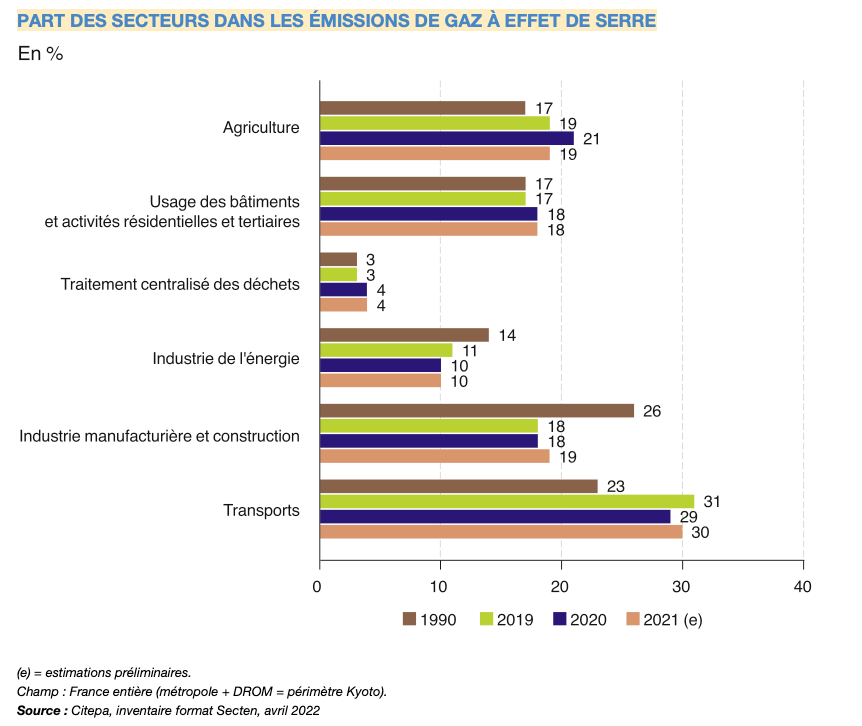
Source: Citepa
Electric vehicles are asserting themselves as an accessible alternative to reach carbon neutrality in 2050. Do you want to deploy electric mobility and charging stations in your company? Follow the guide.
Preservation of the environment, financial savings, tax cuts, regulatory expectations, green image: professional electromobility offers numerous advantages for companies.
On average, electric vehicles emit 3 to 4 times less CO2 than thermal cars. Over the entire life cycle, their carbon footprint is 20 to 60% lower than that of diesel vehicles (thanks to the mostly carbon-free origin of Electricity in France).
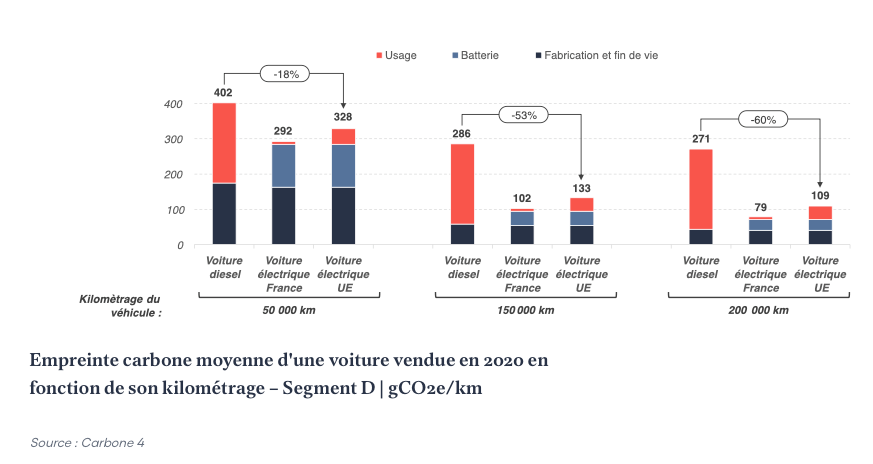
Average carbon footprint of a car sold in 2020 according to its mileage — Source: Carbone 4
The carbon footprint decreases with increasing mileage. However, a professional vehicle drives 2.25 times more than a private vehicle. With the deployment of charging stations in your company, you will quickly improve your environmental impact. Electric mobility also frees you from traffic constraints in ZFe-m (low-emission mobility zones).
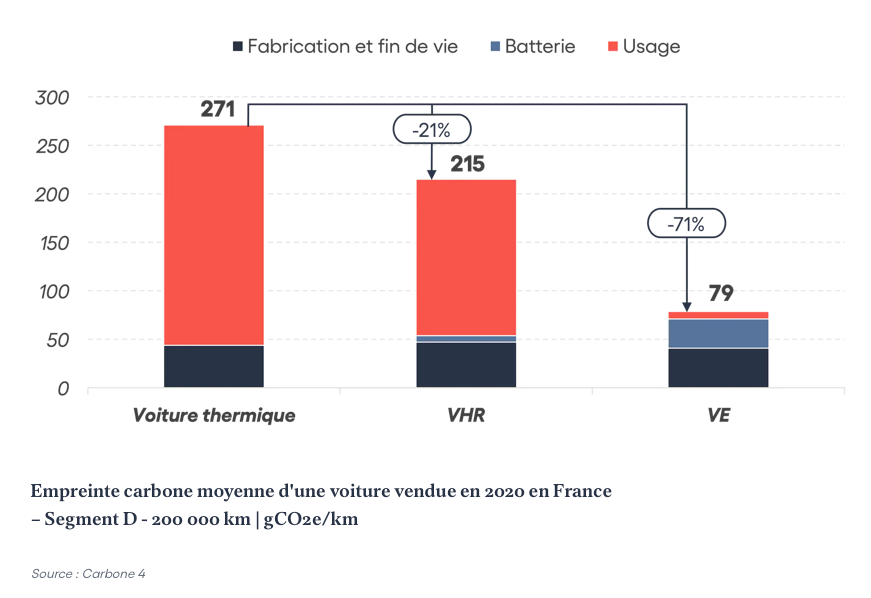
Average carbon footprint of a car sold in 2020 in France — Source: Carbone 4
This diagram shows that the CO cost2 of manufacturing and end of life is largely offset by the cost in CO2 during use.
The icing on the cake: the low emissions of fine particles from electric vehicles, a good point for air quality and public health.
With the electrification of your car fleet, you reduce your company's dependence on fossil fuels and price fluctuations.
According to INSEE figures, refueling for 100 km averaged 12.5 euros in 2022 for a gasoline-powered car consuming 7 liters/100 km, and 13 euros for a diesel car.
In comparison, the cost of recharging an electric car consuming 15 kWh/100 km is estimated at around 4 euros per 100 km. The bill varies according to the vehicle and the contract taken out. It can be reduced by coupling charging stations to a clean and renewable energy source, via photovoltaic awnings.
Professional electromobility also makes it possible to control operating expenses. Thanks to the simplified mechanics of electric vehicles, only the tires, brake pads and discs, air filters and windshield wipers need to be changed regularly. When properly maintained, the battery has an average lifespan of 8 to 10 years.
At the time of purchase, an electric vehicle is more expensive than an internal combustion vehicle. You can optimize your investments thanks to government incentives, accessible under conditions:
• Aid for the purchase of electric vehicles : ecological bonus, conversion bonus, ZFe-m bonus and retrofit bonus.
• Incentive tax system : exemptions from taxes, tax deduction of depreciation, possible deduction of the battery purchase price and recovery of VAT on electric charging.
Since the 1Er January 2023, professional fleets are no longer eligible for the Advenir bonus intended to support the purchase of charging stations.
Electric mobility feeds the CSR policy of your company (Corporate Social Responsibility). CSR is increasingly being scrutinized by your customers and commercial and financial partners, today and tomorrow.
By installing charging stations and by driving an electric vehicle, you are sending a positive signal. It is a concrete, visible and accessible action that enhances your image as a sustainable corporate brand, committed to the energy transition and carbon neutrality.
The 2019 LOM Mobility Orientation Act sets out obligations in terms of greening car fleets and charging infrastructures. They were strengthened in 2021 by the Climate and Resilience Law.
Quotas have been imposed since 2022 on companies with more than 100 professional vehicles. When renewing their fleet annually, they must acquire or use low-emission vehicles in a minimum proportion of 10%. This percentage will gradually increase to reach 70% in 2030.
If you are not concerned today, these obligations could become more stringent in the coming years. Discussions are ongoing at European level. The intended objective? 100% electrification of professional vehicles by 2030.
In terms of charging infrastructures, the LOM law requires the deployment of charging stations in the car parks of new tertiary and industrial buildings, up to 10% of the spaces for a car park with less than 40 spaces and 20% beyond.
Deploying charging stations in business requires a detailed analysis of needs in order to make the right choices and reduce investment costs.
As with any project, you must start by studying your operational needs: how many trips are made by your professional vehicles? What are the distances covered? How many electric vehicles do you need, with what range and how much power? Do you want to open up charging to your employees, customers and partners?
The answers to these questions determine the model of charging stations adapted to your use and their number.
To anticipate investments, you must also analyze the capacity of your car park and your electrical network.
How much space do you have available for installing charging stations? Is major civil engineering work required to connect them? Is the sizing of your electrical installation sufficient?
You need to choose charging infrastructures that are adapted to your business and your use. There are three types of load:
• The slow charging station (3.7 kW single phase) : it works with an E/F household electrical outlet. The time for a full recharge varies from 8 to 12 hours.
• The normal/accelerated charging station (7 or 22 kW three-phase) : it requires one to three hours to partially recharge a battery. Its advantage? More electric vehicles can be charged in the same amount of time.
• The fast charging station (43 kW three-phase DC) : very powerful, it recharges 100 km in less than 30 minutes. They are mainly found on highway areas.
As a general rule, a power between 3 and 7 kW is sufficient for the majority of electric vehicles and the daily uses of a company whose car fleet can recharge at night. If you open your charging stations to your customers and partners, you can consider investing in a more powerful 22 kW station.
Charging station installers offer associated services. You can subscribe to features of monitoring of energy consumption And ofload data analysis.
You can also opt for smart charging stations, equipped with a system of Smart Charging. This smart charging mode optimizes charging. For example, it can:
• Prioritize favorable times for recharging, depending on network capacities and electricity rates.
• Control the available power by distributing it evenly between the charging stations in case of simultaneous use by several electric vehicles.
• Stop charging stations In case of Peak consumption of your buildings.
• Optimize solar self-consumption and prioritize the use of clean energy, if you have opted for charging infrastructures connected to photovoltaic shades.
If you own your premises and land, you can equip your car park with charging infrastructure in complete freedom, with one exception: if you are in a condominium, you must file an application with the condominium by asserting your right to the socket.
If you are a tenant of your premises and land, you must obtain the prior agreement of the lessor owner, as for all work to transform rented premises.
Electric mobility is leading to a change in uses. It has an impact on the modes of travel of employees.
Depending on the size of your company, it is recommended at least to inform the Social and Economic Committee. In all cases, it is important to involve your employees by training them in the proper use of charging stations and electric cars and in eco-driving.
The electric vehicle is not a miracle mobility solution. To reduce the carbon footprint of your company, the most effective way is to reduce employee travel and to favor more sustainable modes of transport.
But, when no alternative is possible, professional electromobility is an energy transition solution worth seizing. The key: reducing emissions and the environmental impact of your business and... your expenses!
Today, more than ever, electric mobility is one of the levers for achieving carbon neutrality. As such, businesses have a role to play in the energy transition.
You want to install charging stations and/or convert your company's vehicle fleet to electric? In partnership with Bump, SirEnergies is there to help you and support you in building an eco-responsible image for your business.
Click below for more information:
In a few clicks, organize an exchange with one of our experts.


weekly newsletter subscribers

4.9

.png)

The €/MWh is a price unit used in wholesale markets, while kWh is the unit visible on your bills.
The subscribed power must be calculated according to the consumption profile and uses (heating, industrial processes, tertiary equipment). One fine analysis makes it possible to ensure the adequacy between real need and contract.
Tertiary companies are concerned by taxes such as TICFE or TICGN. Sirenergies checks the accuracy of invoices, identifies possible exemptions, and helps correct errors to sustainably reduce costs.
Farms must deal with high seasonal needs (greenhouse heating, irrigation, storage) and high volatility of prizes. Controlling these costs is essential to maintain profitability and secure the business.
Ce record de 92,3 TWh s'explique par la conjonction de trois facteurs :
Le processus repose sur l'utilisation de la force de l'eau (énergie cinétique) issue des courants, des chutes d'eau ou des dénivelés. Le fonctionnement suit trois étapes clés :
In 2025, the supplier had a NPS (Net Promoter Score) of +16 and a note of 4,17/5.
Satisfaction is based on a “zero solicitation” model and 100% in-house customer service in Toulon, guaranteeing proximity and responsiveness that cannot be found with major historical suppliers.
Sourcing consists in identifying and analysing the offers of several electricity and gas suppliers. This approach makes it possible to obtain contracts adapted to the consumption profile and budgetary constraints of the company.
L'ARENH est remplacé par le VNU (Versement Nucléaire Universel), un mécanisme de redistribution des revenus excédentaires d'EDF en cas de prix très élevés, et par les CAPN, des contrats long terme pour les gros industriels.
Le kVA mesure la capacité maximale que votre compteur peut supporter à un instant T, tandis que le kWh mesure la quantité d'énergie consommée sur une durée.
Un appel d’offres permet de mettre en concurrence plusieurs fournisseurs d’électricité et de gaz afin d’obtenir des conditions contractuelles optimisées. C’est une démarche transparente qui permet de choisir l’offre la plus adaptée aux besoins budgétaires et techniques de l’organisation.
Changing suppliers can allow you to benefit from more competitive prices, adapted services or better contractual conditions. Thanks to sourcing, change is happening without interruption of supply.
Les profits include a direct reduction in bills, strengthened budgetary forecasting and better control of consumption. Businesses gain visibility and efficiency thanks to adapted tools.
Some businesses may obtain a partial or total exemption from the TICFE or the TICGN, depending on their activity and energy intensity. The support of an expert makes it possible to identify the eligibility criteria and to put together the file.
Industrial companies consume large volumes of energy for their production processes. They have to deal with the volatility of prizes, multi-site management and specific taxes. Controlling costs is essential to remain competitive.
Les coopératives de taille ETI ou grande entreprise peuvent être soumises à l'audit énergétique réglementaire (norme NF EN 16247). Sirenergies n'a ni la compétence ni l'accréditation pour réaliser cet audit : nous vous orientons vers un bureau d'études partenaire accrédité, et vous accompagnons en amont sur vos achats et en aval sur le pilotage.
This makes it possible to choose the right time to contract, secure your budgets and anticipate increases.
Le dispositif ARENH a laissé place au VNU (Versement Nucléaire Universel).
Ce changement structurel expose davantage les entreprises aux prix de gros, rendant la gestion des risques plus complexe qu'auparavant.
Il devient alors indispensable de définir une stratégie d'achat d'électricité avec Sirenergies pour lisser l'impact de la volatilité des marchés sur votre budget.
Exceeding capacity leads to financial penalties and can impact the size of the contract. Adjust the correctly subscribed power makes it possible to avoid these additional costs.
These are signals sent by RTE during periods of tension on the electrical network. The Sirenergies tool informs you in real time to anticipate your uses.
Les caves coopératives de taille ETI ou grande entreprise peuvent être soumises à l'audit énergétique réglementaire (norme NF EN 16247). Sirenergies n'a ni la compétence ni l'accréditation pour réaliser cet audit : nous vous orientons vers un bureau d'études partenaire accrédité, et vous accompagnons en amont sur vos achats et en aval sur le pilotage.
C'est l'indicateur d'efficacité d'un appareil électrique ; il représente le ratio entre la puissance active (utile) et la puissance apparente (totale).
To calculate Scope 2 emissions, use the following formula:
Energy quantity (kWh) × Emission factor (kg CO₂ e/kWh).
Use databases like ADEME for precision.
En 2025, la France a atteint un solde exportateur net de 92,3 TWh, battant le précédent record de 2024 (89 TWh).
Yes. The supplier guarantees an offer 100% renewable via the official Guarantees of Origin (GO) mechanism.
For the most demanding companies, the offer GREENVOLT+ ensures very low carbon intensity electricity, sourced exclusively from independent French producers (hydraulic, wind, solar).
Parce que la puissance souscrite en kVA détermine le prix de l'abonnement et que tout dépassement peut entraîner des surcoûts importants.
Plusieurs leviers existent pour préserver la fiscalité locale :
En analysant votre courbe de charge pour identifier la puissance réelle appelée, puis en demandant un ajustement à votre fournisseur ou via un expert en énergie.
Oui, elle est considérée comme une énergie renouvelable à faibles émissions de gaz à effet de serre.
De plus, l'eau ne subit aucune transformation chimique durant le cycle de production et réintègre son milieu naturel en aval.
Cependant, la construction de barrages nécessite des mesures pour protéger les écosystèmes (débit minimum, passes à poissons).
One invoice consists of several elements: consumption, supplier share, taxes and contributions. The analysis of each line makes it possible to identify possible errors and to check the consistency with the signed contract.
It allows you to prove your commitment to the energy transition and to meet regulatory requirements.
Le calendrier 2026 impose deux échéances majeures :
Pour simplifier ces démarches, vous pouvez centraliser vos données de consommation avec la plateforme Pilott de Sirenergies, garantissant ainsi la conformité de vos rapports réglementaires.
L'abondance de production française tire les prix du marché de gros vers le bas.
En vertu du mécanisme de l'Ordre de Mérite (Merit Order), les centrales les moins coûteuses (nucléaire, renouvelables) couvrent la demande plus souvent, évinçant les centrales à gaz ou charbon plus onéreuses.
Cela multiplie les épisodes de prix bas, voire négatifs, sur le marché spot.
Même le bâtiment le plus moderne et le mieux isolé perd son efficacité si ses usages sont inadaptés. La technologie et les normes ne suffisent pas : la transition énergétique est avant tout une transformation humaine.
Derrière chaque kilowattheure consommé se cache une habitude.
Un collaborateur sensibilisé comprend qu'ouvrir une fenêtre alors que le chauffage est allumé ou laisser un ordinateur en veille consomme de l'énergie inutilement. En replaçant l'humain au centre de la stratégie de gestion de l'énergie, l'entreprise s'assure que ses équipements performants sont utilisés de manière optimale, garantissant ainsi une rentabilité durable et un impact environnemental réduit.
All businesses, from SMEs to large organizations, can benefit from this service. Les local authorities also find it a lever to better control their budgets.
Sourcing offers better visibility on the market and promotes the selection of competitive contracts. It helps to reduce the risks associated with price volatility and to optimize the energy budget.
The industry is concerned by TICFE, TICGN and other contributions that may represent an important part of invoices. Sirenergies identifies cases of exemption and accompanies the procedures to benefit from them.
Idéalement entre 6 et 12 mois avant l'échéance, de préférence au printemps ou au début de l'été lorsque la demande est plus faible.
Communities are subject to taxes such as TICFE or TICGN. Sirenergies analyzes invoices, identifies exemption possibilities and fixes possible errors to reduce the tax burden.
La réussite d'un projet collectif énergie repose sur trois piliers fondamentaux :
Among the taxes include TICFE, TICGN, CTA, CJA and TURPE. They represent a significant part of the bill and vary according to consumption profiles. Understanding them well is essential to optimize costs.
Farms are subject to taxes such as TICFE or TICGN. Sirenergies verifies their application, identifies cases of exemption and accompanies the procedures to reduce the tax burden.
Le transport (RTE) correspond aux "autoroutes" de l’électricité. Il s’agit de transporter de très grandes quantités d'énergie sur de longues distances, depuis les centrales de production (nucléaires, barrages, parcs éoliens offshore) vers les régions de consommation.
La distribution (Enedis) s'apparente aux "routes départementales" et aux rues. Elle récupère l'électricité à la sortie du réseau de transport pour la livrer directement chez le client final, en abaissant la tension pour qu'elle soit utilisable par vos appareils.
The range E @sy is available in four pricing structures to adapt to each risk profile:
Pas nécessairement sur votre facture finale. Si les prix de gros (le prix de l'énergie brute) ont baissé, les coûts d'acheminement (TURPE) et certaines taxes augmentent, compensant souvent la baisse de la part énergie.
C'est le levier le plus rapide pour obtenir des résultats visibles. L'éclairage représente environ 40 % de la consommation d'électricité d'une commune.
Passer au LED avec pilotage intelligent permet de réduire la facture de 50 à 80 %, avec un retour sur investissement (ROI) rapide, souvent estimé à 2 ou 3 ans.
En 2026, les principaux leviers sont : la renégociation de votre contrat de fourniture au bon moment, l'optimisation de votre tarif d'acheminement (TURPE), la vérification de votre éligibilité aux taux réduits de taxes (Accise), et la réduction de votre consommation (efficacité énergétique, autoconsommation).
Tertiary companies must manage their energy costs while guaranteeing the comfort of users (offices, shops, services). Consumption is often linked to heating, air conditioning and lighting, which requires precise monitoring to avoid budgetary excesses.