




Summarize with AI

March 6, 2026
8
Min reading
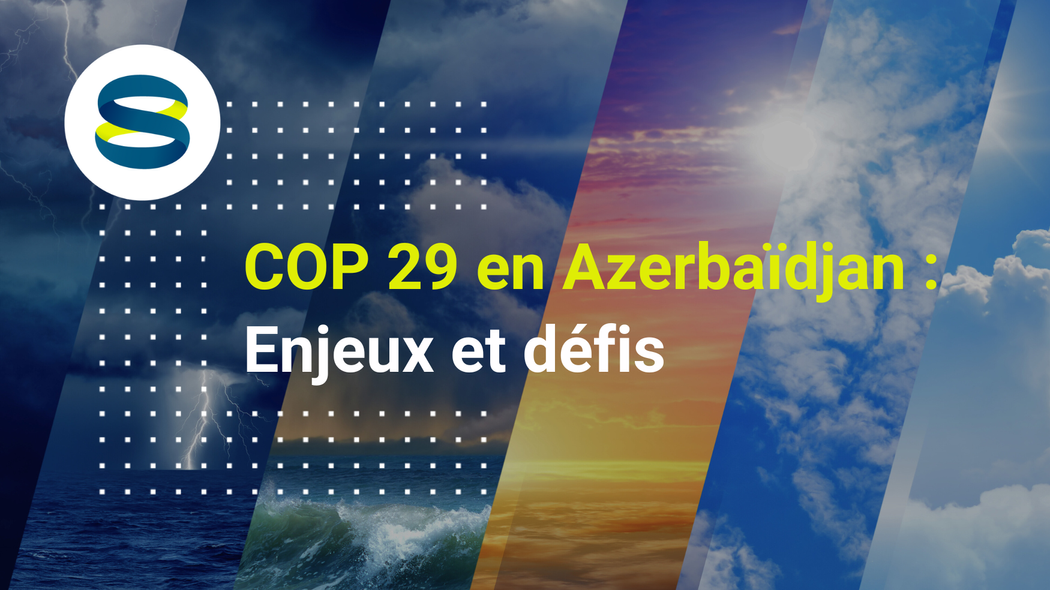
From November 11 to 22, 2024, nearly 50,000 participants are meeting in Baku, Azerbaijan, to negotiate the future of our planet. Since 1995, the Conference of the Parties has brought together representatives of States and civil society every year to combat climate change. Record temperature levels and extreme weather events call for the acceleration of concrete measures.
Mainly focused on climate finance, will COP 29 meet the challenge of achieving carbon neutrality in 2050?
While expectations are high and ambitions are high, the absence of some leaders worries.
The idea of creating a COP on climate emerged in 1992, during the Rio Earth Summit, with the signing of the United Nations Framework Convention on Climate Change (UNFCCC).
Three years later, more than 120 countries are participating in the first Climate Conference of Parties. Each year, the COPs bring together countries that are signatories to the climate change convention, but also representatives of civil society and the private sector (NGOs, academics, scientists, companies...). Together, all stakeholders set goals, take stock and propose concrete solutions to combat global warming. This annual meeting marks a highlight in the ongoing negotiation process to achieve the goals of the international framework convention on climate.
The COP is hosted alternately by each United Nations regional group (Africa, Asia-Pacific, Eastern Europe, Eastern Europe, Latin America and the Caribbean, Western Europe and other states).
Half as many people are expected at COP 29 compared to the previous edition. These defections raise fears of a slowdown in engagement in energy transition.
80,000 people participated in COP28. A year later, less than 50,000 participants are expected in Baku. The presidents of France, America, China and Brazil, as well as the German chancellor or the president of the European Commission, are among the notable absentees. On the sidelines of negotiations, civil society is also less represented.
These absences are nothing new. Until 2015, COPs attracted barely 10,000 participants. For many years, negotiations took place in the shadows. The Paris Agreement, signed in 2015, brings climate change onto the media scene. But participation in COPs remains unequal. Thus, the Baku conference, considered to be technical and financial, is attracting less interest than COP28, which took stock of the Paris Agreement for the first time. Many leaders prefer to focus on the internal affairs of their countries.
These explanations hide the real causes of these absences. The choice of Baku as the host city awakens geopolitical tensions. Relations are tense with France, which is close to Armenia, a rival of Azerbaijan. The country is also an ally of Russia, at war against Ukraine, supported by Europe.
The authoritarian regime in Azerbaijan worried. Against the background of restrictions on freedom and violations of human rights, the context considered dangerous hampers the participation of civil society.
A gas country, Azerbaijan is also raising the question of conflicts of interest on fossil fuels, like the United Arab Emirates in 2023. This choice highlights the disagreements about the goals to be achieved, in particular concerning gas qualified as“transition energy” by the Deputy Minister of Foreign Affairs of Azerbaijan, President of COP29.
The last reason given for the boycott was the “waste of time”. With these words, the Foreign Minister of Papua New Guinea denounces the fruitless COP discussions and the inaction of the major emitters of greenhouse gases and oil and gas states.
The defection of the leaders of the main greenhouse gas emitters poses a threat to the ambitions of COP 29. Of potential blockages in the negotiations and thelack of political commitments could undermine momentum and slow progress.
Especially since this political weakness may not be offset by the impetus of civil society and academia.
According to the British Chatham House Institute, “without the space and impetus for contributions from academia and civil society, Azerbaijan risks failing in its climate leadership efforts, with consequences both nationally and internationally.”
After a politically-oriented COP 28, the Baku conference is more technical and financial. It is no less crucial in a world that is on the way, according to the executive secretary of the UNFCCC, “towards an increase of around 2.7°C” over the century. The aim of the Paris Agreement is to limit the rise to 1.5°C.
The main challenge of COP 29 is climate finance, “essential catalyst for climate action” according to its president.
First objective: increase the financial aid provided by rich countries — historical responsible for global warming — To the poorest countries — the most threatened and the most dependent on fossil fuels. Fixed at $100 billion per year since 2009, the amount of aid is currently insufficient to finance mitigation and adaptation projects and to deal with the consequences of climate change (agricultural losses, drought, natural disasters, natural disasters, infrastructure adaptation, etc.). Needs are assessed by the IPCC to $2.4 trillion per year. The solution could include the Mobilization of private funding and the commitment of multilateral development banks.
Ahead of the meeting, Azerbaijan proposed the creation of a Climate Finance Action Fund (CFAF). Backed by voluntary contributions from governments and oil, gas and coal companies, this new fund would allow the financing of projects ofrenewables, green industry and the decarbonization of agriculture.
NGOs and other countries prefer a tax on the most polluting sectors (aviation, maritime transport) or on billionaires.
Discussions should also continue on the financing of loss and damage funds, intended to mitigate the already real and inevitable impacts of global warming.
In 2025, COP30, in Brazil, will mark 10 years of the Paris Agreement. Following the first assessment presented at COP 28, the negotiation of new, more ambitious Nationally Determined Contributions (NDCs) is a priority of the Baku conference.
These national climate plans define the goals for reducing greenhouse gas emissions and for exiting fossil fuels, as well as the concrete actions implemented to achieve them.
Presented at the beginning of 2025, the new CDNs must correct the lack of ambition And the lack of concreteness previous strategies.
Faced with the already real and inevitable consequences of global warming, adaptation is a urgent priority of COP 29. The objective is to reduce the vulnerability of populations, the environment and the economy, and to strengthen the resilience of communities.
The negotiations focus on four issues: the adaptation finance for developing countries, the ensuring equitable access to resources, improving the mechanisms of sharing knowledge and technology and the implementation of national adaptation strategies.
In particular, the President of COP 29 called for the development of national adaptation plans (PNA) “ambitious, comprehensive and robust”. As of July 2024, less than 40% of stakeholders had presented an adaptation strategy. To move from planning to implementation, the focus must be on concrete commitments.
The Baku conference should also define the modalities for implementing the Emirates-Belém 2025-2026 work programme onidentification of reliable and transparent indicators to monitor and assess the global adaptation goal.
The objective? Guarantee the effectiveness of actions.
COP29 must validate the mechanisms of global carbon market, whose creation is provided for in article 6 of the Paris Agreement. The principle is simple: force the most polluting states to buy carbon credits to offset their greenhouse gas emissions.
The funds generated by the market should be used for financing energy transition, adaptation and mitigation projects, especially in developing countries.
But, almost 10 years after the decision to create it, the failure of the negotiations did not allow the international carbon market to be implemented in operation. Discussions focus on credit accounting, transparency and the risks of “double-counting” discounts. During COP 29, key decisions are expected for Clarify these mechanisms, guarantee their integrity and ensure a real contribution to the reduction of CO emissions2 in the world.
Each year, the COPs reveal fundamental disagreements and controversies between countries. These tensions complicate, but not compromise, the achievement of global climate goals.
The boycott by the Foreign Minister of Papua New Guinea symbolizes the climate divide between developed and developing countries. The lack of attention that he denounces is shared by many disadvantaged countries, the first victims of global warming. These suffer from a Feeling of climate injustice, accusing developed countries of not meeting their financial commitments despite their historical responsibility for the climate crisis.
This gap highlights profound inequalities that sometimes hinder the search for global and ambitious solutions. These points of friction are creating tensions in the COP negotiations. For example, for the carbon market, developing countries fear that rich countries will buy carbon credits en masse in order not to reduce their greenhouse gas emissions. Climate finance or the loss and damage fund also continue to fuel disagreements.
The climate conferences of the parties are marked by the palpable tensions between oil and gas producing countries and countries calling for more ambitious measures for the energy transition. The successive choice of oil and gas states to host the COP highlights the oppositions.
Thus, European countries, the United Kingdom, Canada and the nations most vulnerable to climate change are calling for a rapid exit from fossil fuels and the end of their subsidies. Producing countries (United States, Saudi Arabia, Russia...) and countries dependent on these energies for their economic development (China, India) reject a binding end date.
One Historical progress was, however, applauded during the COP 28, whose final agreement refers to the gradual exit from fossil fuels and recalls the need to reduce the use of coal.
COP29 is emerging as a crucial moment in the global fight against climate change. It will have to respond to major challenges: the mobilization of climate finance for vulnerable countries, the strengthening of climate commitments and the implementation of the global carbon market. However, the absence of key leaders as well as geopolitical tensions raise concerns about the effectiveness of the negotiations. Will COP29 be a COP for nothing or will it lead to historic agreements on financing? Let's bet that the disagreements will give way to the decisions necessary to achieve the objective of the Paris Agreement.
You too can take action for the climate by reducing your greenhouse gas emissions. Do you want to optimize your energy consumption? Contact our experts for customized energy solutions.
In a few clicks, organize an exchange with one of our experts.


weekly newsletter subscribers

4.9

.png)

Le calendrier 2026 impose deux échéances majeures :
Pour simplifier ces démarches, vous pouvez centraliser vos données de consommation avec la plateforme Pilott de Sirenergies, garantissant ainsi la conformité de vos rapports réglementaires.
La réussite d'un projet collectif énergie repose sur trois piliers fondamentaux :
Les coopératives de taille ETI ou grande entreprise peuvent être soumises à l'audit énergétique réglementaire (norme NF EN 16247). Sirenergies n'a ni la compétence ni l'accréditation pour réaliser cet audit : nous vous orientons vers un bureau d'études partenaire accrédité, et vous accompagnons en amont sur vos achats et en aval sur le pilotage.
It allows you to prove your commitment to the energy transition and to meet regulatory requirements.
To calculate Scope 2 emissions, use the following formula:
Energy quantity (kWh) × Emission factor (kg CO₂ e/kWh).
Use databases like ADEME for precision.
Yes. The supplier guarantees an offer 100% renewable via the official Guarantees of Origin (GO) mechanism.
For the most demanding companies, the offer GREENVOLT+ ensures very low carbon intensity electricity, sourced exclusively from independent French producers (hydraulic, wind, solar).