

Fine chemicals: industrial research and development laboratories
Research laboratories: finally measure your energy costs
Who pays for the air your fume hoods exhaust day and night? In a chemistry lab, fresh air is heated by gas in winter, cooled by electricity in summer, and then exhausted without recovery. Sirenergies helps you secure electricity and gas contracts for your research laboratory and isolates its consumption.



Key industry figures
Ventilation, fume hoods, and fresh air: the cost of an industrial laboratory
Safety protocols require an airflow rate that no one considers reducing. This constant baseline, largely independent of the number of tests performed, is well-suited for multi-year electricity and gas procurement strategies.
Energy consumption per square meter in a laboratory: up to ten times that of an office
A single fume hood consumes more energy per year than three American homes
Share of gas in the pharmaceutical industry's energy consumption in 2024
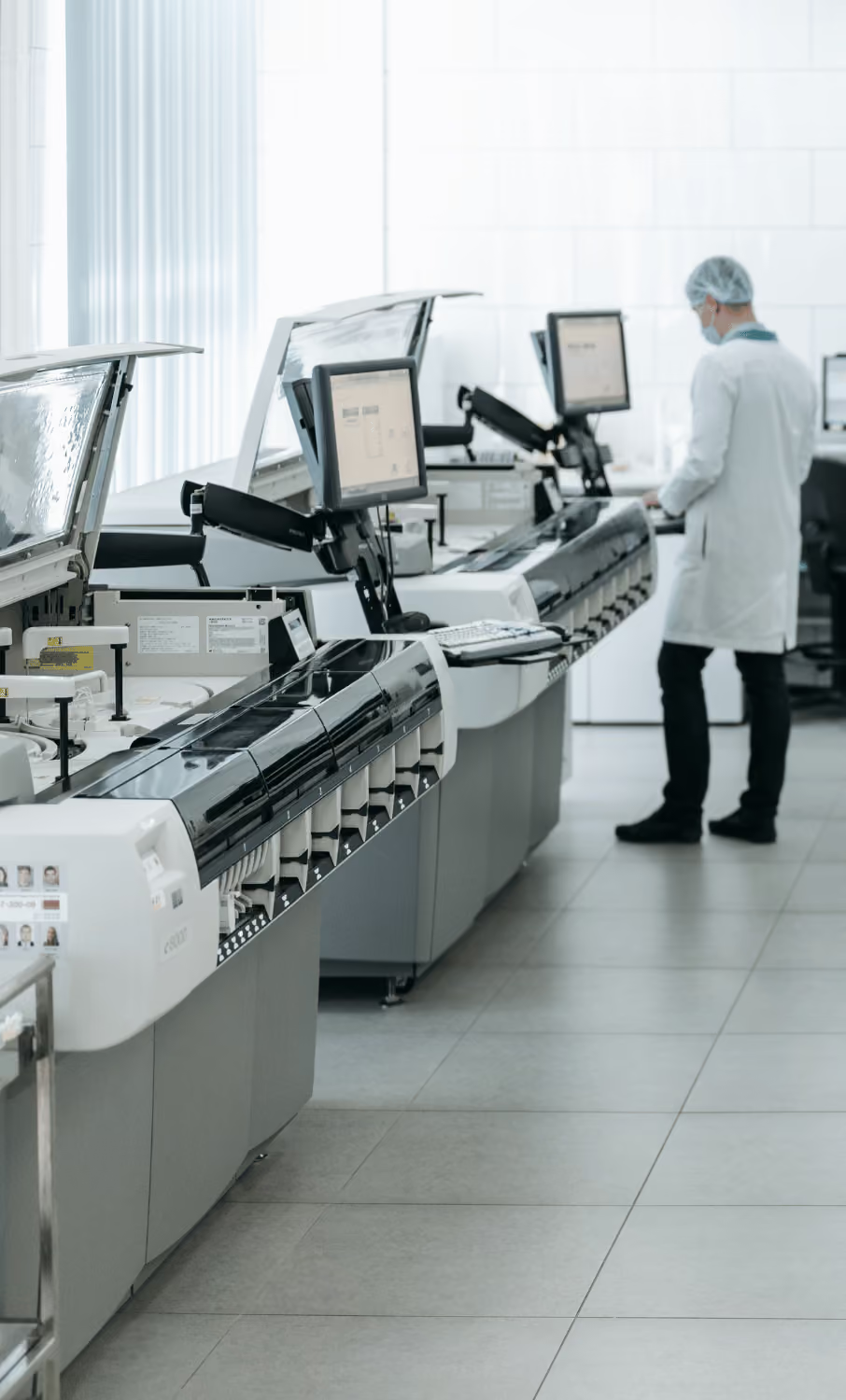
The energy profile of an industrial research laboratory
Fresh air for fume hoods: the permanent baseline of a laboratory's energy bill
The reality: a building that breathes fresh air, whether tests are running or not
A chemistry or formulation laboratory does not recycle its air: what enters through the air handling unit exits through the fume hoods and exhaust systems. Design guidelines typically recommend 6 to 10 air changes per hour for these facilities (DOE and EPA, Labs21, 2008). Electricity powers fans, chillers, ovens, and analyzers; gas heats the fresh air in winter and sometimes produces humidification steam. The result: a baseline consumption that does not decrease at night or on weekends.
Our role: treating the laboratory as a distinct site
Fume hood flow rates and ventilation setpoints are managed by your safety officers, technical teams, and their engineering consultants. Sirenergies advises your management on three key levers:
- Purchasing: the ventilation base load purchased at a fixed price over several installments, based on our recommendation.
- Transmission: subscribed power and TURPE (public electricity network usage tariff) option adjusted to a flat profile, ATRD (third-party access to gas distribution networks) capacity reviewed for the boiler room.
- The data: laboratory consumption isolated from office consumption.

Your energy challenges
The 3 energy challenges for industrial research laboratories
Paying for fresh air that circulates even when no one is working, determining if the building falls under the tertiary decree, and identifying the true cost of each laboratory in your invoices: these are three common questions in chemical and pharmaceutical research centers. Sirenergies provides answers through contract management and measurement.
Fresh air paid for day and night
Safety hoods continuously extract air that the central system must then heat or cool. This base load does not follow test schedules or occupancy, yet it is often purchased under a contract calibrated for office use.
A contract built on the base load
We analyze your load profiles to isolate this permanent baseline, recommend purchasing it at a fixed price over several terms, and adjust your subscribed power to match a highly consistent electrical profile.

Tertiary Decree: a blurred scope
A research laboratory located on an industrial site is not covered, but a research facility integrated into a primarily tertiary building is, with its energy-intensive processes then needing to be isolated via sub-metering. You still need to know which category your site falls into.
Data separated by usage
We inventory your delivery points and invoices, link each meter to its specific usage, and guide you toward an engineering firm for sub-metering. The consumption data tracked in Pilott can then be exported for your declarations.
Energy budgets buried in overhead costs
When research center energy costs are billed per square meter along with office expenses, it becomes impossible to compare two laboratories or forecast the cost of a new testing facility.
Building-specific metrics
Working with your teams, we build energy and budget metrics for each building or facility, powered by next-day consumption data from Pilott and projected over the year to help you prepare for every investment decision.
Contractual and data expertise
Optimization and management of your research center contracts
From air handling units to sample freezers, Sirenergies provides expert advice on electricity and gas for your industrial laboratories. We focus on contracts, supply, and measurement, never on the safety flow rates established by your safety officers and technical teams.
Contractual and capacity audit
Analysis of your electricity and gas contracts, their expiration dates, and your subscribed power levels, annual review of excise duties, and identification of CEE (energy savings certificate) schemes applicable to your ventilation equipment.
Purchasing strategy and competitive bidding
Consultation with our partner suppliers based on specifications that separate laboratory and office usage, clause-by-clause comparison of offers, negotiation prepared with you until signature, and subsequent monitoring of your fixed-price periods.
Distribution optimization (TURPE / ATRD)
For electricity, subscribed power and TURPE options adjusted for ventilation running non-stop; for gas, daily ATRD capacity reviewed for the boiler room heating the fresh air. We handle all procedures with network operators.
Ventilation tariff modeling
Energy budget simulation based on various hedging strategies, cost estimation for reduced flow rates during unoccupied hours as decided by your teams, and feasibility studies for PPAs (Power Purchase Agreements) or photovoltaic self-consumption.
Pilott software platform
Next-day consumption tracking by delivery point, budget forecasting, price alerts for electricity and gas markets, centralized contract documentation, and carbon footprint monitoring for your research sites.
Expert consulting dedicated to laboratories
A consultant who understands laboratory safety constraints, monitors markets and regulations (excise duties, tertiary decree, CEE), and works with you to build indicators that link energy, budget, and research activity.
Our platform
Pilott, simplified management to track your consumption
- Consolidate the meters for your research centers and offices
- Identify spikes in consumption overnight or on weekends the very next day
- Set an alert threshold for electricity or gas prices
- Simulate your annual budget and find all your contracts in one place


Fine chemicals
Explore other processes
Un autre secteur ?


Methodology and definitions
What is energy consulting for an industrial research laboratory?
A laboratory consumes far more energy per square meter than an office, yet it is often purchased under the same contract. For an industrial research center, energy consulting involves separating these two profiles, managing the procurement of electricity and gas used for ventilation and heating, and then exploring ways to green this permanent base load: through rooftop photovoltaic self-consumption or guarantees of origin integrated into the contract. Sirenergies consultants carry out this work using the Pilott platform.
The context
Companies based in France spent 41.9 billion euros on their research and development activities in 2024 (MESRE-SIES, April 2026, provisional data). The energy used by their laboratories is included without being isolated.
- Separate: laboratory and office meters identified, scope of the tertiary decree clarified.
- Hedge: ventilation base load at a fixed price, power and gas capacity sized according to the actual profile.
- Green: self-consumption or guarantees of origin calculated for your budget.

How much of your research budget is being lost through exhaust air?
Your invoices and load curve are all that is needed to isolate the ventilation base load and calculate the potential. No obligation.

