

Fine chemicals: distillation and separation
Distillation units: reduce the cost of your columns
At the base of the column, the reboiler demands steam day and night; at the top, the condenser rejects this heat into the cooling water. From gas for steam to electricity for pumps, vacuum, and cooling systems: Sirenergies helps you reduce the energy costs of your industrial distillation, covering both procurement and distribution.


Key industry figures
Steam, gas, and electricity: the true energy footprint of separation
A column primarily consumes heat, which is rarely visible item-by-item on an invoice. Knowing the breakdown of gas, electricity, and purchased steam is the prerequisite for any procurement strategy for your site.
High-end estimate of global energy absorbed by thermal separation processes like distillation
Gas consumed by the French chemical industry in 2024, relative to its electricity consumption
Share of steam in the raw energy consumed by the chemical industry in 2024
The energy profile of a distillation unit
Reboiler steam: the primary cost driver for a distillation column
The reality: heat paid for twice, once to vaporize and again to condense
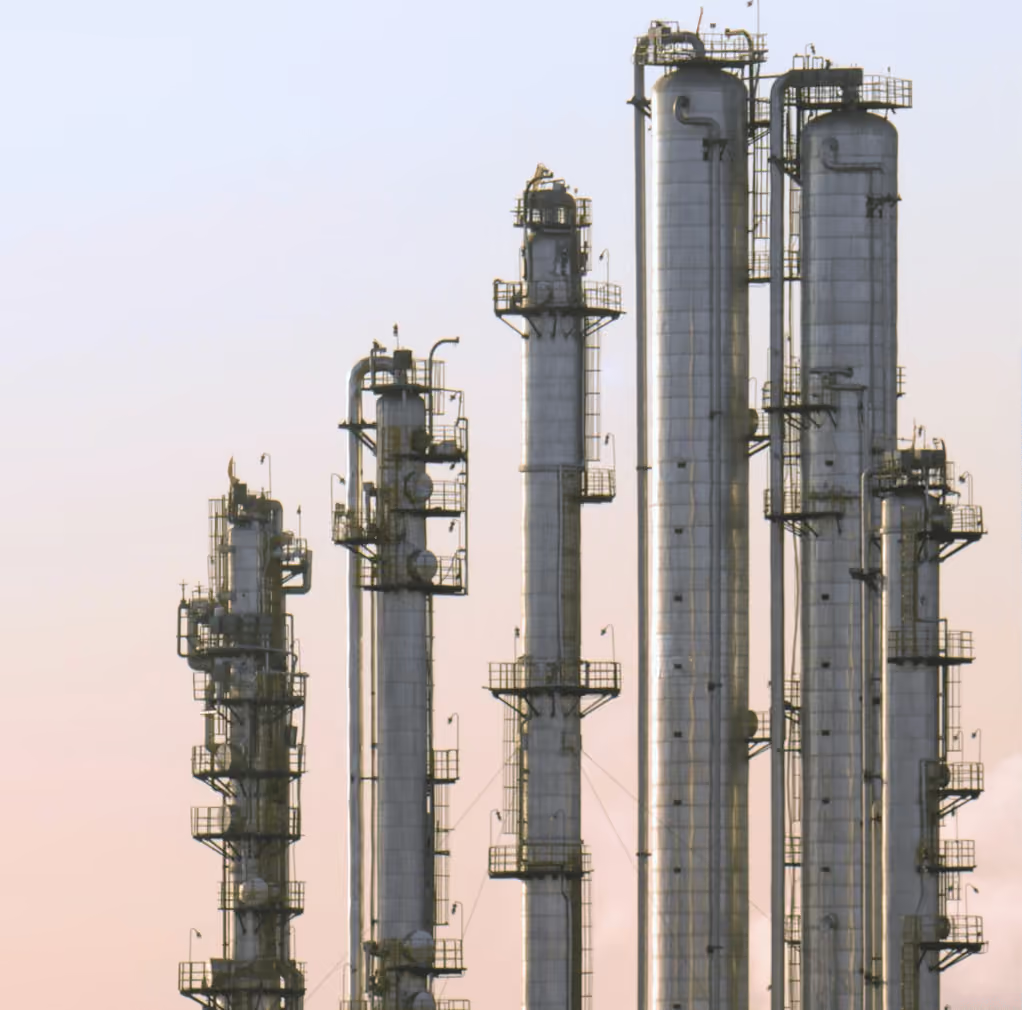
Distillation involves vaporizing a mixture at the base of the column and then condensing it at the top, according to the reflux ratio. The reboiler consumes steam, produced by a gas boiler or purchased from a chemical platform operator; pumps, vacuum units, and condenser cooling systems run on electricity. In large-scale chemical industries, separation operations account for 50% to 70% of energy consumption (AIChE, 2020): gas dominates, but electricity becomes a significant factor when working under vacuum or at low temperatures.
Our role: supporting the procurement and distribution of everything your column consumes
Reflux and thermal integration are the responsibility of your process engineers and design offices. Sirenergies advises your management team on three key levers:
- purchasing boiler gas as a continuous base load, which you lock in over several timeframes;
- optimizing ATRD or ATRT capacity (third-party access to gas distribution or transport networks), as well as subscribed power and TURPE (public electricity network usage tariff) options;
- calculating the impact of a proposed electrification project on both your contracts before it is implemented.

Your energy challenges
The 3 energy challenges of distillation and separation columns
Essential steam whose price tracks gas, electrification that shifts costs from one energy source to another, and utility costs rarely linked to a specific column: these three issues arise at most separation sites. Here is how Sirenergies addresses them, from contracts to data.
One of the most energy-intensive chemical processes
In technical literature, distillation columns are recognized as one of the most energy-intensive processes in the chemical industry due to their continuous heating and reflux cycles.
Utility energy audit
Sirenergies audits your electricity, steam, and gas contracts to determine the actual impact of your columns on your utility bills.

Underutilized waste heat
On many sites, the heat generated by distillation columns is still not sufficiently recovered, even though technical solutions—such as low-pressure steam recovery and mechanical vapor recompression—are available.
Guidance on waste heat recovery
Sirenergies guides you toward best practices and the right technical partners to recover this heat, in addition to optimizing your contracts.
Non-activated interruptible contracts
Sites with continuous distillation or petrochemical processes are often managed directly by their incumbent supplier, without interruptible contract or demand response options always being activated.
Contract structuring and industrial demand response
Sirenergies structures your contract, including its interruptibility options, and connects you with an aggregator to monetize your demand response potential.
Contractual and data expertise
Optimizing and managing contracts for your separation units
From the boiler room supplying the reboilers to vacuum and refrigeration units, Sirenergies supports you with the gas and electricity needs of your columns. Our consultants work on contracts, supply, and data; process adjustments remain in the hands of your engineers.
Contractual and capacity audit
Review of your gas and electricity contracts, their expiration dates, your daily capacities and subscribed power, annual excise tax analysis, and identification of CEE (Energy Savings Certificate) schemes related to heat recovery.
Purchasing strategy and competitive bidding
Specifications that distinguish the continuous base load of your reboilers, consultation with our partner suppliers, multi-criteria analysis of offers, negotiated preparation alongside you, and subsequent monitoring of your hedging and price-fixing.
Distribution optimization (TURPE / ATRD)
For gas, daily ATRD capacity reviewed for the boiler room, or ATRT if your site is connected to the transport network. For electricity, subscribed power and TURPE options adjusted for pumps, vacuum, and refrigeration. We handle the procedures with network operators.
Steam tariff modeling
Energy budget forecasting based on various hedging strategies, comparison of gas versus electricity for steam production, study of your utility flexibility, and, if the process allows, support for demand response valuation.
Pilott software platform
Next-day consumption data for every gas and electricity meter, market price alerts, carbon footprint tracking, and centralized contracts, with CSV or API export to your production monitoring tools.
Expert consulting dedicated to the chemical industry
A consultant who understands the utilities of a chemical site, monitors markets and regulations (excise taxes, capacity mechanisms, CEEs), and builds indicators with your teams that link energy, budget, and tons separated.
Our platform
Pilott, simplified management to track your consumption
- Consolidate your units' gas and electricity meters in one place
- Check the previous day's consumption every morning, including the boiler room
- Receive an alert when the gas price reaches your purchasing threshold
- Forecast your annual steam budget and access all your contracts in one location


Fine chemicals
Explore other processes
Un autre secteur ?


Methodology and definitions
What is energy consulting for industrial distillation?
A distillation column that runs year-round requires roughly the same volume of gas every day. Energy consulting for industrial distillation starts with this consistency: it precisely sizes the daily gas capacity reserved on the network, compares steam produced on-site with steam purchased from a platform, and adjusts the electrical power for pumps, vacuum systems, and cooling. Sirenergies consultants carry out this work using the Pilott platform and then assist with the procurement of both energy sources.
The context
In 2024, the French chemical industry consumed 8,356 kilotonnes of oil equivalent in energy, including raw material usage (Insee, EACEI survey, 2026).
- Capacity: ATRD or ATRT (third-party access to gas distribution or transport networks) review based on actual boiler room consumption.
- Steam: comparison of the total cost of produced steam versus purchased steam.
- Electricity: subscribed power simulated prior to any mechanical vapor recompression.

What does the steam sent to your reboilers every year actually cost?
Your gas and electricity bills and your load profiles are all we need to estimate the potential. No obligation.

