

Warehouses and 3PL: standard (ambient) warehouse
Logistics providers: optimize your warehouse energy
In an ambient warehouse, the goods themselves consume almost nothing: the real costs come from heating work areas, charging forklifts, and lighting aisles, whether using gas or electricity. Energy optimization for a logistics warehouse starts with your contracts, which Sirenergies helps you put out to tender on a site-by-site basis.


Key industry figures
Heating and networks: what really drives the bill for an ambient warehouse
In an ambient warehouse, heating the space costs more than lighting, and both gas and electricity network tariffs are revised every summer. Buying at the right time and in the right volume is critical.
Heating and cooling: share of the 2030 threshold for an ambient warehouse in H1 zone
Average increase in GRDF's ATRD gas distribution tariff as of July 1, 2026
Average increase in Enedis's HTA and low-voltage TURPE as of August 1, 2026
Quelques industriels qui nous font confiance


The energy profile of a standard warehouse
Heating storage cells and charging equipment drive the bill
An ambient warehouse consumes energy primarily for its staff and equipment
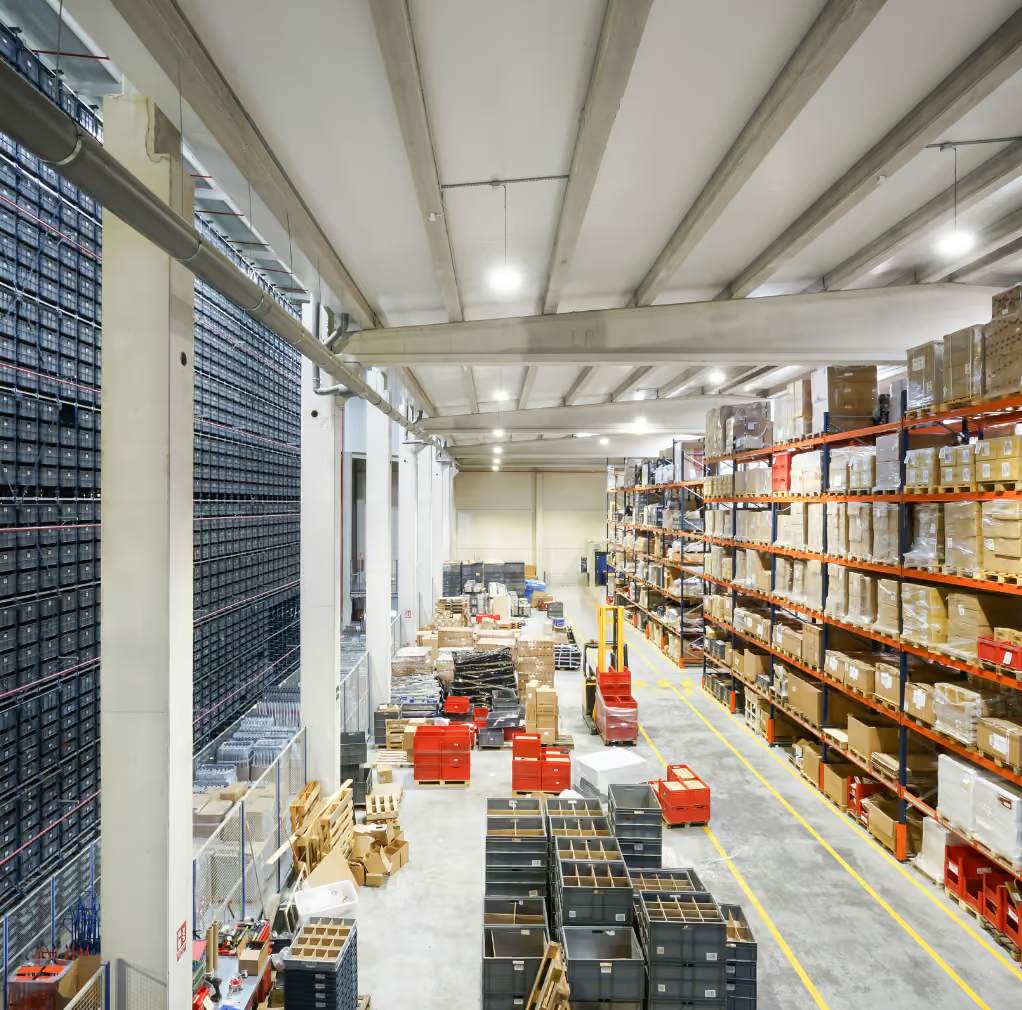
In winter, keeping work areas frost-free or at a comfortable temperature requires gas-fired unit heaters or radiant panels—sometimes electric—across vast volumes. Throughout the year, charging forklifts and pallet jacks puts a load on the electrical grid: the Tertiary Decree reference value estimates this at 4.21 kWh/m²/year, which is more than the LED aisle lighting (Ministry of Ecological Transition, 2024). The profile is twofold, with a gas peak in winter and electrical power demands linked to charging cycles.
Our role: helping you buy at the right price and pay the right amount for network access
Your installers work on the building; Sirenergies advises you on what you buy and pay for.
- Purchasing aligned with winter: a gas and electricity consultation, with coverage that you decide based on heating seasonality.
- Distribution: power and TURPE (public electricity network usage tariff) options based on your charging cycles, and ATRD (third-party access to gas distribution networks) options based on heating.
- Site-by-site monitoring: consumption data for each warehouse available in Pilott at D+1, to identify drifts before the invoice arrives.


Your energy challenges
The 3 energy challenges of ambient warehouse management
A colder-than-expected winter, an expanding fleet of forklifts, a roof slated for solar power generation: an ambient warehouse's energy bill is shaped by decisions made far beyond the energy contract itself. Here are the three areas where Sirenergies prioritizes its support for logistics professionals.
Contractual and data expertise
Optimizing and managing contracts for your warehouses and platforms
From heating warehouse cells in winter to the daily charging of equipment, Sirenergies handles your gas and electricity contracts together. Your sites keep their current setup; we adjust what you buy, what you pay the network, and how you track it.
Contractual and capacity audit
Reviewing your gas and electricity contracts and their deadlines, auditing subscribed power levels and daily gas capacities, and performing annual analyses of excise duties and energy savings certificates (CEE) applicable to each of your warehouses.
Purchasing strategy and competitive bidding
Tendering for your entire portfolio or site by site: drafting specifications, analyzing offers clause by clause, and providing support throughout negotiations until you sign, with no capital ties to the suppliers consulted.
Distribution optimization (TURPE / ATRD)
For electricity, we select the TURPE option and subscribed power based on your charging cycles. For gas, we verify the ATRD option in relation to your heating needs. We handle all procedures with network operators.
Tariff modeling for self-consumption
Simulating your budget with and without rooftop photovoltaic installations, assessing the impact of shifting equipment charging to off-peak hours, and analyzing price risks to help you make informed investment decisions.
Pilott software platform
Consumption data for each warehouse at D+1, price alerts for electricity and gas markets, centralized contracts and invoices, and data export via CSV or API to your own tools.
Expert consulting dedicated to logistics
A dedicated consultant tracks your deadlines, coverage levels, and the regulations affecting your platforms, using budget and consumption indicators defined together with you.
Our platform
Pilott, simplified management to track your consumption
- Centralize all your warehouses and platforms, regardless of their supplier
- Track the consumption of each site at D+1
- Get alerted when gas or electricity prices hit your threshold before winter
- Simulate your energy budget and manage your contracts from a single interface


Warehouses and 3PL
Explore other processes
Un autre secteur ?


Methodology and definitions
What is energy consulting for an ambient logistics warehouse?
For an ambient logistics warehouse, the bulk of the bill is determined at the time of purchase: the portion of gas covered before winter, the choice between fixed and market-indexed prices, and the timing of price fixing. Energy consulting helps the operator or owner make these decisions, compares offers clause by clause, and manages distribution fees for both energy types. Sirenergies consultants handle this using the Pilott platform.
A growing sector
Metropolitan France has 93 million m² of warehouses of 10,000 m² or more, an increase of 2.3% over one year (SDES, data as of December 31, 2024). Most fall under the tertiary decree.
The three Sirenergies levers
- Hedging: a portion of gas fixed before winter, electricity purchased in multiple installments.
- Distribution: TURPE (public electricity network usage tariff) and ATRD (third-party access to gas distribution networks) reviewed at each annual tariff revision.
- Monitoring: consumption data at D+1 by site and export for reporting.

How much of your warehouse energy budget is tied up in your contracts?
A review of your contracts and load profiles is enough to calculate the potential savings per site. No obligation.

