

Virginie
LEFÈVRE
Sirenergies editor
Table of contents


What is a local distribution company (ELD)?
March 6, 2026
5
Min reading

For more than half a century, monopoly was in force in the energy sector in France. Indeed, the EDF-GDF group covered all the activities in the sector. However, you have to go back to the pre-war period to understand the origin of ELDs.
First, it should be remembered that in 1946 France had one of the densest electrical networks in the world. It is the result of the activities carried out by a hundred independent companies in this sector.
During the nationalization phase, EDF-GDF brought together nearly 95% of these companies within it. Today, we are going to focus on the remaining 5%. What happened to these energy distribution and supply companies? This is what we call today Local Distribution Companies (ELD).
These companies, often unknown in the energy sector, have been developing multiple activities for several years. From now on, it is time for transformation. The energy transition and the will of the European Union are changing the energy sector. Certainly, these companies do not want to miss out on the transformation of the sector.
ELDs, which represent an exception in the energy landscape in France, intend to take advantage of this.
To do this, we will see where the origin of the creation of ELDs is. Next, we will draw up a portrait of the various current activities of ELDs. Finally, we will look at their future.
What is the origin of ELDs?
First of all, it is worth recalling the state of the energy sector in France in the wake of 1945. Despite the two terrible conflicts at the beginning of the 20th century, France has the densest electricity network in the world.
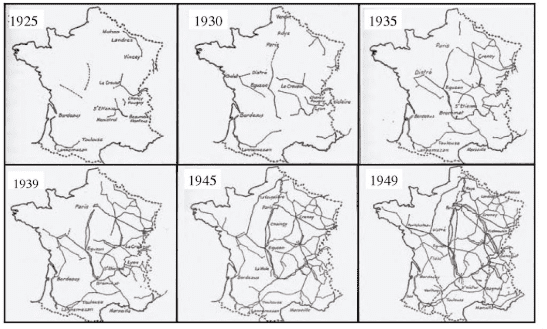
Evolution of the electrical system in the Revue Générale des Chemins de Fer
It is the result of the work of numerous structures, often supported by municipalities and communities.
The profitability of electrical network installations depended heavily on the economic environment in the region. Private companies could then sometimes be quite cautious and that's when the town halls decided, through the regime of concessions and agencies, to take over.
The post-war wave of nationalizations made it possible to concentrate this multitude of actors into a single entity. However, some companies were not affected by this nationalization. You guessed it, these are our famous ELDs.
The law of June 15, 1906 comes into play. This involves the creation of the status of licensing authority of the municipalities that own the networks, which allows these companies to operate the networks. This allows the city hall to maintain some control over these activities.
Thus, in April 1946, some municipalities did not accept the proposal to nationalize the French State. They have remained independent and continue to operate in their respective areas today.
What are the ELDs' activities today?
ELDs are therefore in a monopoly situation. today on their territories. There are no less than 140 for electricity as well as about twenty for gas networks.
The five largest electricity ELDs now total nearly one million meters. As for the three largest French gas ELDs, they represent nearly 350,000 meters.
The historical activities of ELDs revolve around two pillars:
- Management of electricity and gas transmission networks
- The supply of energy
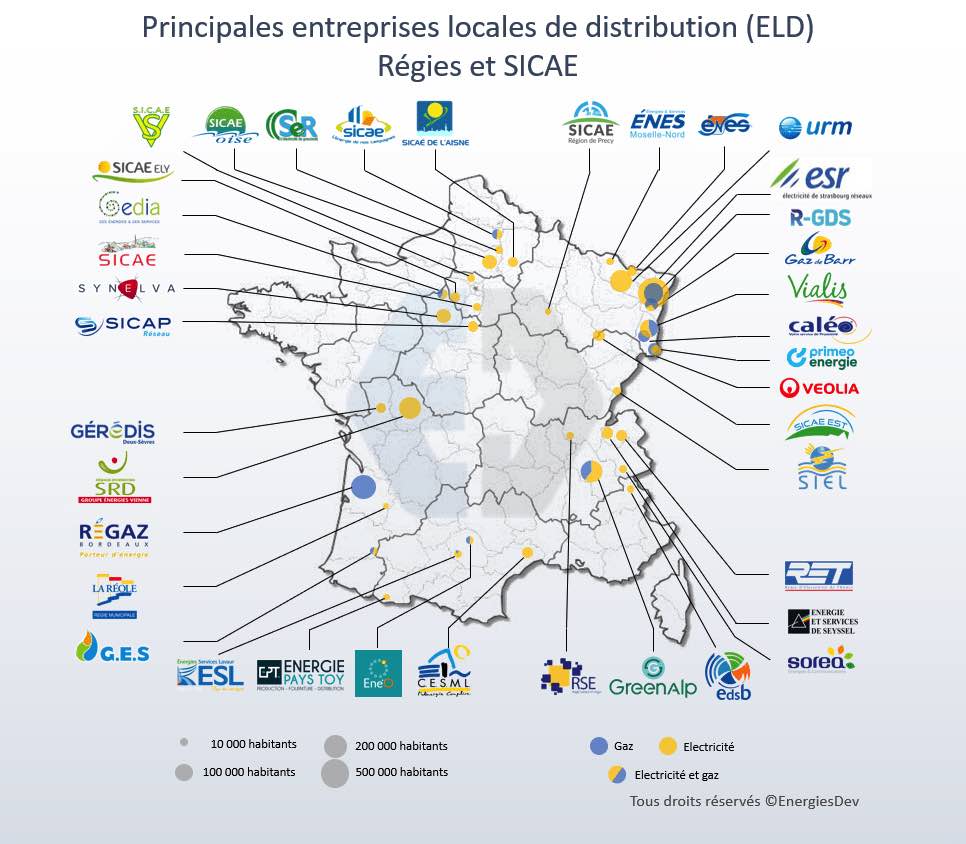
Source: EnergiesDev
With regard to the management of distribution networks
As explained in the introduction, ELDs are in a monopoly situation. They thus maintain the network on their territories while it is Enedis which carries out this public service mission everywhere else on French territory.
These companies have therefore developed technical and recognized expertise in network management. These activities range from maintenance and repair to the development of lines and pipes.
With regard to the supply of electricity and gas
Like EDF, ELDs are the only companies authorized to offer the sale of electricity and gas offers at the regulated rate in their respective areas.
However, faced with the development of competition in the sector, these companies have been forced to transform. For the largest of them, their activities as alternative suppliers extend throughout France.
Diversifying their activities
Energy production
Many ELDs have production assets that allow them to diversify their business portfolios. Some for historical and geographical reasons. Others have been able to expand their activities and investments.
They can thus benefit from additional income from, for example, capacity mechanism. This also applies to renewable energy projects.
The ELDs located in Picardy have, for example, numerous wind farms in the region. As such, south-west France is home to numerous hydroelectric power plants ELD properties in the region.
Energy efficiency
ELDs also often offer services concerning energy efficiency. They offer support for The renovation bonus (The EEC), and therefore encourage their customers to reduce their consumption.
It is common to also see a Assistance with the installation of photovoltaic panels.
What is the future for ELDs?
The next few years will be decisive for the future of ELDs. Indeed, the changes in our sector are not going to stop there. The scheduled end of regulated sales rates will upset the activities of these historical suppliers.
The move towards increased competition is threatening their activities that have hitherto been unaffected by these changes. One of the solutions considered is the regrouping. Unity is strength is not a simple adage in our case.
Indeed, in the face of merging competitors (such as the acquisition of Direct Énergie by TotalEnergies), it is becoming important to organize themselves in order to perpetuate their activities. Lucia or Proxelia are good examples of grouping ELDs together in order to reach the necessary critical size.
So we are at a turning point in their stories and developments. Most major ELDs seem to have understood this paradigm shift and are undertaking new activities. The scheduled end of regulated gas tariffs should accelerate this movement. As far as electricity is concerned, the end of TRV (Regulated Sales Rates) is not yet in place; however, it is not improbable to see it appear in the coming years.
We regularly publish news articles to find out more about the end of TRVs; feel free to go to the “News” section of our website.


Take the first step towards optimization
In a few clicks, organize an exchange with one of our experts.





weekly newsletter subscribers

4.9
