






Summarize with AI

November 4, 2026
6
Min reading
Renewable energies are the future and the way towards a successful energy transition. Many countries and companies around the world are turning to hydropower, solar or wind power, but blue energy is still barely exploited.
Because of its huge potential, several experts see osmotic energy as the future of global electricity production. It nevertheless faces many technical, technological and financial obstacles that could hold back its development.
Definition, operating principle, key figures and outlook: Sirenergies takes you to the heart of osmotic energy.
The energy source attracting researchers' attention has a rather hard-to-remember name. Osmotic? Behind this strange name lies an ingenious natural mechanism.
The osmotic phenomenon is linked to osmosis. It is driven by differences in concentration, and therefore in pressure, between two aqueous solutions. These differences are measured with an osmotic coefficient.
Osmosis generally comes with hydrostatic pressure. Osmotic energy is obtained from osmosis through a semi-permeable membrane, and this pressure is then used to produce electricity.
Osmotic pressure can also be observed with inorganic minerals, such as mineral salts, in water. The water in a living organism is a perfect example: osmosis drives the isotonic, hypotonic and hypertonic processes needed to keep the body's water and salt balance stable.
Osmotic energy therefore relies on osmosis to renew itself. It belongs to the family of marine energies and is a green source of energy. With this renewable energy, electricity can be produced from salt.
In practice, electricity is obtained from the difference in salinity between river water and sea water where they meet. This movement, osmosis, has an energy potential similar to that of a waterfall. To understand how osmotic energy works, we first need to explain osmosis.
Osmosis is the transfer of a solvent through a membrane under the effect of a concentration gradient. It takes the form of a flow of water from a dilute solution towards a concentrated one. Osmotic energy uses this phenomenon to generate electricity, but it is still at the experimental stage.
There are several techniques for producing electricity from osmosis. This variety allows scientists to explore many options, with laboratory experiments and tests in real conditions. Sirenergies explains how osmotic energy works.
At first sight, the idea seems straight out of a science fiction series, yet osmotic energy makes it possible. In simple terms:
This transfer of fresh water creates overpressure in the sea water tank and increases the initial flow. A third of this water is sent to an electric turbine to produce electricity, and the rest goes back to the pressure exchanger to repeat the pressurisation process. There are two proven techniques for generating electricity from osmotic energy: pressure retarded osmosis and reverse electrodialysis.
Pressure retarded osmosis uses two tanks separated by a semi-permeable membrane. As you might expect, one contains salt water and the other fresh water, following the principle of osmosis. The fresh water molecules increase the pressure in the salt water tank, and the pressurised water is then sent to a turbine to produce electricity.
The advantage of pressure retarded osmosis is that it works much like a hydroelectric dam. It could be used at river mouths all over the world.
However, it attracts little interest and little investment. Why? Because an osmotic power plant would need 200,000 m² of membrane to produce 1 MW of electricity.
The first osmotic power plant prototype opened in 2009 in Tofte, Norway. Built by Statkraft, it had a capacity of 2 to 4 kW and was meant to serve as a test before building a large osmotic power plant.
Reverse electrodialysis is based on the composition of salt water, which contains negatively charged chloride ions and positively charged sodium ions. The migration of these ions through the membrane drives electricity production: in other words, the flow of charged ions between the solutions produces an electric current.
However, the membranes used in the first experiments were not efficient enough. To solve this, scientists created a membrane just 3 atoms thick. With 1 m² of this membrane, it would theoretically be possible to produce 1 MW of electricity.
Renewable energies are benefiting from the latest technologies to help our planet move away from fossil fuels. Amid this wave of research and innovation, osmotic energy offers real hope. Here is why.
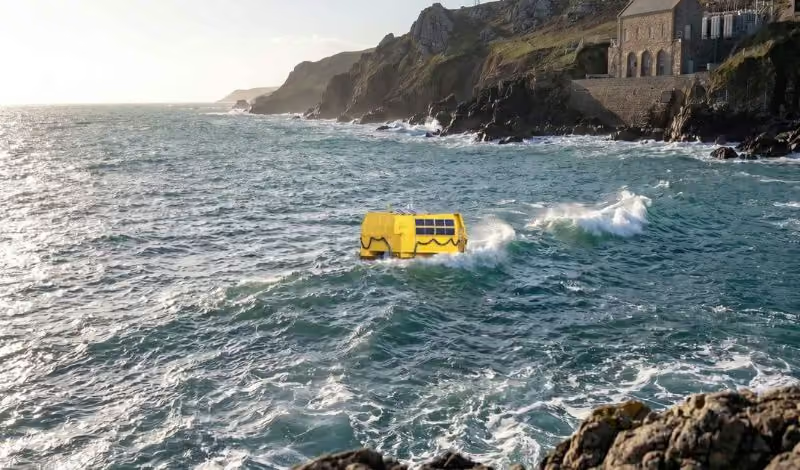
France's first osmotic power plant, being installed at Port-Saint-Louis-du-Rhône at the time of writing, is an innovative project that uses osmotic energy to produce electricity.
The plant is located in the Bouches-du-Rhône, in the south of France, at the mouth of the Rhône. This location makes it possible to use the difference in salinity between the river's fresh water and the salt water of the Mediterranean.
The plant uses a membrane that separates the fresh water of the Rhône from the salt water of the sea:
The Port-Saint-Louis-du-Rhône osmotic power plant is the result of a partnership between the Compagnie Nationale du Rhône (CNR) and the French start-up Sweetch Energy.
CNR brings its expertise in water and energy management, while Sweetch Energy develops the osmotic technology. The project is expected to contribute to the energy transition in France by supplying clean and sustainable energy.
This pioneering project could play a key role in our energy future by using an abundant natural resource: the meeting of river water and sea water.
Osmotic power is still in its infancy, and it is hard to estimate how important it could become. More precisely, the place of blue energy will depend mainly on technological progress and on the ability to harness it at a lower cost.
Let us look at the question from another angle and consider the advantages and drawbacks of osmotic energy. First of all, it is a fully renewable energy. As such:
Osmotic energy can be produced regardless of the weather, which makes electricity production highly predictable.
The energy and technical stakes are high, because an osmotic power plant can theoretically operate 8,000 hours a year. With large installed capacity, it could therefore run three to four times longer than the average wind turbine.
As for the drawbacks, several obstacles stand in the way of rapid development. Membranes that are robust, porous and large enough to generate electricity on a large scale are not yet available. Suitable sites for osmotic plants are also often highly industrialised or urbanised.
The current efficiency of osmotic energy is low and attracts very few investors. Finally, brackish water, the only residue of osmosis, can upset local ecosystems. Before osmotic energy can be seen as the energy of the future, scientists will have to solve these problems.
In short, blue energy meets many of the criteria to become an energy of tomorrow. Large osmotic plants are not expected for several years, but this energy sector is one of the most strategic. It is particularly attractive for countries with long coastlines that do not want to rely only on hydropower, whose output depends on rainfall and river flows.
In a few clicks, organize an exchange with one of our experts.


weekly newsletter subscribers

4.9
