





Summarize with AI

March 6, 2026
6
Min reading
When we talk about alternatives to fossil fuels, Hydrogen makes its appearance often. Indeed, H2O has several qualities.
First of all, we can recall that hydrogen is a chemical element that makes up about 75% of the universe. Mainly located in stars and giant planets, it is a considerable source of energy.
It is also interesting to remember that hydrogen is a renewable energy source that was discovered several centuries ago.
We observe the first experiments related to hydrogen at the beginning of the 19th century.E century, in particular the electrolysis of water, and then the development of fuel cells. However, it is interesting to note that it is only very recently that this fuel has resurfaced.
Indeed, it is the energy transition that has brought this energy source up to date. But what makes its use relevant and feasible today? So we are going to answer that question in this article.
From a molecular point of view, H2O is present everywhere on our planet. As a reminder, it is one oxygen atom and two hydrogen atoms (H2O). It is exceptional to note that H2O represents nearly 90% of the atoms (in number) present on our planet (yes!).
This also concerns us, because almost 10% of the mass of a human body consists of hydrogen. An abundance that can be a major advantage in the context of the energy transition.
First of all, we must remember that hydrogen is not an energy, but rather An energy vector. That is to say, it makes it possible to transport or store primary energy produced previously.
It should also be remembered that the energetic power of hydrogen is very important. A hydrogen molecule releases about three times more energy than its equivalent in gasoline.
The International Energy Agency (IEA) assured in a report that already dates from 2019 that Hydrogen is an energy of the future. Indeed, thanks to its low CO2 emissions, this energy seems to be a credible alternative.
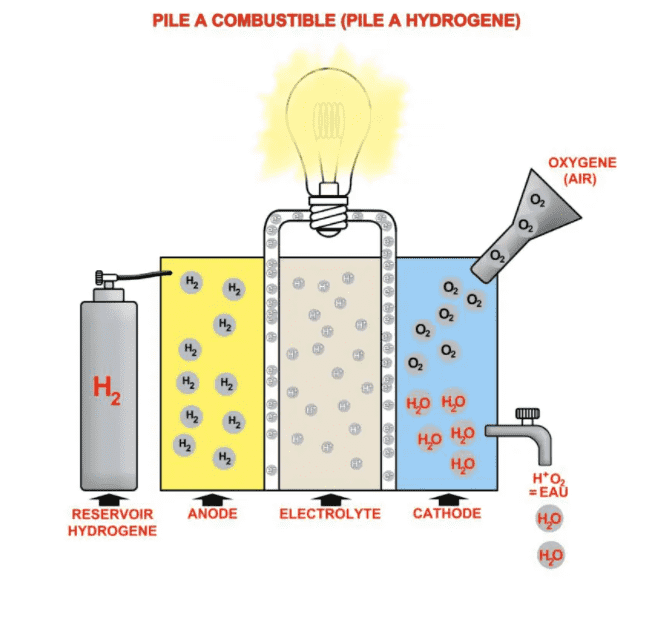
Indeed, combined with a fuel cell, this energy does not emit CO2. Water is the only discharge from a fuel cell. As we will see, this question is not as simple as it is necessary to take into account the entire life cycle.
As mentioned, hydrogen is a vector and is not present in its pure state in nature. It is therefore necessary to mobilize energy to extract it, transport it, transform it. It is certainly much less polluting than other alternatives, but not without any CO2 emissions.
The climate emergency favors the emergence of renewables. By definition, these means of production are Intermittent. They only produce when conditions permit.
There is a process involving hydrogen that makes it possible to overcome this problem:
We can therefore imagine that, when the network is in energy deficit, we can then use these reserves to produce electricity.
One of the most important climate issues is the transport sector. The transport of goods or people consumes a lot of energy.
One of the solutions considered to decarbonize this sector is therefore hydrogen. Indeed, today, the majority of transport operates on fossil fuels. The transport sector accounts for around 30% of France's global emissions.
We can therefore imagine vehicles that run on hydrogen. The combustion of this gas only produces water, this property makes it a serious candidate as the fuel of the future. This is a hydrogen engine.
There is also the possibility of installing a fuel cell to equip vehicles. Many manufacturers are interested in the possibility of installing a battery that supplies the car with electricity. In this case, hydrogen solves the problem of the autonomy of electric vehicles.
The efficiency of hydrogen in a fuel cell is nearly 50% (which is exceptional). From a technical point of view, it is the opposite of electrolysis. Here we are talking about a mixture of air and hydrogen.
Inside the battery, hydrogen energy is then converted into electrical energy.
Beyond these two examples, there are numerous applications of hydrogen. As such, we can cite:
The following diagram summarizes well the different uses of this energy of the future:
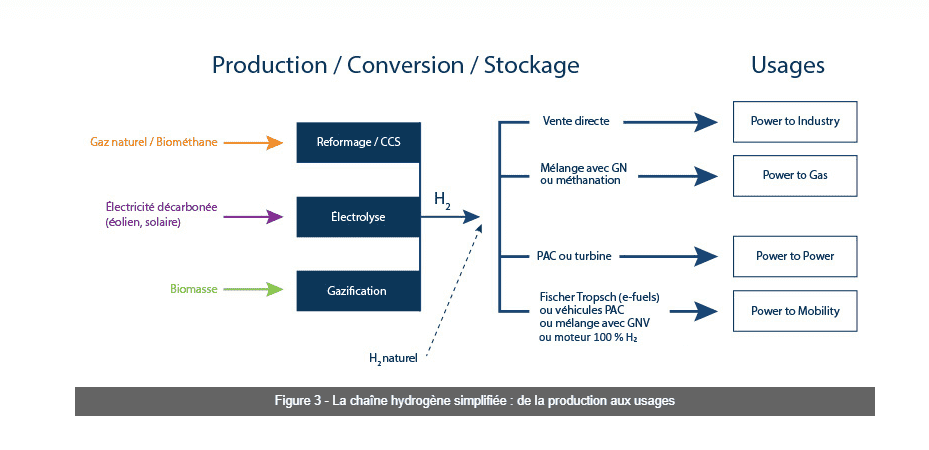
Source: IFP Energies Nouvelles
There are several ways to produce hydrogen. Some of them consume fossil fuels. Even if the future use of hydrogen only releases water, initial production can be a problem.
Today, the observation is simple: a majority of the initial production of electricity or hydrogen (depending on the process chosen) is of fossil origin.
The energy transition should allow us to reduce our CO2 emissions, so we must favour a renewable energy source. It is for this reason that we distinguish several “types” of hydrogen :
The development of the hydrogen sector requires heavy investments throughout the production chain, whether in terms of production, transport or even the storing.
It is absolutely necessary to succeed in reducing the costs of fuel cells or even those of electrolysers. This is the prerequisite for the large-scale emergence of this technology.
Not all processes are equivalent. Today, the electrolysis process is more expensive than other means of production such as steam reforming or reforming with CO2 capture.
The Hydrogen Council estimates that around 20 billion euros of investment are needed per year to reach a critical size in ten years. This amount may seem large, but it is currently more than 30 times less than the funds allocated to investments in oil.
In this respect, we should highlight the announcements made by the government on this subject. Barbara Pompili, Minister for Ecological Transition, and Bruno Le Maire, Minister of the Economy, announced an investment of 7 billion euros over ten years.
Hydrogen certainly has undeniable qualities, but also flaws. Beyond the general reflection on the energy sources used to create electricity (coal, gasses, etc.), the problem is essentially financial.
To enable hydrogen to fulfill its role properly, it would therefore be necessary to increase the proportion of non-carbon electricity (nuclear or ENR) in the global energy mix. This therefore requires additional investments. The support of the public authorities is therefore essential in this problem.
To go further, do not hesitate to consult our article to know Energy sources that we have not yet exploited.
You are a venture and do you feel lost in the jungle of natural gas and electricity offers? Are you wondering what is the best energy contract for your business?
SirEnergies offers you an offer adapted to the specificity of your business, regardless of your size.
Click below for more information:
In a few clicks, organize an exchange with one of our experts.


weekly newsletter subscribers

4.9
