




Summarize with AI

March 6, 2026
9
Min reading
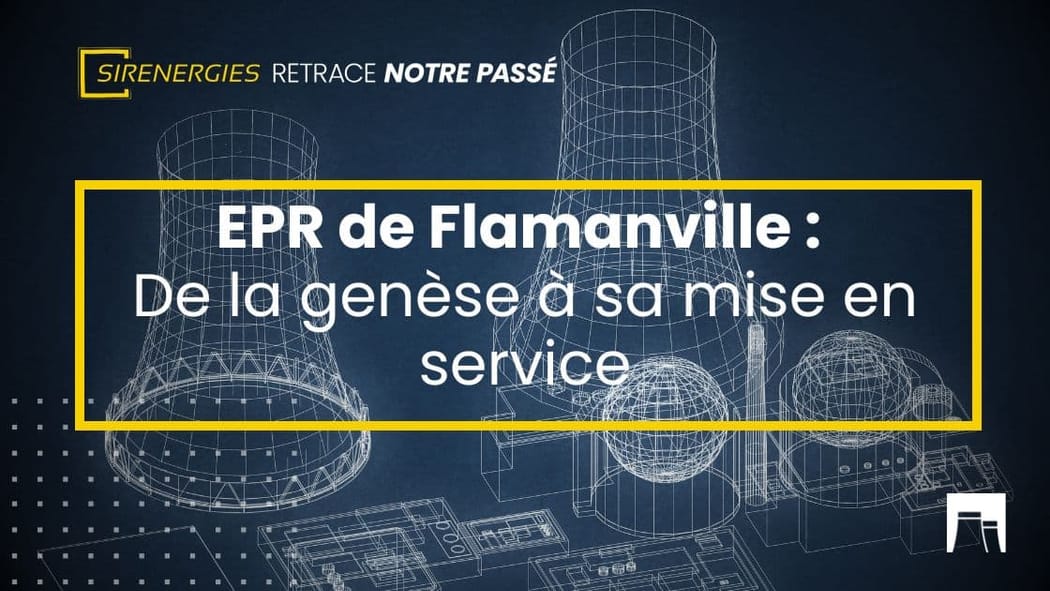
“Imminent.” This is the adjective used on Saturday July 6, 2024 by Luc Rémond, CEO of EDF, to announce the first nuclear fission reaction at the Flamanville EPR reactor. Its commissioning is expected this summer, after the authorization granted on May 7, 2024 by Nuclear Safety Authority (ASN).
The most powerful nuclear reactor in the world, the EPR is an efficient and safe version of second-generation pressurized water reactors. Its construction integrates all recent advances in safety, reduction of environmental impact and technical performance for safe, competitive and low-carbon electricity production.
After its commissioning, France will be the third country in the world to have an EPR, after China and Finland. Between hopes, oppositions, delays and financial excesses, plunged into the troubled history of the construction of the Flamanville EPR.
At the end of the 20th centuryE Century, the question of renewing the French nuclear fleet began to arise. Energy consumption is constantly increasing.
The environmental issue is emerging on the international scene, with the signing of the Kyoto Protocol in 1997. It is in this context that the EPR is designed, a safer, more profitable and low-carbon nuclear reactor.
EPR stands for European Pressurized Reactor, translated into French as “European pressurized reactor”. This Third-Generation Evolutionary Technology Was designed in the 1990s as part of a partnership between France and Germany.
Pressurized Water Nuclear Reactor (PWR), the EPR does not represent Not a technological breakthrough. He Operates on the same principle as second-generation nuclear power plants. The fission of uranium atoms Produces heat. It transforms water into steam to activate a turbine and produce electricity.
In the 1990s, the EPR seemed the ideal candidate for renewing the French nuclear fleet.
A modern version of the pressurized water reactors (PWR) already in operation in France, the EPR is adapted to existing nuclear sites and electrical infrastructures.
With 1,600 MW of capacity, it is More Powerful and More Profitable. According to EDF, the EPR could “Produce 22% more electricity than a traditional reactor from the same quantity of nuclear fuel.”
With its redundant safety systems and its thick concrete containment envelope, the EPR is finally More secure Than his second-generation big brother. Its lifespan is estimated at 60 years., which is 20 years longer than current nuclear power plants.
The EPR has three objectives: Strengthening Nuclear Safety, Improve Economic Profitability power plants, Reduce environmental impact of electrical production.
The EPR Project was Initiated in 1989 by Framatomet and Siemens, joined by EDF and its German counterparts. But France is not yet ready for this evolution.
In 1999, the government led by Lionel Jospin refused the creation of an EPR in France. In the 2000s, a change in political majority paved the way for its construction.
After many years devoted to the analysis of safety objectives, The Authorization Decree Creation of the Flamanville 3 Nuclear Reactor Was published in April 2007. Work began at the end of 2007 with commissioning scheduled for 2012.
After numerous challenges posed by construction, the Nuclear Safety Authority (ASN) gave its Green Light for Commissioning, 12 years late.
Located in Normandy, the Flamanville Nuclear Power Plant was commissioned in 1985. Two second-generation nuclear reactors produce between 15 and 17 GWh each year.
Originally, the site was designed to House Four Reactors, which offered the Area required for the construction of the new EPR. The site has a second advantage: its Proximity to the Sea, facilitating access to a cooling source. Even at the time of Heat wave, seawater maintains a temperature adapted to nuclear power use, without flow constraints.
A serial leader and prototype, the Flamanville EPR has encountered numerous obstacles. Initially lasting 5 years, the project lasted 17 years to build a secure and robust EPR, meeting ASN safety criteria.
The EPR differs from second-generation nuclear reactors, mainly by Its enhanced design and safety:
After 18 months of preparatory work, The first concrete was poured on December 3, 2007. The first few years are devoted to the structure. The assembly of the turbine began three years later, in December 2010.
The Control Room was installed in 2011. The construction of the nuclear reactor began in 2012, symbolized in 2013 by the Installation of the reactor building dome.
The First Deferral of Commissioning Was announced in 2014 after the discovery of the non-conformity of the lid and the bottom of the nuclear reactor vessel.
Les Overall “cold” and “hot” tests Start in 2017 for a period of three years. Nuclear fuel is delivered in 2021, after authorization from ASN. The same year, the Minister for Ecological Transition gave EDF permission to operate the Flamanville EPR. But the commissioning was again postponed to allow the welds to resume.
Les Overall requalification tests (ERE) take place in the fall of 2023. After successful tests, the verification of 400 safety and availability criteria and a Public consultation, ASN issues the commissioning authorization on 7 May 2024.
Throughout the project, EDF had to overcome technical challenges. Cracks in the concrete slab, anomalies in certain iron reinforcements, and manufacturing defects in the liner intended to seal the containment chamber punctuated the beginnings of the project.
In 2014, a Anomaly in the Manufacture of the Steel of the Lid and the Bottom of the Tank of the Flamanville EPR reactor is discovered.
After the justification of Areva NP (which became Framatomé again in 2018), ASN and IRSN Declare that the bottom of the tank is suitable, subject to periodic checks. On the other hand, the replacement of the lid is already planned after a first operating cycle.
In 2017, Non-conformities are noted at the level of the welds of the main secondary circuit, ensuring the transfer of water vapor to the turbine. The Risk of Breakage Has proven. Solder differences are also observed on the primary circuit.
Of Upgrade Work are committed in 2020. This complex project, using remote-operated tools and a new stress-relieving heat treatment (TTD) process for the first time, required many months of studies and qualifications.
Since the authorization for commissioning on May 7, 2024, EDF has initiated the Start-up procedure, under the close supervision of ASN.
As of May 8, 2024, the Loading uranium In the reactor vessel has begun. Of Precritical tests Were carried out in June 2024, with the temperature of the main primary circuit and the main secondary circuits rising to more than 110°C.
The next stage is expected to take place by the end of July. It's about the Reactor Discrepancy, that is, the start of the nuclear fission chain reaction. It Will Be Followed By The Connecting the turbine to the electrical network.
The effective start of nuclear power production can then begin. The tests are carried out in stages. The Increase in Power is Gradual, Punctuated by ASN agreements authorizing the continuation of tests.
An initial inspection by the Nuclear Safety Authority is planned for 25% threshold Of the power of the EPR. ASN then check the calibration of the reactor protection system.
The Authority intervenes a second time at the 80% power threshold to ensure that the installation complies with its safety demonstration. The aim is toReach 100% of the power of the nuclear reactor by the end of 2024.
Additional inspections are planned throughout the start-up and testing phases.
After the start of production, Work will have to be desired. ASN commissioning authorization is subject to Replacement of several pieces of equipment in the coming years.
The Replacing the tank lid is already planned 18 months after the start, during the first fuel recharge.
Two Valve protection Main Secondary Circuits will have to be changed within six years, and the Exchangers Between the intermediate refrigeration (RRI) and rescued raw water (SEC) circuits must also be replaced before the first ten-year visit.
It is still early to draw up an economic and environmental assessment of the EPR project in Flamanville. Its construction is above all synonymous with additional costs. Will they be able to be offset by the reduction in the cost of nuclear electricity production and the reduction of the environmental impact? The issue remains unresolved.
From an economic point of view, the Flamanville EPR shines mainly for its Local Economic Benefits.
In the Normandy region, its construction mobilized 800 employees of EDF and 2,000 employees of service companies. A total of 1,400 job seekers were recruited and trained. Around this major project, 58 infrastructure projects Have been carried out in connection with roads, construction, renovation, childhood, health or sport.
The National Economic Record is much more mixed.. The Flamanville EPR is singled out for its Excesses. Initially estimated at 3.3 billion euros, its construction is now valued at 13.2 billion euros by EDF, i.e. four times the initial budget.
In total, the Court of Auditors figures the investment at 19.1 billion euros, including the commissioning of the nuclear reactor and loan interest. Will the financial and technical gains match these additional costs? According to the Court of Auditors, this remains to be confirmed.
According to EDF, EPR technology Reduced the quantity of Radioactive nuclear waste. The EPR consumes 17% less uranium compared to 1,300 MW nuclear reactors. The most complete fission of uranium Generates less irradiated material.
The EPR should also In the long term, be able to use 100% MOX fuel recycled, a mixture of uranium oxide and plutonium oxide.
The EPR also improved to the reduction of CO emissions2 And to decarbonization, with its Low-carbon mode of electricity production. According to ADEME, The nuclear kWh emits 6 g CO2 Against 418 g of CO2 For the Gas Power Plants, 1.058 g CO2 For coal-fired power plants, 10g CO2 for wind power and 30g for solar photovoltaic.
Despite these good environmental results, the EPR remains A subject of controversy. Its construction was not without impact on the environment. But it is especially the Legitimate question of nuclear waste and its management Which continues to crystallize the opposition to Nuclear Energy.
The commissioning of the Flamanville EPR marks the end of a 35-year journey. Despite technical challenges, operational setbacks and oppositions, electricity production should start this summer 2024 and reach total power at the end of the year.
Future nuclear flagship in France, the Flamanville EPR is part of France's energy transition and decarbonization strategy.
This feedback opens the way to a version of a nuclear reactor that is easier to build: the EPR2. France aims to build six EPR2 and eight additional EPR2, with the first commissioning in 2035 at the Penly nuclear power plant site in Normandy.
In a few clicks, organize an exchange with one of our experts.


weekly newsletter subscribers

4.9

.png)

Farms are subject to taxes such as TICFE or TICGN. Sirenergies verifies their application, identifies cases of exemption and accompanies the procedures to reduce the tax burden.
These are signals sent by RTE during periods of tension on the electrical network. The Sirenergies tool informs you in real time to anticipate your uses.
Some businesses may obtain a partial or total exemption from the TICFE or the TICGN, depending on their activity and energy intensity. The support of an expert makes it possible to identify the eligibility criteria and to put together the file.
C'est l'indicateur d'efficacité d'un appareil électrique ; il représente le ratio entre la puissance active (utile) et la puissance apparente (totale).
Le kVA mesure la capacité maximale que votre compteur peut supporter à un instant T, tandis que le kWh mesure la quantité d'énergie consommée sur une durée.
The €/MWh is a price unit used in wholesale markets, while kWh is the unit visible on your bills.
En 2025, la France a atteint un solde exportateur net de 92,3 TWh, battant le précédent record de 2024 (89 TWh).
This makes it possible to choose the right time to contract, secure your budgets and anticipate increases.
One invoice consists of several elements: consumption, supplier share, taxes and contributions. The analysis of each line makes it possible to identify possible errors and to check the consistency with the signed contract.
Le transport (RTE) correspond aux "autoroutes" de l’électricité. Il s’agit de transporter de très grandes quantités d'énergie sur de longues distances, depuis les centrales de production (nucléaires, barrages, parcs éoliens offshore) vers les régions de consommation.
La distribution (Enedis) s'apparente aux "routes départementales" et aux rues. Elle récupère l'électricité à la sortie du réseau de transport pour la livrer directement chez le client final, en abaissant la tension pour qu'elle soit utilisable par vos appareils.
Communities are subject to taxes such as TICFE or TICGN. Sirenergies analyzes invoices, identifies exemption possibilities and fixes possible errors to reduce the tax burden.
Parce que la puissance souscrite en kVA détermine le prix de l'abonnement et que tout dépassement peut entraîner des surcoûts importants.
The subscribed power must be calculated according to the consumption profile and uses (heating, industrial processes, tertiary equipment). One fine analysis makes it possible to ensure the adequacy between real need and contract.
Exceeding capacity leads to financial penalties and can impact the size of the contract. Adjust the correctly subscribed power makes it possible to avoid these additional costs.
The industry is concerned by TICFE, TICGN and other contributions that may represent an important part of invoices. Sirenergies identifies cases of exemption and accompanies the procedures to benefit from them.
Ce record de 92,3 TWh s'explique par la conjonction de trois facteurs :
The range E @sy is available in four pricing structures to adapt to each risk profile:
Sourcing consists in identifying and analysing the offers of several electricity and gas suppliers. This approach makes it possible to obtain contracts adapted to the consumption profile and budgetary constraints of the company.
Tertiary companies are concerned by taxes such as TICFE or TICGN. Sirenergies checks the accuracy of invoices, identifies possible exemptions, and helps correct errors to sustainably reduce costs.
Oui, elle est considérée comme une énergie renouvelable à faibles émissions de gaz à effet de serre.
De plus, l'eau ne subit aucune transformation chimique durant le cycle de production et réintègre son milieu naturel en aval.
Cependant, la construction de barrages nécessite des mesures pour protéger les écosystèmes (débit minimum, passes à poissons).
In 2025, the supplier had a NPS (Net Promoter Score) of +16 and a note of 4,17/5.
Satisfaction is based on a “zero solicitation” model and 100% in-house customer service in Toulon, guaranteeing proximity and responsiveness that cannot be found with major historical suppliers.
L'abondance de production française tire les prix du marché de gros vers le bas.
En vertu du mécanisme de l'Ordre de Mérite (Merit Order), les centrales les moins coûteuses (nucléaire, renouvelables) couvrent la demande plus souvent, évinçant les centrales à gaz ou charbon plus onéreuses.
Cela multiplie les épisodes de prix bas, voire négatifs, sur le marché spot.
C'est le levier le plus rapide pour obtenir des résultats visibles. L'éclairage représente environ 40 % de la consommation d'électricité d'une commune.
Passer au LED avec pilotage intelligent permet de réduire la facture de 50 à 80 %, avec un retour sur investissement (ROI) rapide, souvent estimé à 2 ou 3 ans.
Le processus repose sur l'utilisation de la force de l'eau (énergie cinétique) issue des courants, des chutes d'eau ou des dénivelés. Le fonctionnement suit trois étapes clés :
Le dispositif ARENH a laissé place au VNU (Versement Nucléaire Universel).
Ce changement structurel expose davantage les entreprises aux prix de gros, rendant la gestion des risques plus complexe qu'auparavant.
Il devient alors indispensable de définir une stratégie d'achat d'électricité avec Sirenergies pour lisser l'impact de la volatilité des marchés sur votre budget.
Un appel d’offres permet de mettre en concurrence plusieurs fournisseurs d’électricité et de gaz afin d’obtenir des conditions contractuelles optimisées. C’est une démarche transparente qui permet de choisir l’offre la plus adaptée aux besoins budgétaires et techniques de l’organisation.
Tertiary companies must manage their energy costs while guaranteeing the comfort of users (offices, shops, services). Consumption is often linked to heating, air conditioning and lighting, which requires precise monitoring to avoid budgetary excesses.
Yes. The supplier guarantees an offer 100% renewable via the official Guarantees of Origin (GO) mechanism.
For the most demanding companies, the offer GREENVOLT+ ensures very low carbon intensity electricity, sourced exclusively from independent French producers (hydraulic, wind, solar).
Among the taxes include TICFE, TICGN, CTA, CJA and TURPE. They represent a significant part of the bill and vary according to consumption profiles. Understanding them well is essential to optimize costs.