




Summarize with AI

January 21, 2026
8
Min reading

Has France lost energy sovereignty?
In any case, this is the title of a parliamentary information report published in March 2023. The report highlights the successive mistakes made by governments that posed the threat of a blackout in the winter of 2022/2023.
In question? The energy destabilization linked to the war in Ukraine, but also the cessation of the production of a quarter of the nuclear fleet.
Since then, France's energy situation has returned to normal.
But is our country's energy future secure? Is France really sovereign in the energy field? Can nuclear energy save France?
Between strengths and weaknesses, a portrait of a France under tension in the face of energy challenges.
Since 2022 and its first appearance in French law, energy sovereignty has been at the heart of political discourse. But what does this concept mean in practice? Can we say that France is sovereign in the energy field?
Energy sovereignty is the capacity of a country to meet all of its national needs thanks to a secure supply And to a control of the entire energy chain, from production to consumption, including transport and storage.
Energy sovereignty does not mean autonomy. A sovereign country can secure its supply by relying on international cooperation and imports.
This concept also includes the ability to make sovereign decisions in the field of energy.
Energy sovereignty is an issue for France, especially economic. Securing the supply of electricity and gas, by maintaining affordable energy prices, protects the competitiveness of businesses and the purchasing power of households.
The winter of 2022/2023 raised doubts about France's energy sovereignty. However, despite the periodic tensions, Until now, France has maintained its position as a sovereign energy power through a determined, adaptive and resilient policy.
The French energy strategy is based on strong sovereign decisions, like:
But if France is a sovereign energy power, is it independent in this area? According to the commission of inquiry into the loss of sovereignty and energy independence in France, “energy independence seems to be a mirage.” The main weakness of our country is based on a subsoil poor in fossil natural resources and the obligation to import gas, oil, coal, liquefied natural gas (LNG) and uranium.
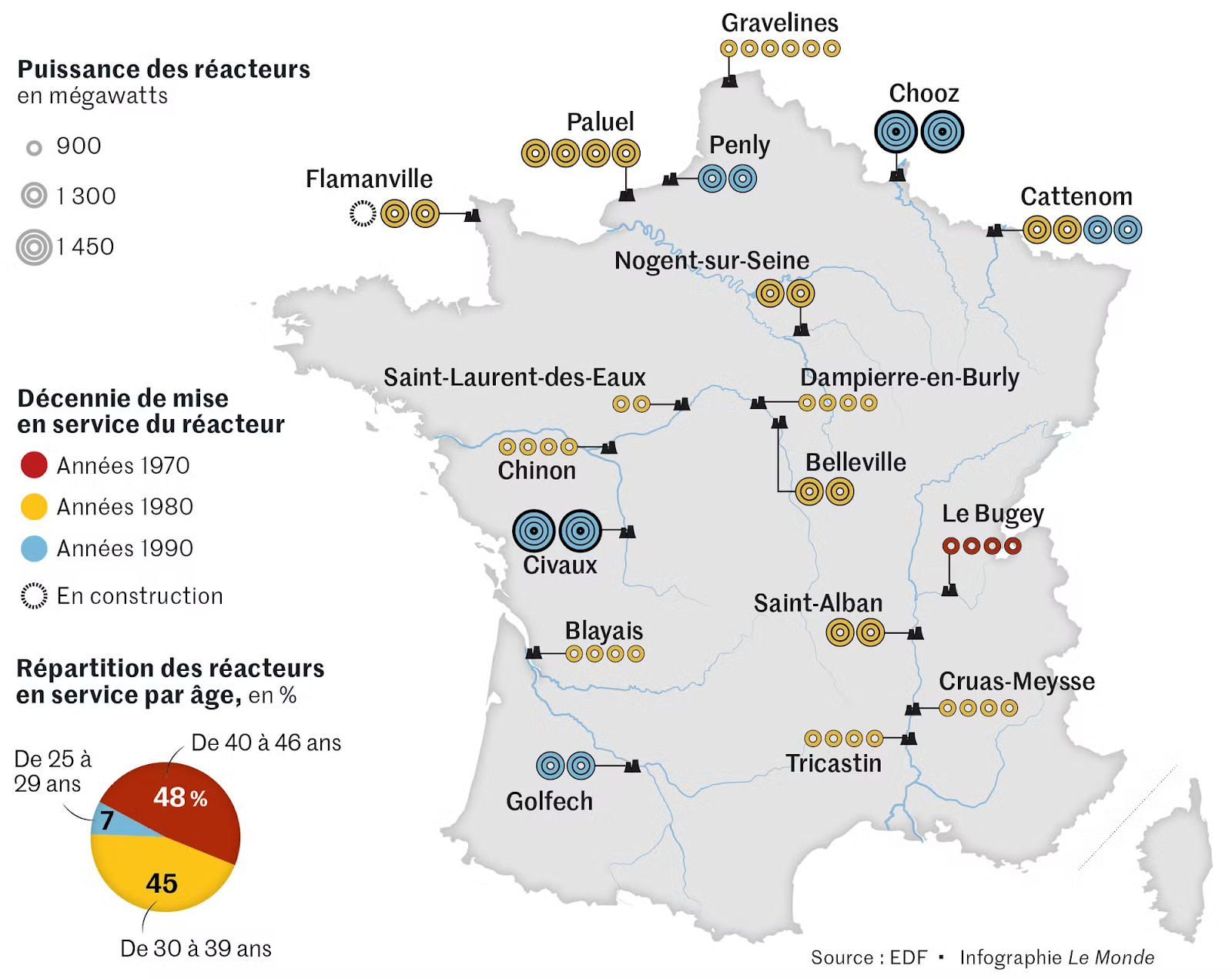
As early as 1974, France made the choice of “all nuclear” to protect its energy sovereignty. This bias has given rise to 57 nuclear reactors, the foundation of national energy sovereignty.
It is thanks to nuclear energy that France is showing One of the lowest energy dependence rates in Europe (56.3% in 2023).
Nuclear is the primary source of national electricity production. After a historic drop in 2022 due to corrosion problems, nuclear production returned to its 2021 level in 2024 with 361.7 terawatt hours (TWh) produced. France remains the 3rd largest nuclear producer in the world, after the United States and China.
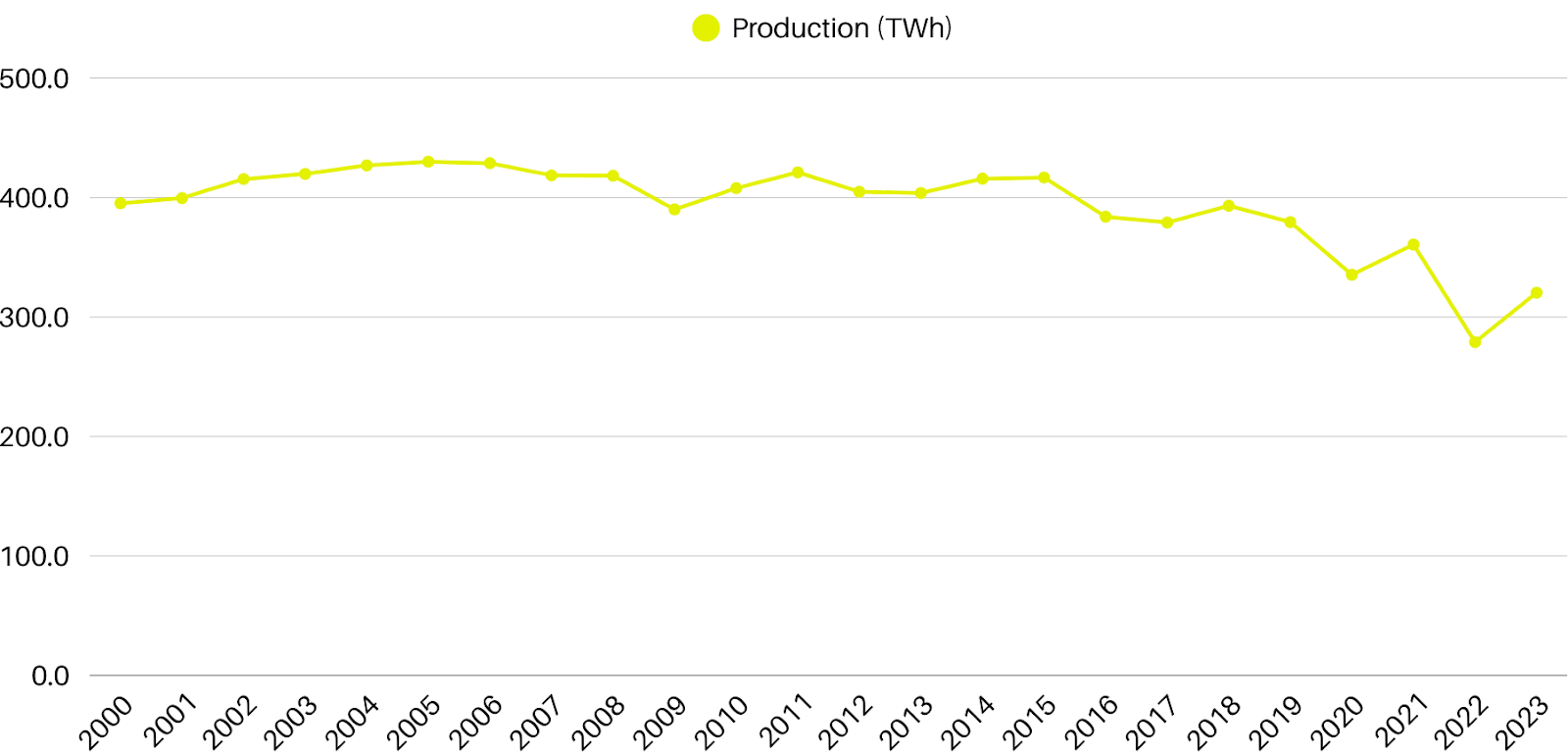
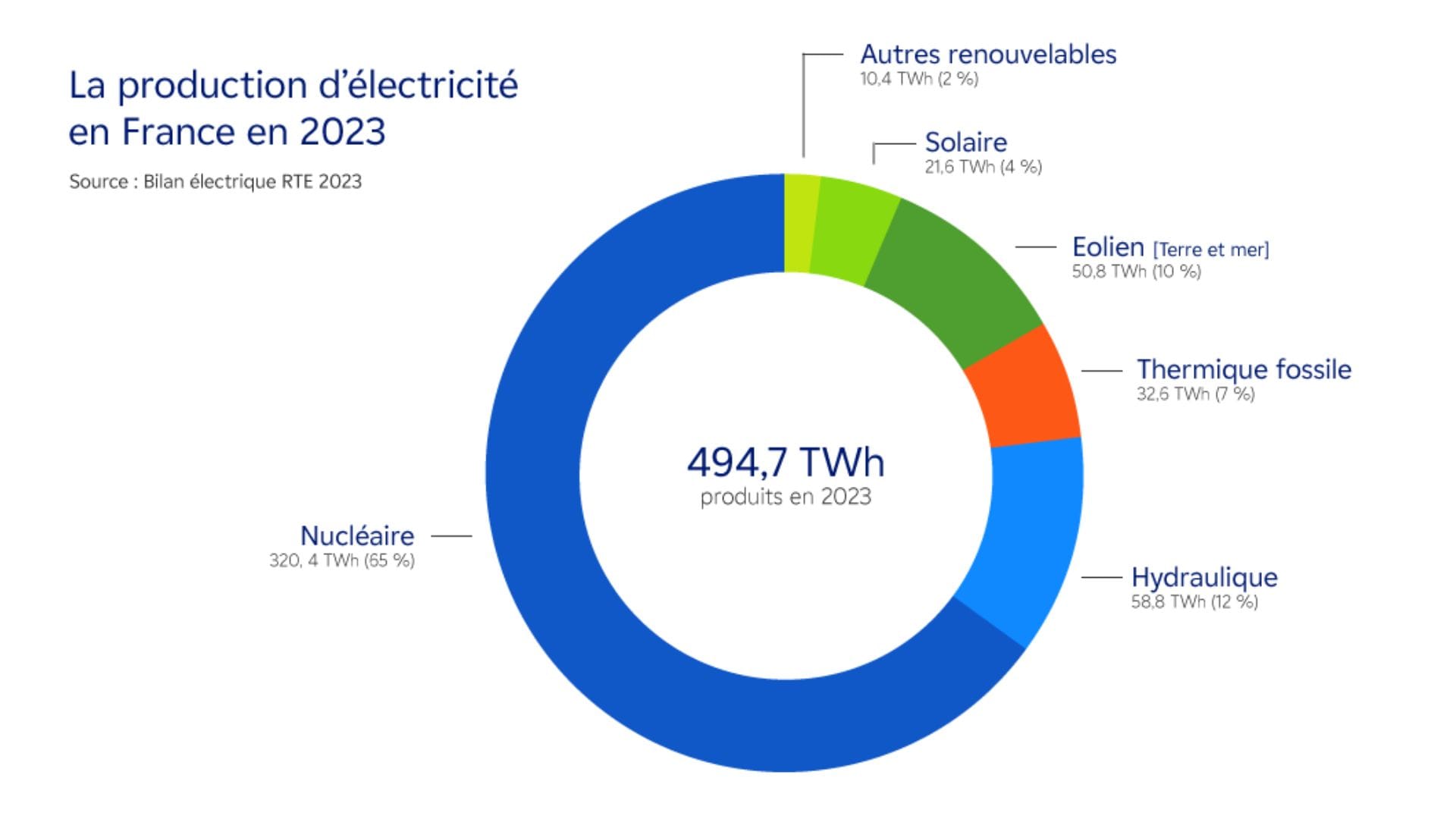
Nuclear energy represents 65% of the French energy mix, followed by hydroelectricity and fossil fuels.
Nuclear electricity has many other advantages in maintaining France's competitiveness and supporting its energy transition.
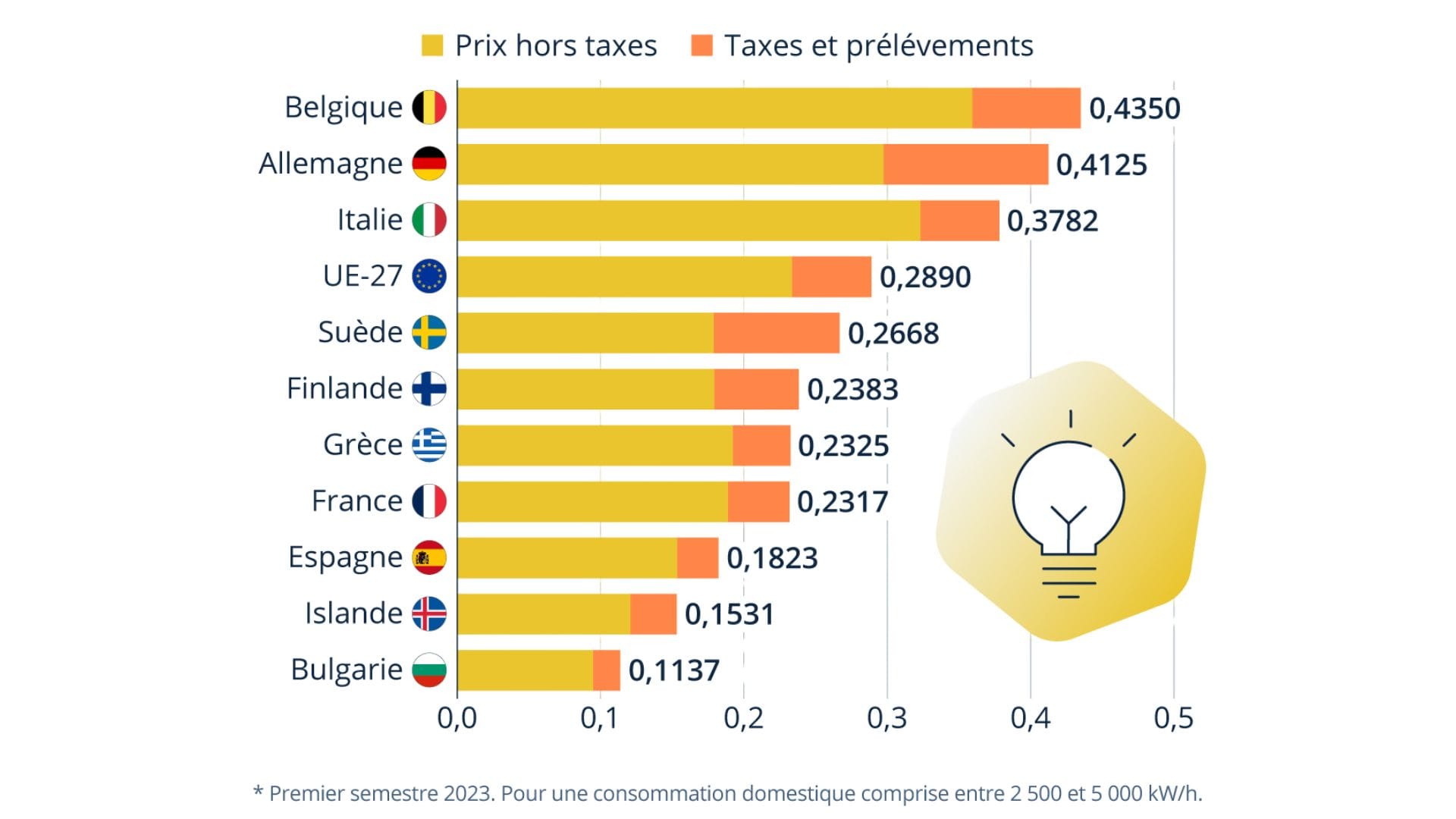
Thanks to nuclear power, France is showing a competitive electricity prices, lower than the average for the states of the European Union.
Nuclear production is also a An asset to reduce Greenhouse gas emissions and fight against global warming. Nuclear energy shows a carbon footprint almost zero. According to ADEME, The nuclear kWh emits 6 g of CO2, against 418 g of CO2 for gas-fired power plants and 1,058 g of CO2 for coal-fired power plants.
What place for nuclear power in France's future energy strategy?
In his Belfort speech in 2022, President Emmanuel Macron reaffirmed the place of nuclear power alongside renewable energies to reconcile energy transition and energy sovereignty.
The Belfort speech announces the three axes of the national energy strategy to get France out of fossil fuels and achieve carbon neutrality in 2050: relaunch civil nuclear power, accelerate renewable energies and support energy sobriety.
The message from the state is clear. Energy sovereignty is based on complementarity of nuclear electricity and renewable energies, not on their opposition.
The first results of this energy mix strategy are there. In 2024, For the first time, low-carbon production exceeded the threshold of 95% of electricity produced in France. This record announced by RTE is the combination of a rapid recovery in nuclear production and exceptional renewable production (hydraulic, wind and solar production).
In his Belfort speech, President Emmanuel Macron also hears “Establishing energy sovereignty on industrial sovereignty”.
Concretely, it is about supporting the green industry development to create jobs that cannot be relocated and to guarantee national energy independence.
This desire is reflected in the green industry law of October 23, 2023 intended to promote the decarbonized reindustrialization of France. It is also manifested by a financial support for renewable and low-carbon sectors (solar sector, methanization sector, hydrogen sector...) via purchase prices, public subsidies or massive investments.
Nuclear is a strength for France's energy sovereignty. But it's also his weakness. The park is aging. To maintain its energy sovereignty, France must secure its nuclear production.
With the electrification of uses, electricity needs are constantly growing. They should reach 700 TWh by 2050. Modernizing the nuclear fleet French is essential to answer them.
If power plants are designed for a minimum operating period of 40 years, technical progress makes it possible to exceed this threshold. In 2021, theNuclear safety authority blew the first lock by authorizing the extension up to 50 years of the operation of 900 MW reactors.
Since then, the discussion has continued. In a report published in July 2024, Senators recommend “extending beyond 60 years, in strict compliance with safety standards, a maximum of reactors in the current nuclear fleet.” In December 2024, ASN confirmed this possibility.
For its part, EDF is preparing. Since 2014, the group has been carrying the Grand Carénage Project in order to renovate, modernize and guarantee the sustainability of the qualification of equipment after 40 years.
The revival of civil nuclear power is also based on construction of new generation reactors with increased security and higher efficiency. The State thus intends to build at least six EPR2, a figure that could rise to 14.
In addition, one billion euros of investments are planned in the SMR development (Small Modular Reactors). Less powerful than EPR2 but smaller and more flexible, SMRs make it possible to cover local electricity demand on a small scale. To learn more about the differences between EPR and SMR, see This article.
The main weakness of French nuclear power is its raw material: France no longer has natural uranium deposits.
However, France needs 8,000 to 9,000 tons of uranium per year. All must be imported from Niger, Kazakhstan, Australia, Australia, Canada or Uzbekistan.
Supplier of uranium for EDF, the Orano group focuses on diversification of sources And long term contracts over twenty years to secure supply.
France also has ten years of stock in the form of natural uranium and depleted uranium.
Chernobyl, Fukushima: these tragedies have marked the collective memory. Nuclear energy is inflaming debates. She raises legitimate debates on safety, the management of radioactive waste or the import of uranium. However, nuclear power in France has not No major crises have ever been experienced, thanks to strict supervision and regulation by ASN.
Another controversy: costs. The construction of six EPR2 reactors is estimated at 52 billion euros over a period of 25 years. A small SMR modular reactor should cost between 100 million and 1.5 billion euros.
While these figures are dizzying and obviously need to be optimized, these investments remain the key to the decarbonization of France and its energy sovereignty.
Nuclear energy remains the cornerstone of France's energy sovereignty. It's also his Achilles heel. Even the smallest pitfall in nuclear production can threaten energy supplies, as the winter of 2022/2023 proved.
The energy future is no longer being played out on a single front: only the combination of robust nuclear production and efficient renewable energies will allow France to maintain control of its production. While total independence is a utopia, national energy sovereignty imposes bold and responsible strategic choices, in line with the challenges of the 21st century.E century.
In a few clicks, organize an exchange with one of our experts.

weekly newsletter subscribers

4.9

.png)

Communities are subject to taxes such as TICFE or TICGN. Sirenergies analyzes invoices, identifies exemption possibilities and fixes possible errors to reduce the tax burden.
The subscribed power must be calculated according to the consumption profile and uses (heating, industrial processes, tertiary equipment). One fine analysis makes it possible to ensure the adequacy between real need and contract.
C'est l'indicateur d'efficacité d'un appareil électrique ; il représente le ratio entre la puissance active (utile) et la puissance apparente (totale).
Tertiary companies are concerned by taxes such as TICFE or TICGN. Sirenergies checks the accuracy of invoices, identifies possible exemptions, and helps correct errors to sustainably reduce costs.
Parce que la puissance souscrite en kVA détermine le prix de l'abonnement et que tout dépassement peut entraîner des surcoûts importants.
This makes it possible to choose the right time to contract, secure your budgets and anticipate increases.
Farms are subject to taxes such as TICFE or TICGN. Sirenergies verifies their application, identifies cases of exemption and accompanies the procedures to reduce the tax burden.
Some businesses may obtain a partial or total exemption from the TICFE or the TICGN, depending on their activity and energy intensity. The support of an expert makes it possible to identify the eligibility criteria and to put together the file.
L'abondance de production française tire les prix du marché de gros vers le bas.
En vertu du mécanisme de l'Ordre de Mérite (Merit Order), les centrales les moins coûteuses (nucléaire, renouvelables) couvrent la demande plus souvent, évinçant les centrales à gaz ou charbon plus onéreuses.
Cela multiplie les épisodes de prix bas, voire négatifs, sur le marché spot.
Le processus repose sur l'utilisation de la force de l'eau (énergie cinétique) issue des courants, des chutes d'eau ou des dénivelés. Le fonctionnement suit trois étapes clés :
The range E @sy is available in four pricing structures to adapt to each risk profile:
Yes. The supplier guarantees an offer 100% renewable via the official Guarantees of Origin (GO) mechanism.
For the most demanding companies, the offer GREENVOLT+ ensures very low carbon intensity electricity, sourced exclusively from independent French producers (hydraulic, wind, solar).
Ce record de 92,3 TWh s'explique par la conjonction de trois facteurs :
C'est le levier le plus rapide pour obtenir des résultats visibles. L'éclairage représente environ 40 % de la consommation d'électricité d'une commune.
Passer au LED avec pilotage intelligent permet de réduire la facture de 50 à 80 %, avec un retour sur investissement (ROI) rapide, souvent estimé à 2 ou 3 ans.
En 2025, la France a atteint un solde exportateur net de 92,3 TWh, battant le précédent record de 2024 (89 TWh).
Un appel d’offres permet de mettre en concurrence plusieurs fournisseurs d’électricité et de gaz afin d’obtenir des conditions contractuelles optimisées. C’est une démarche transparente qui permet de choisir l’offre la plus adaptée aux besoins budgétaires et techniques de l’organisation.
Le kVA mesure la capacité maximale que votre compteur peut supporter à un instant T, tandis que le kWh mesure la quantité d'énergie consommée sur une durée.
Sourcing consists in identifying and analysing the offers of several electricity and gas suppliers. This approach makes it possible to obtain contracts adapted to the consumption profile and budgetary constraints of the company.
Among the taxes include TICFE, TICGN, CTA, CJA and TURPE. They represent a significant part of the bill and vary according to consumption profiles. Understanding them well is essential to optimize costs.
Tertiary companies must manage their energy costs while guaranteeing the comfort of users (offices, shops, services). Consumption is often linked to heating, air conditioning and lighting, which requires precise monitoring to avoid budgetary excesses.
The industry is concerned by TICFE, TICGN and other contributions that may represent an important part of invoices. Sirenergies identifies cases of exemption and accompanies the procedures to benefit from them.
Exceeding capacity leads to financial penalties and can impact the size of the contract. Adjust the correctly subscribed power makes it possible to avoid these additional costs.
In 2025, the supplier had a NPS (Net Promoter Score) of +16 and a note of 4,17/5.
Satisfaction is based on a “zero solicitation” model and 100% in-house customer service in Toulon, guaranteeing proximity and responsiveness that cannot be found with major historical suppliers.
Le transport (RTE) correspond aux "autoroutes" de l’électricité. Il s’agit de transporter de très grandes quantités d'énergie sur de longues distances, depuis les centrales de production (nucléaires, barrages, parcs éoliens offshore) vers les régions de consommation.
La distribution (Enedis) s'apparente aux "routes départementales" et aux rues. Elle récupère l'électricité à la sortie du réseau de transport pour la livrer directement chez le client final, en abaissant la tension pour qu'elle soit utilisable par vos appareils.
Oui, elle est considérée comme une énergie renouvelable à faibles émissions de gaz à effet de serre.
De plus, l'eau ne subit aucune transformation chimique durant le cycle de production et réintègre son milieu naturel en aval.
Cependant, la construction de barrages nécessite des mesures pour protéger les écosystèmes (débit minimum, passes à poissons).
One invoice consists of several elements: consumption, supplier share, taxes and contributions. The analysis of each line makes it possible to identify possible errors and to check the consistency with the signed contract.
Le dispositif ARENH a laissé place au VNU (Versement Nucléaire Universel).
Ce changement structurel expose davantage les entreprises aux prix de gros, rendant la gestion des risques plus complexe qu'auparavant.
Il devient alors indispensable de définir une stratégie d'achat d'électricité avec Sirenergies pour lisser l'impact de la volatilité des marchés sur votre budget.
These are signals sent by RTE during periods of tension on the electrical network. The Sirenergies tool informs you in real time to anticipate your uses.
The €/MWh is a price unit used in wholesale markets, while kWh is the unit visible on your bills.