

Hotels and chains: 2 to 5-star hotels and luxury properties
Hoteliers, take control of energy use in every room
An empty room still needs heating or cooling, and hot water must be ready by 7 a.m. From boiler rooms in winter to air conditioning in summer, plus kitchens, spas, and pools: a hotel's energy needs follow two seasons and two bills. Sirenergies supports you in purchasing your gas and electricity and fine-tuning your power requirements.



Key industry figures
Rooms, boilers, and air conditioning: the energy footprint of a hotel
A hotel consumes energy day and night, all year round, with winter heating and summer air conditioning relying on different energy sources. Without a dual-contract purchasing strategy, you end up paying a premium for peak usage each season.
2 to 5-star hotels in operation in France in 2025.
Share of heating in the energy consumed by small and medium-sized accommodations.
Share of tourism-related floor space reported on OPERAT already compliant with the 2030 target.
Quelques industriels qui nous font confiance




The energy profile of a hotel
Heating, hot water, and air conditioning make up the bulk of the bill
The reality: a building that never sleeps, with two alternating energy sources
A 2 to 5-star hotel operates day and night, all year round, regardless of occupancy. In winter, gas boilers or heat pumps keep rooms and hallways at the right temperature; in summer, electric air conditioning takes over. Domestic hot water never stops: it accounts for 15% of the energy consumed by lodging establishments (ADEME, 2026), with a peak during morning showers. Restaurants, laundry facilities, spas, or pools add their own gas or electricity usage.
Our role: guiding your decisions on both contracts
Your technical teams remain in control of the equipment; Sirenergies works alongside you on everything that can be contracted and measured.
- Procurement: a joint tender for electricity and gas for your properties, where you select the offer based on our recommendation.
- Distribution: TURPE (public electricity network usage tariff) power levels aligned with air conditioning, and ATRD (third-party access to gas distribution networks) daily capacity for cold snaps.
- Data: D+1 tracking in Pilott that correlates every kWh with nights sold.

Your energy challenges
The 3 energy challenges for 2- to 5-star hotels and palaces
Heating in winter, air conditioning in summer, and bills that say nothing about nights sold: a hotel manager or group technical director often pays three times over. Once for the price, once for the delivery, and once for the data missing when it comes time to report consumption. Here is how Sirenergies addresses each of these points.
HVAC and domestic hot water: major cost drivers
Heating, air conditioning, and domestic hot water are among the primary energy consumers in a hotel, although there is no single official figure that defines their exact share.
HVAC energy audit
Sirenergies analyzes your contracts and load profiles to determine the actual impact of your heating, air conditioning, and domestic hot water systems.

Tertiary Decree and OPERAT reporting preparation
Facilities of 1,000 m² or more must report their annual energy consumption on OPERAT and commit to a reduction trajectory, an obligation separate from the mandatory energy audit.
Support for preparing consumption data
Sirenergies helps you consolidate your consumption data by facility for your OPERAT report, without replacing the organization conducting your mandatory energy audit, if applicable.
Dispersed multi-site contracts
Hotel chains and multi-site groups often manage their electricity and gas contracts on a site-by-site basis, without group negotiation.
Procurement and supplier tendering via framework agreements
Sirenergies consolidates your sites and puts our trusted partner suppliers in competition across your entire portfolio.
Contractual and data expertise
Optimizing and managing your hotel and palace contracts
From the boiler heating rooms in winter to the air conditioning cooling them in summer, Sirenergies advises you on purchasing and monitoring gas and electricity consumption for your hotels. Our proposals are based on your star rating, your services, and your occupancy calendar: a palace and a seaside 3-star hotel do not have the same rhythm.
Contractual and capacity audit
Review of your electricity and gas contracts hotel by hotel, verification of subscribed power levels and boiler daily capacity, followed by an annual analysis of excise duties and CEE certificates applicable to your equipment.
Purchasing strategy and competitive bidding
Consulting suppliers for all your properties, gas and electricity combined, analyzing offers clause by clause, and staggering price fixings over time to avoid purchasing the entire volume at the wrong moment.
Distribution optimization (TURPE / ATRD)
Both networks matter equally. TURPE: tariff options and power levels by period aligned with summer air conditioning. ATRD: options and daily capacity adjusted for heating and hot water peaks. Includes all dealings with network operators.
Tariff modeling of the cost per night
Energy budget projections for each hotel based on several price and occupancy scenarios. The same simulation calculates the impact on your two bills of replacing a boiler with a heat pump or installing photovoltaic self-consumption.
Pilott software platform
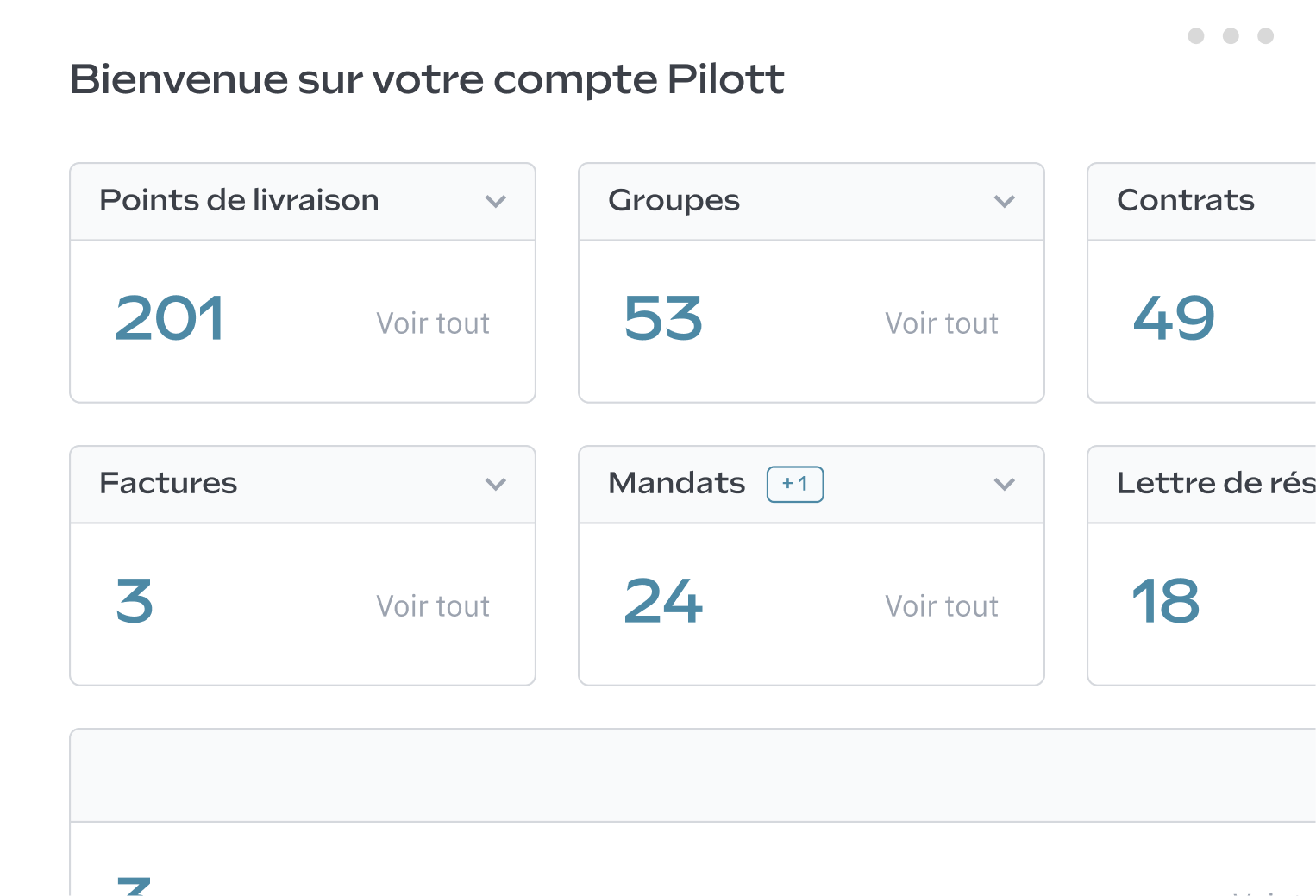
All your properties on one interface: previous day's consumption, alerts when electricity or gas prices cross your thresholds, budget projections, and archived contracts. CSV exports, scheduled or via API to your management tools.
Expert consulting dedicated to the hotel industry
A dedicated consultant monitors your markets and deadlines, keeps you informed of regulatory changes affecting the hotel industry, and works with you to build indicators such as energy cost per occupied room.
Our platform
Pilott, simplified management to track your consumption
- Centralize the meters for all your hotels, from 2-star to palace
- Track consumption for low-occupancy nights at D+1
- Receive an alert when gas or electricity reaches your price thresholds
- Simulate the season's budget and manage all your contracts in one place


Hotels and chains
Explore other processes
Un autre secteur ?


Methodology and definitions
What is energy consulting for 2 to 5-star hotels?
Energy consulting for 2 to 5-star hotels and luxury properties involves analyzing gas and electricity bills item by item (supply, distribution costs, taxes) to address each one based on heating and air conditioning peaks. Sirenergies consultants support hoteliers with their procurement and monitor each property via the Pilott platform, relative to the number of nights sold.
Two-thirds occupancy, yet fully heated
In 2025, the average occupancy rate for French hotels was 62.3% (INSEE, occupancy surveys). However, heating, ventilation, and hot water systems serve the entire building, and hotels of 1,000 m² or more are subject to the Tertiary Eco-Energy scheme.
The levers we use:
- Supply: a joint gas and electricity tender, with a pricing schedule that you set based on our advice.
- Distribution: TURPE (public electricity grid usage tariff) power levels and ATRD daily capacity reviewed annually.
- Taxes: electricity excise duty (formerly TICFE), natural gas excise duty (formerly TICGN), and CTA (distribution tariff contribution) verified on every invoice.

What portion of your room revenue goes toward heating and air conditioning?
An analysis of your gas and electricity contracts is all it takes to estimate your savings, hotel by hotel. No obligation.

