

Slaughterhouse and cutting: industrial cutting and charcuterie
Industrial charcutiers, calculate your energy cost per kilo
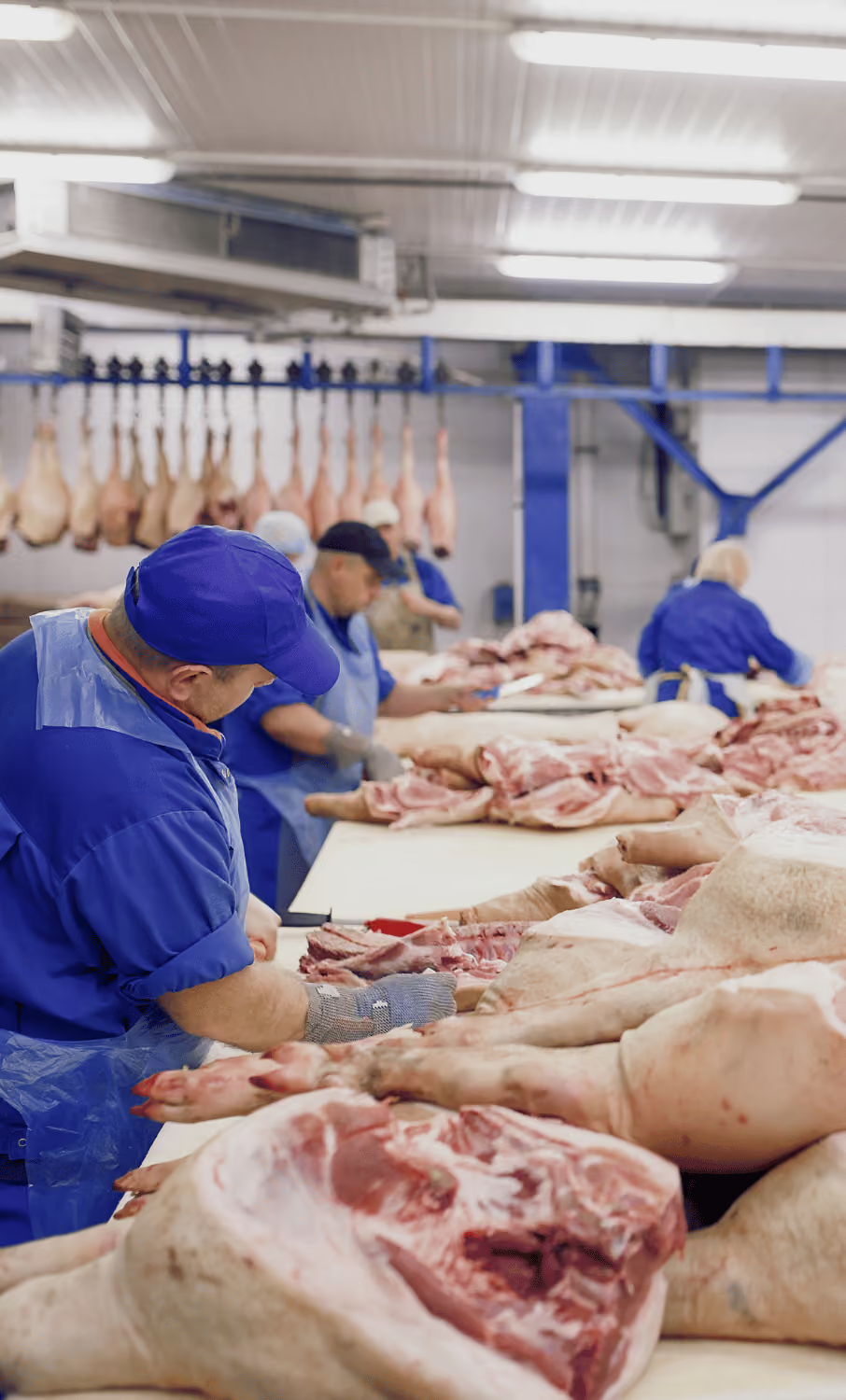
Cutting rooms kept at 12°C, drying rooms where hams remain for months, cooling tunnels: the electricity never stops. Cookers, smokehouses, and cleaning systems draw from the gas boiler room. Sirenergies optimizes energy for your cutting or charcuterie facility and links every contract to the cost per kilo.



Key industry figures
A sector of SMEs with thin margins and energy that never switches off
Many charcuterie workshops buy in small volumes, paying more than large sites. With such tight margins, every poorly negotiated gas or electricity contract shows up directly in the bottom line.
Charcuterie products produced each year in France by companies in the sector.
Gross operating margin rate for the charcuterie industry in 2024.
Gas price ratio between small and large industrial sites in 2024.
The energy profile of a cutting and charcuterie facility
Refrigeration runs continuously, while cooking and smoking draw on gas
The reality: three workshops, three profiles under one roof
A single site often combines cutting, cooking or curing, and then slicing and packaging. Depending on the product mix, either electricity or gas dominates.
- Cutting and slicing: refrigerated rooms and cooling tunnels powered by electricity, including nights and weekends.
- Dry curing: a dry-cured ham spends at least 130 days between salting and leaving the drying room (Code of Charcuterie Practices, 2011), in regulated electric drying rooms.
- Cooked and smoked products: cookers, drying rooms, smokehouses, and hot water systems most often rely on the gas boiler room.
Our role: linking every contract to what you produce
Your drying rooms and cookers remain the responsibility of your refrigeration and heating contractors; Sirenergies advises your management team on three key levers.
- Electricity procurement tailored to a stable base load, with effective long-term hedging.
- A gas contract, a TPA (Third-Party Access to gas distribution networks) option, and a daily capacity dimensioned to your cooking cycles.
- Revised TURPE (tariff for the use of public electricity networks) power levels, followed by tracking in Pilott that correlates expenses with tonnage produced.

Your energy challenges
The 3 energy challenges of industrial cutting and charcuterie
What do you do with refrigeration that never stops, cookers whose gas usage depends on customer orders, and invoices that no tool reconciles with the tonnage produced? These are the questions a charcuterie plant manager faces. For each one, Sirenergies offers a contractual and data-driven solution.
Continuous refrigeration is highly energy-intensive
In cutting plants and slaughterhouses alike, maintaining the cold chain remains the primary source of energy consumption.
Energy audit for refrigeration systems
Sirenergies analyzes your contracts and load profiles to measure the true cost of your continuous refrigeration.

Compressed air and cold zone lighting are often overlooked
Compressed air and cold zone lighting are added to continuous refrigeration costs without always being tracked as separate line items.
Compressed air and lighting audit
Sirenergies identifies waste in your compressed air and lighting systems, in addition to your refrigeration costs.
Multiple, poorly centralized sites
For multi-site industrial cutting and charcuterie groups, managing contracts in isolation masks the total cost of energy and deprives the group of major leverage.
Centralized management via Pilott
Sirenergies centralizes the monitoring of all your sites on a single platform, with alerts for any deviations.
Contractual and data expertise
Optimization and management of your charcuterie workshop contracts
From the drying room where hams mature to the cooked ham cookers, Sirenergies handles the electricity and gas for your workshops together. Every proposal starts with your product mix and tonnages, because a dry-cured meat producer and a cooked product manufacturer do not buy energy the same way.
Contractual and capacity audit
Review of your electricity and gas contracts workshop by workshop, including their expiration dates, subscribed power levels, and daily capacity, along with an annual analysis of excise duties and Energy Savings Certificates (CEE) applicable to your drying rooms, cookers, and refrigeration units.
Purchasing strategy and competitive bidding
Consulting with suppliers on a very steady volume of electricity and gas that follows cooking schedules, clause-by-clause offer analysis, and a written recommendation on which portion to fix immediately and which to leave to the market.
Distribution optimization (TURPE / ATRD)
Electricity: TURPE options and power levels adapted to continuous refrigeration and drying. Gas: TPA option and daily capacity aligned with your busiest cooking days. We handle all procedures with network operators.
Tariff modeling of cost per kilo
Simulation of the energy cost for each product family based on several price scenarios: cooked ham, dry-cured meats, sliced products. Useful for your commercial negotiations or for calculating the cost of switching from a gas cooker to an electric one.
Pilott software platform
Your workshop meters on a single screen: consumption at D+1, price alerts for electricity and gas, projected budget, archived contracts and invoices, and data exportable via CSV or API.
Expert advice dedicated to the charcuterie industry
A dedicated consultant understands the constraints of dry-curing and cooking, monitors your markets and deadlines, keeps you informed of regulatory changes, and defines the key performance indicators for your energy budget with you.
Our platform
Pilott, simplified management to track your consumption
- Bring your cutting, cooking, and dry-curing workshops together on a single interface
- View electricity and gas consumption for each site the following day
- Receive an alert when electricity or gas prices exceed your thresholds
- Project your annual energy budget and keep all your contracts in one place



Slaughtering and cutting
Explore other processes
Un autre secteur ?


Methodology and definitions
What is energy consulting for industrial cutting and charcuterie?
For a cutting facility or a curing plant, every kilowatt-hour ends up in the cost per kilo, and the bill is not limited to the price of energy: taxes and contributions make up a portion of it. Energy consulting for industrial charcuterie verifies these line items, supports the procurement of electricity for refrigeration and gas for cooking, and then links expenses to the kilos produced. Sirenergies consultants carry out this work using the Pilott platform.
Why site size matters
In 2024, establishments consuming less than 2,000 MWh of electricity paid 2.6 times more per megawatt-hour than those consuming over 20,000 MWh (Insee Première No. 2095, February 2026).
The levers
- Annual review of the excise duty on electricity (formerly TICFE), the excise duty on natural gas (formerly TICGN), and the CTA (contribution tarifaire d'acheminement).
- Base electricity load covered by successive fixed-price contracts, with workshops grouped into a single tender.
- Energy cost per kilo tracked daily in Pilott, workshop by workshop.

How much energy cost is in every kilo of ham that leaves your facilities?
Your contracts and twelve months of invoices are all it takes to calculate what you could recover. No obligation.

