

Institutional catering: central kitchens
Institutional caterers, lower the energy costs of your meals
Delivering via cook-serve or cook-chill methods requires different energy needs: gas for pots on one hand, electricity for blast chillers on the other, at the same times. Sirenergies helps you optimize your central kitchen's gas and electricity contracts and adjusts your power levels to match your production peaks.


Key industry figures
Cooking, cooling, and cleaning: the energy of a central kitchen
A central kitchen produces meals in a single morning for restaurants it never sees. Its delivery method determines its consumption profile, and the purchasing strategy must follow this profile rather than an annual average.
Meals served annually by institutional catering in France.
Energy per meal for cook-serve compared to cook-chill.
Maximum time to cool a cooked dish from 63°C to below 10°C.
The energy profile of a central kitchen
Gas cooking and electric cooling share the same morning
The situation: two energy sources used simultaneously, for a few hours a day
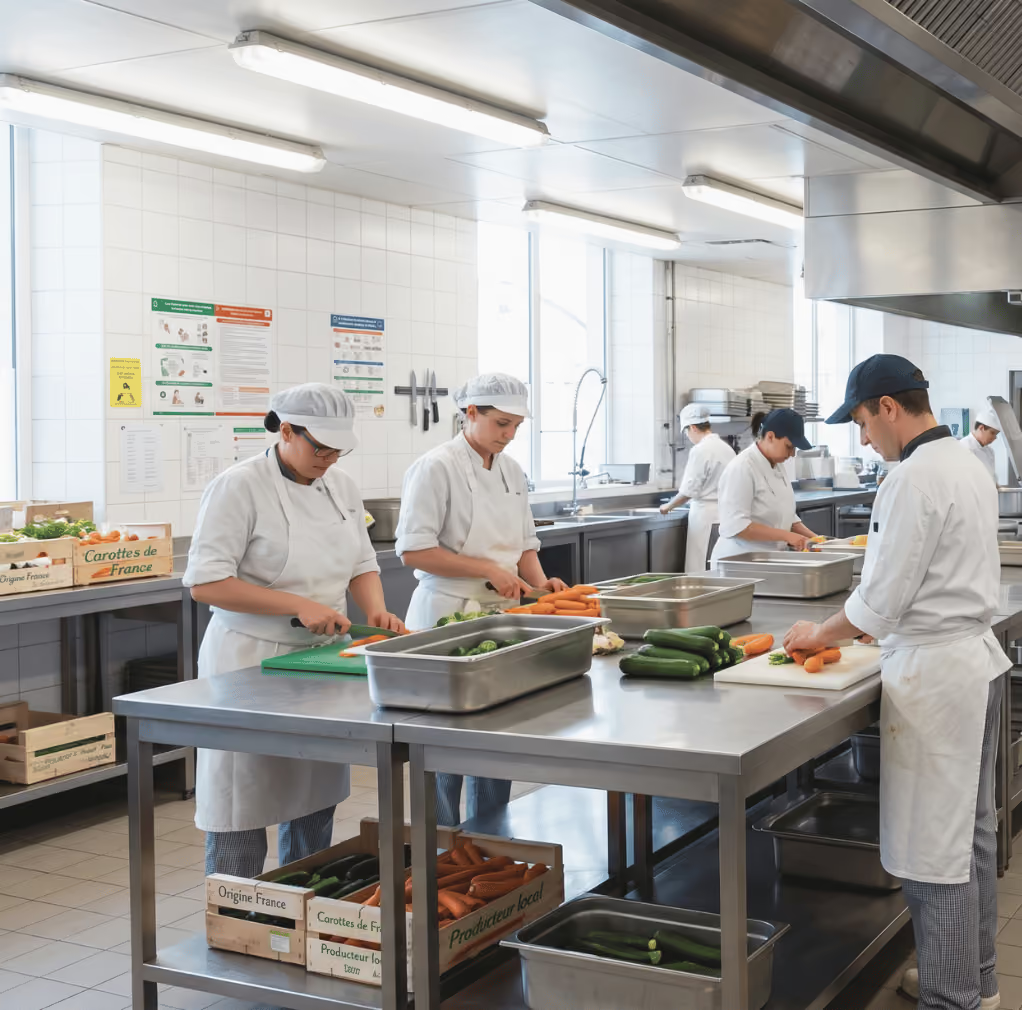
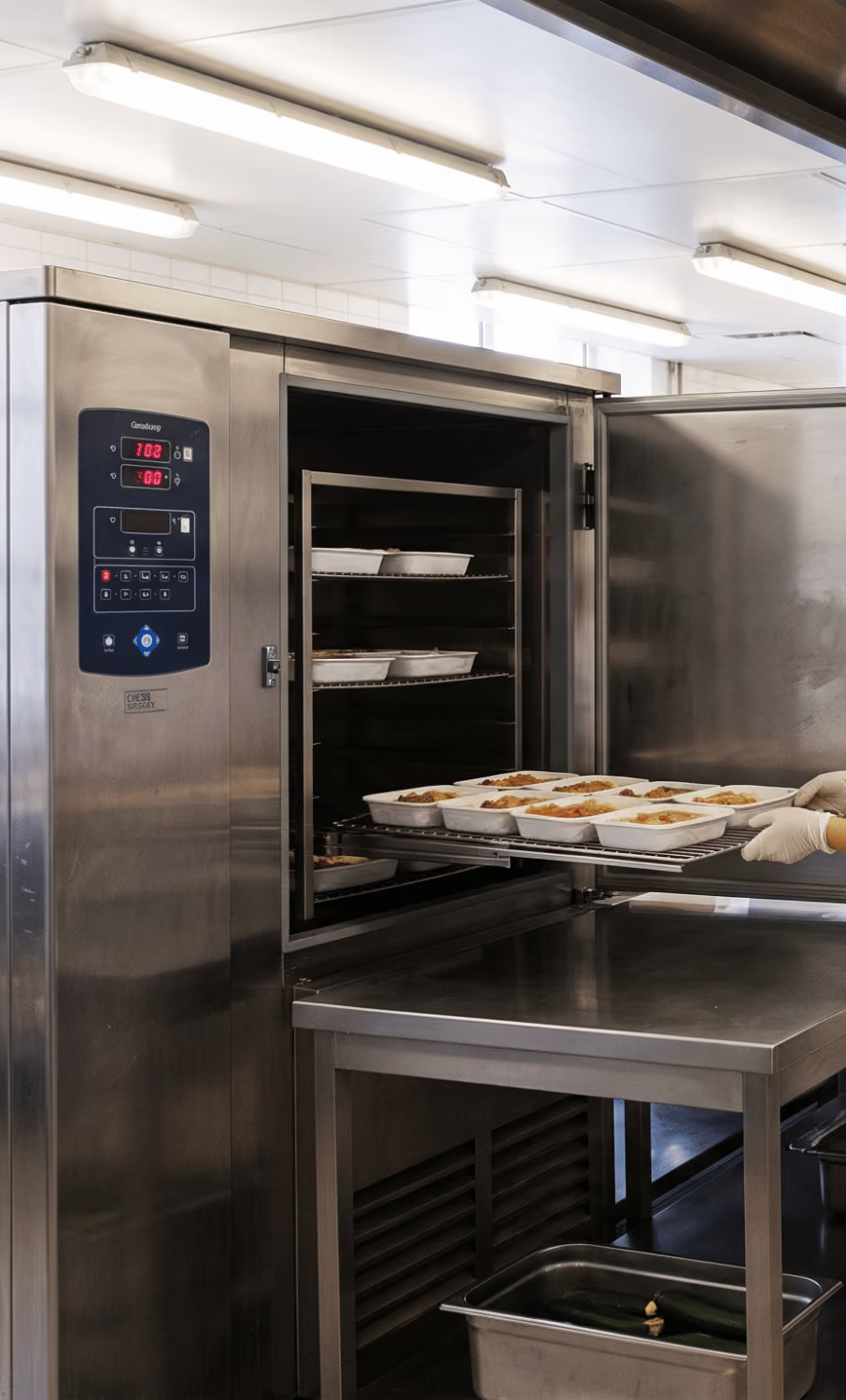
At opening, pots, tilting pans, and combi ovens heat up, most often using gas. By late morning, dishes are either sent out via cook-serve at over 63°C or enter blast chillers, which are very electricity-intensive; dishwashing and cold rooms then take over. Cooking alone uses 0.35 to 2 kWh per meal in cook-serve (ADEME, Design and Management program).
Our role: helping you make decisions on what can be contracted and measured
Kitchen designers, refrigeration engineers, and consulting firms manage your equipment. Sirenergies acts on three levers:
- Purchasing: a joint consultation for cooking gas and refrigeration electricity, for which we analyze the offers before you make your choice.
- Transmission: TURPE (public electricity network usage tariff) power levels adjusted for morning peaks, and ATRD (third-party access to gas distribution networks) daily capacity reviewed based on your statements.
- The data: consumption data available at D+1 in Pilott, reported per meal produced, kitchen by kitchen.

Your energy challenges
The 3 energy challenges for central kitchens
A power peak every morning, a refrigeration system that health regulations forbid you from cutting back on, and bills scattered between the kitchen and its satellite restaurants: central kitchens face a combination of constraints. Sirenergies addresses them one by one, through contracts, distribution, or data, without ever affecting your food safety management plan.
Poorly consolidated multi-energy contract
A central kitchen combines gas for cooking with electricity for refrigeration and dishwashing, two contracts often negotiated separately without a comprehensive overview.
Procurement and competitive bidding for gas and electricity suppliers
Sirenergies structures a joint purchasing strategy for both your energy sources, working with our trusted partner suppliers.

Continuous refrigeration with little oversight
Positive and negative refrigeration systems run continuously to preserve food products, representing a stable consumption cost that is rarely audited in detail.
Energy audit for refrigeration systems
Sirenergies analyzes your contracts and load profiles to determine the true cost of your refrigeration, without ever compromising your health and safety compliance.
Decentralized central kitchen network
Food service groups operating multiple central kitchens often manage their contracts site by site, without consolidated reporting.
Centralized management via Pilott
Sirenergies centralizes the monitoring of all your kitchens on a single platform, providing load curves for each site and alerts in the event of any deviations.
Contractual and data expertise
Optimization and management of your central kitchen contracts
From gas tilting skillets to electric blast chillers, Sirenergies monitors both energy sources in your central kitchens. Every recommendation is based on your production method, your number of meals served, and the distribution of contracts between the local authority, the service provider, and the satellite restaurants.
Contractual and capacity audit
Review of every contract for the kitchen and its satellites: price, expiration date, account holder, power per period, and gas capacity. Annual audit of electricity excise duties (formerly TICFE), natural gas excise duties (formerly TICGN), and Energy Savings Certificates (CEE).
Purchasing strategy and competitive bidding
Consultation with suppliers for cooking gas and refrigeration electricity, in a single lot or by site, with price fixing spread over time. For local authorities, we prepare the specifications and analyze public procurement bids.
Distribution optimization (TURPE / ATRD)
Electricity : TURPE version and power levels per period aligned with cooking and cooling peaks.
Gas : ATRD option and daily capacity adjusted to your meal volume. Includes coordination with network operators.
Tariff modeling for electrification
Before replacing a gas pot or oven with electric equipment, we calculate the impact on both your bills and your subscribed power. The same simulation evaluates the potential for rooftop solar self-consumption for the kitchen.
Pilott software platform
The central kitchen and each of its satellites on one interface: previous day's consumption, alerts when gas or electricity prices exceed your thresholds, budget projections, and archived contracts. CSV export, scheduled or via API.
Expert consulting dedicated to central kitchens
A dedicated consultant monitors your contracts and deadlines, keeps you informed of regulatory changes, and works with you to build an energy cost-per-meal indicator, useful for revising your contracts and benchmarking your kitchens.
Our platform
Pilott, simplified management to track your consumption
- Bring the central kitchen and its satellite restaurants together on a single dashboard
- Check consumption on non-production days at D+1
- Receive an alert when gas or electricity reaches your price thresholds
- Simulate the annual budget and manage all your contracts in one place



Institutional catering
Explore other processes
Un autre secteur ?


Methodology and definitions
What is energy consulting for a central kitchen?
In a central kitchen, cooking is paid for in gas and blast chilling in electricity, both during the same morning hours. Energy consulting involves adjusting the distribution costs for both networks to match these peaks, supporting the procurement of both energy sources, and tracking their cost per meal: this is the work of Sirenergies consultants, equipped with the Pilott platform.
A production model that has become the standard
In 2025, 57% of collective catering facilities that submitted their data served meals prepared by a central kitchen (2025 EGalim statistical report). From 1,000 m² upwards, these kitchens are subject to the Tertiary Eco-Energy scheme.
What we actually do
- Adjust your TURPE (public electricity grid usage tariff) power settings and ATRD (third-party access to gas distribution networks) capacity to match your peak usage.
- Prepare a joint tender for the kitchen and its satellite sites, then analyze the bids with you.
- Monitor each site daily in Pilott and calculate the energy cost per meal.

How much does the energy for a meal from your central kitchen cost?
Your contracts and twelve months of invoices are all we need to calculate your savings, kitchen by kitchen. No obligation.

