

Virginie
LEFÈVRE
Sirenergies editor
Table of contents


What is a Regional Driving Agency (RCA)?
March 6, 2026
4
Min reading

Enedis, operator of the public electricity distribution network in 95% of metropolitan France, relies on its 28 Regional Driving Agencies (RACs) to ensure the transmission of electricity.
They are real “control towers”, where 500 “electricity switchers” work. They monitor the status of the 20,000-volt high-voltage electrical network (HTA) in real time, 7 days a week, 24 hours a day, 24 hours a day. They can recharge customers in a few minutes in the event of incidents.
In addition to this surveillance and the management of incidents on the HTA network, the ACRs constantly adapt (flow management) the networks to the loads and the work to be carried out in order to guarantee the best criteria of safety, quality of supply and delivery costs.
Through this management of flows, they are an essential link in the ecological transition, with 90% of renewable energies being connected to the public electricity distribution network.
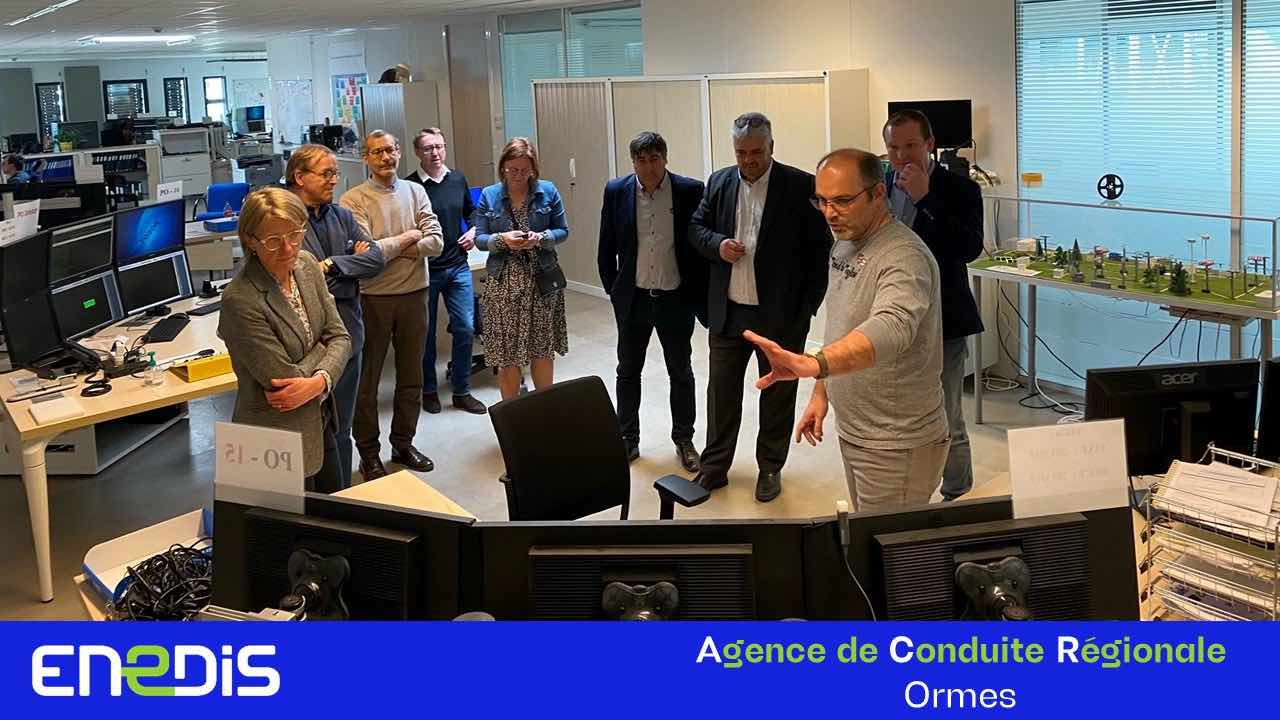
Ormes Regional Driving Agency - Source: Enedis
How do Regional Driving Agencies work?
The ACRs supervise
- 2,300 source workstations that are located at the interface between the networks RTE and Enedis ;
- 665,000 km of 20,000 volt high-voltage power lines;
- 145,000 remote-controlled maneuvering units for the continuous control of electricity flows on the network.
ACRs restore electricity as quickly as possible in the event of incidents
ACR jobs are in constant evolution, under the impetus of new technologies And of the scanning of the electrical network: control tools, digitization of source stations and network equipment, sensors, fault detectors, IoT (Internet of Things), remote alarms, Linky counter...
- 20,000 incidents handled by ACRs on the public distribution network, per year;
- 750,000 concentrators (associated with Linky meters) that send real-time information on the state of the electrical network to the ACRs.
ACRs optimize the implementation of projects on the network or nearby
The role of ACRs also consists in support the activity scheduled by Enedis Regional Directorates: maintenance work, connections, commissioning of new equipment, network modernization, etc.
These include To identify And of realize the maneuvers allowing to secure the flows on the network, of minimize discomfort felt by the customer and especially to allow carrying out this work safely by technicians from Enedis and its partner companies.
RCAs manage the flows of ecological transition
In addition to the traditional means of managing networks, ACRs pilot local flexibilities. Flexibility is a temporary increase or decrease in the electrical power injected or withdrawn by a site connected to the distribution network (producer, consumer, storer).
This power modulation, at the request of Enedis, is done during a given period to contribute to a local need on the electrical network, such as connecting more of renewable energies while limiting infrastructure investments.
90% of renewable energies are connected to the public electricity distribution network.
ACRs are protected against cyberattacks
The public service mission, the territorial network and the very nature of our activities led the State to declare Enedis Essential Services Operator (DARE).
This status obliges the company to adopt the most advanced and highest standards of quality and safety for securing its industrial information systems, in particular in accordance with current regulations on cybersecurity (NIS directive).
In this context, Enedis is constantly adapting the surveillance, protection and defense of its systems, and improving the resilience of its organization in the face of the risks of cyberattacks.
To secure the electricity supply this winter, Enedis Regional Driving Agencies (ACRs) are mobilized in the implementation of safeguard measures decided by the public authorities and RTE, Blood pressure drops of -5%, but also load shedding device, as a last resort.
The drop in blood pressure -5%
The device for temporarily reducing blood pressure by 5% is a so-called “safeguard” measure when the balance of the electrical system, and in particular the supply-demand balance, is threatened.
It is activated urgently and its effect is almost immediate ; the speed of reaction is also essential in maintaining The supply-demand balance.
This measure consists in reducing the output voltage of the transformers (high voltage) of the source stations to reduce the electrical consumption downstream by approximately 5%.
Its execution is supervised by Enedis ACR teams, on the orders of RTE's operating centers. This temporary decrease in blood pressure is almost imperceptible by customers.
The load shedding
Load shedding is a device of temporary cuts lasting approximately 2 hours which consists in temporarily suspending the power supply to part of the public distribution network, mainly due to a imbalance between electricity consumption and production.
On the decision of RTE, Enedis is carrying out the technical gesture to implement these temporary cuts organized at the scale of a territory directly on the medium-voltage electricity network. This is an operational maneuver carried out within the Enedis ACRs intended to protect the electrical system in France.
The volume of the offloaded part of the network is proportional to the imbalance to be compensated. The ACRs are also in charge of relasting.
The load shedding device has always been one of the mechanisms that can be potentially activated in the event of risks to the balance of the electrical system in France.


Take the first step towards optimization
In a few clicks, organize an exchange with one of our experts.





weekly newsletter subscribers

4.9
