

Virginie
LEFÈVRE
Sirenergies editor
Table of contents


The history of EDF from 1940 to today
March 6, 2026
5
Min reading
Through this series of articles, SirEnergies looks at our past and the history that has shaped and shaped today's energy landscape. By the way, EDF, what was it like before?
When was EDF created?
In the wake of the Second World War, many power plants needed to be rebuilt. At that time, the French government proposed to nationalize gas and electricity. The law of April 8, 1946 created Électricity de France.
Nationalization has several goals:
- Recovering the French economy
- modernise existing structures
- rationalize efforts
- become energy independent
- have control over the country's strategic directions
From that date, the State nationalized no less than 95% of private companies in the electricity and gas sector in order to create a single entity dedicated to electricity and gas: EDF-GDF.
EDF: the 1950s, the era of modernization
At the beginning of the 1950s, only two out of three inhabitants had access to electricity; the electrification of France would not be completed until the beginning of the 1960s.
Marshall Plan money was first invested in the construction of hydroelectric dams and then in the modernization of thermal power plants.
However, dams are not numerous enough to meet an ever increasing demand for electricity, at the rate of doubling consumption every ten years. It was in 1960 that EDF chose 220 volts!
EDF: the 1960s, the era of production
It was in 1963 that Électricity de France created The blue counter, in order to increase the electrical power of its subscribers. EDF installs more than 70,000 per month, it's an incredible success. The blue meter became a symbol of the accession of the French to electrical comfort. Moreover, we no longer speak of “subscribers” but “customers”.
It was during the same year that in Chinon, EDF produced its first kilowatt hours of electricity from nuclear sources thanks to its EDF1 reactor. This reactor has now been dismantled and converted into a museum (” La Boule ”).
In 1966, EDF inaugurated The tidal power plant of Rance, between Saint-Malo and Dinard (Ille-et-Vilaine), it is the very beginning of renewable energies. For the 1re Once in the world, a factory will convert the energy of marine currents into electricity.
EDF: the 70s, the era of energy independence
In 1971, integrated electric heating was launched and populated homes. Gas and water heaters petroleum are therefore facing a major new competitor: EDF and its electricity.
Three years later, in 1974, the 1Er Minister Pierre Messmer announces the launch of a major electro-nuclear program: launch 13 nuclear power plants of 1,000 MWh each in 1974 and 1975.
It was through this program that Fessenheim emerged in 1977, followed by many others such as Bugey and Gravelines. The country's energy independence is therefore in place!
EDF: the 80s
In the 1980s, many companies in the electrical sector around the world were privatized. For EDF, it is the start of internationalization.
During this decade, France partly exported its electricity by inaugurating a France-United Kingdom direct current interconnection (called IFA 2000). The project is a major one: several tens of kilometers of submarine cables to be buried in chalk to interconnect the two electrical networks.
EDF: the 90s
In the mid-1990s, customer service became one of EDF's main concerns. To manage distribution, EDF-GDF Services is created. At that time, numerous advertising campaigns highlighted the services offered by the company.
During 1992, EDF took its first international participations.
In 1994, EDF inaugurated its first nuclear power plant abroad: Daya Bay (in China).
At the end of December 1999, two storms ravaged France. EDF agents have increased the number of projects to restore power in certain areas.
It was at this time that EDF created the FIRE (the Rapid Electricity Intervention Force).
EDF: the 2000s
The “storm of the century” that took place at the dawn of the 2000s accelerated the burying of electrical networks. Today, more than 40% of electrical lines are buried in the ground on French territory.
At the beginning of the 21stE century, The electricity market is opening up to competition. In 2004, EDF became a public limited company, with the State remaining in the majority (84%).
During this decade, EDF went public, two subsidiaries were created: RTE (in 2000) and ErDF (in 2008). RTE manages the public network of transporting of electricity and ErdF ensures the distribution.
The group continues to strengthen itself in Europe, but also globally, by inaugurating the Nam Theun hydroelectric power plant (in Laos) to name but a few.
EDF creates tidal, onshore and offshore wind farms. The objective: a energy mix balanced and not only focused on nuclear power, as well as electricity production low carbon.
In 2004, The opening of electricity markets concerns only professionals and local authorities. It was not until 2007 that private customers were also affected.
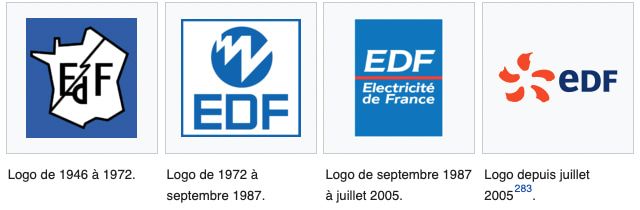
EDF visual identity since 1946 - Source: Wikipedia
EDF: today
The group is now present in more than 30 countries. In the nuclear field, the company is launching a new generation of reactor: Flamanville EPR (which will produce more electricity than any other reactor in the world). Its commissioning is scheduled for the end of 2022.
The group also invests in research on The energies of the future to integrate new uses, such as the electric car.
The future of EDF is at the heart of energy transition And of the fight against global warming, as for many other major energy companies in France and Europe.
To find out more about EDF (nowadays) do not hesitate to consult our article: EDF: historical electricity producer and supplier.
Did you know that?
If you enjoy this series of articles recounting our past and our history, know that we will be dealing with the tumultuous history of electricity in France very soon. Subscribe to our newsletter so you don't miss a thing!
Subscribe


Take the first step towards optimization
In a few clicks, organize an exchange with one of our experts.



weekly newsletter subscribers

4.9
