




Summarize with AI

March 6, 2026
7
Min reading
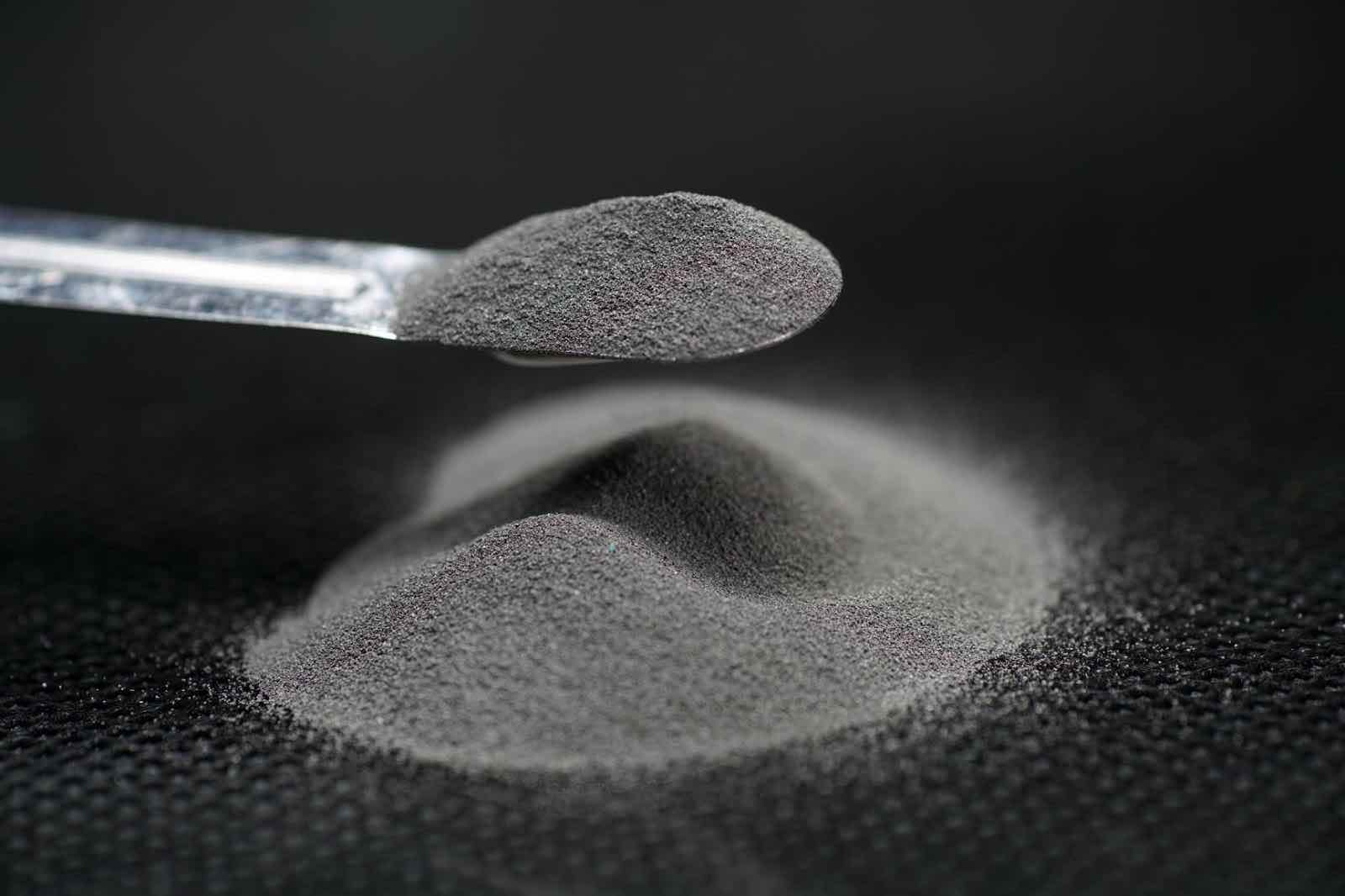
Current environmental issues require us to search for new sustainable, efficient and low-polluting energy sources in order to make the ecological transition a reality. In this quest, certain metal powders are of increasing interest to specialists because of their high energy density and their remarkable physicochemical properties. In particular, Iron powder is a promising energy carrier.
The most famous example dating from October 2020 is that of the successful implementation of a steam generation system based on iron powder by researchers from the Technical University of Eindhoven in a Dutch brewery. Is iron powder the energy of the future? SirEnergies helps you answer this question.
” Iron powder has the same energy density as petroleum derivatives, but one important detail is that it does not emit CO₂ when burned ” says Driss LARAQUI, co-founder of the French start-up Fenix Energy which develops systems for producing energy from iron.
He also adds that” Once iron has been burned, and its energy recovered to heat buildings or produce electricity, it is possible to easily capture the rust produced at low cost and recycle it using renewable energies back to the initial iron ”.
This circular fuel is very successful today because of its ability to produce heat in large quantities and its ability to be recycled in a loop usingsolar energy or wind turbine. Thermal energy is, for example, essential for Heating a home, for thermoelectric power plants, the propulsion systems of certain boats, or even for Make a car engine run.
If we have to do without fossil fuels for various industrial applications, the clean energy sources that come to mind first of all are green electricity from renewable energies (or nuclear) or green hydrogen.
Indeed, renewable energies are Intermittent (depend on sunshine for solar or the seasons for wind power), storage solutions are therefore needed to smooth the production of electricity from renewable energies. The production of hydrogen in renewable surplus phases, for its subsequent combustion or its use in fuel cells, is a solution that is being seriously considered.
However, hydrogen has a very low energy density at atmospheric pressure (32 kWh for 10,000 liters!) , and its highly explosive nature combined with its ease of escaping from tanks increases the safety risks for workers in case of mishandling and makes its long-term storage and long-distance transport very complex.
It is to this problem that is currently being proposed and developed the storage and transport of energy by iron powder. Producing 5 liters of iron powder makes it possible to store as much energy as 10,000 liters of hydrogen!
Iron powder has the advantage of giving off a lot of heat by simple combustion, of being stable, safe and very easy to handle. This resource is also produced abundantly, 2 gigatons per year of iron in the steel industry, which favors large-scale use. It remains to be emphasized that for this iron powder to become “green” it must be recycled in a loop using renewable energies.
Thanks to the development of external combustion engines (for some cars with “exotic” fuels) operating with a specialized burner, iron grains could be an inexpensive alternative to stop the use of gasoline and diesel in generators and car engines, for example.
Just like the coal, iron powder may also contribute to the production of electricity in thermoelectric power plants.
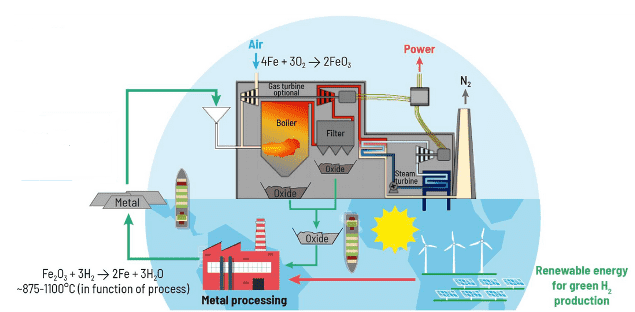
Source: Engie
An energy carrier that is not easily storable and transportable cannot claim to be green energy used on a large scale.
” Long-term storage of iron costs 15 times less than storing hydrogen under 350 bars, and transporting it over 3,000 km (from an inexpensive renewable area to a consumption area) costs 3 times less than liquid hydrogen ” says Driss Laraqui, a doctor who is a metal fuel engineer.
This makes it possible to consider importing green energy in the form of iron from areas abundant in solar energies (such as Morocco) at a cost competitive with natural gas for heating applications for example (while remaining very low carbon).
When it comes to energy storage, this vector actually behaves like a drum. The battery is discharged by burning this iron which releases energy (in the form of heat) and the fuel is recharged by doing the opposite reaction using renewable energies.
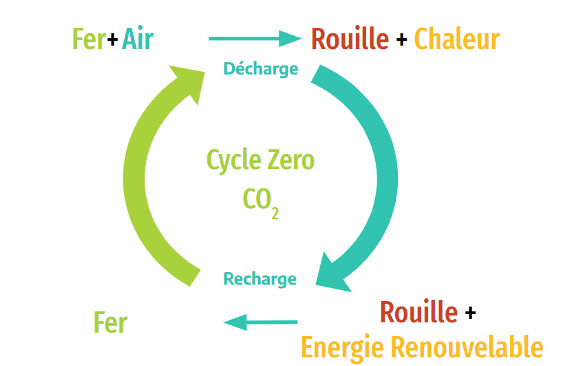
Source: Fenix Energy©
Iron charging and discharging cycle for the production of carbon-free energy and the storage of renewable energies.
In its initial state, iron powder can be thought of as a charged battery. It has an energy density equivalent to about 6 kWh/l (in powder form, iron is 3 times less dense than in ingots), which is 2,000 times greater than that of hydrogen at atmospheric pressure, which is nevertheless a very good fuel.
For everything to go well, you need to have very fine ferrous grains. The latter are better suited to the combustion reaction when they are in contact with oxygen.
By oxidizing iron, we obtain rust in addition to the heat released. The rust obtained then acts as a discharged battery. We note here that there is no emission of CO₂, the characteristic greenhouse gas resulting from the combustion of hydrocarbons.
Unlike fossil fuels such as coal, petroleum or natural gas, the use of iron powder is associated with carbon footprint zero. It does not end there, this promising energy vector is recyclable a very large number of times.
As mentioned above, rust from combustion can be recycled to produce iron powder again. It is in a way as if you have recharged your battery which is still ready to be used. ” Recycling 99% of the iron burned in each cycle would allow the same fuel to be reused 100 times before exhausting it! ” highlights Driss Laraqui.
All you have to do is remove the oxygen that has associated with the iron atoms using either electricity (electrolysis) or high-temperature hydrogen. Hydrogen would therefore be an intermediary for producing green iron, but this way we avoid its complex and expensive transport and storage.
Of course, rust deoxidation processes are complex in practice and require significant technical investments for the total success of the operation. However, this represents much less investment than the construction of pipelines or tanks for liquid or gaseous hydrogen (and less risks).
It's well worth the effort. By being recyclable and non-polluting, this green energy source meets the criteria for being An energy of the future.
You probably know Bill Gates and Jeff Bezos, two prestigious businessmen with some of the biggest fortunes in the world. They recently decided to invest money in a start-up called Form Energy.
The company is developing innovative solutions centered around iron-based batteries, which it considers to be the energy carriers par excellence of tomorrow. We know the ability of these illustrious businessmen to position themselves first in markets with very high growth potential. We can therefore conclude that metal-based energy solutions will be very popular in the future.
Form Energy is currently developing prototypes of iron-air stationary batteries in order to store renewable energies. After lead and lithium, the iron-air battery should be the big revolution in the energy storage market for industrial purposes. It is a low-cost solution (ten times cheaper than current lithium-ion batteries) that should allow energy to be stored for 150 hours, which is a remarkable achievement in this field.
This revolutionary battery uses iron balls that oxidize during discharge. During charging, the rust obtained is transformed into iron. The process seems simple, but still very efficient.
The American company's iron-air batteries are mainly intended for wind and solar power plants who want to sustainably store excess energy. The large size of the modules also prevents the use of the technology by small industries.
However, iron combustion solutions, to be distinguished from Form Energy's stationary batteries, make it possible to produce heat at high temperature and facilitate the exchange of green energies on a global scale, this is the strategic axis chosen by Fenix Energy, a start-up from Lyon.
Iron powder is certainly a very promising energy vector. Boiler houses, chemical industries, boats, cars, cars, thermal power plants, power generators... All major industrial systems currently operating on fossil fuels could become greener thanks to this remarkable circular resource.
All the criteria (recyclable, non-polluting, stable, non-toxic, energetically dense...) seem to be in place to make it an energy of the future. By not limiting ourselves only to iron powder, but by taking into account all metal powders, it will however be necessary to intensify scientific research in order to better understand this energy source. It will then be able to fully play its role alongside other energy sources (renewable or not) in order to satisfy our diverse energy needs.
In a few clicks, organize an exchange with one of our experts.


weekly newsletter subscribers

4.9

.png)

Oui, elle est considérée comme une énergie renouvelable à faibles émissions de gaz à effet de serre.
De plus, l'eau ne subit aucune transformation chimique durant le cycle de production et réintègre son milieu naturel en aval.
Cependant, la construction de barrages nécessite des mesures pour protéger les écosystèmes (débit minimum, passes à poissons).
Exceeding capacity leads to financial penalties and can impact the size of the contract. Adjust the correctly subscribed power makes it possible to avoid these additional costs.
The €/MWh is a price unit used in wholesale markets, while kWh is the unit visible on your bills.
Tertiary companies must manage their energy costs while guaranteeing the comfort of users (offices, shops, services). Consumption is often linked to heating, air conditioning and lighting, which requires precise monitoring to avoid budgetary excesses.
Tertiary companies are concerned by taxes such as TICFE or TICGN. Sirenergies checks the accuracy of invoices, identifies possible exemptions, and helps correct errors to sustainably reduce costs.
Among the taxes include TICFE, TICGN, CTA, CJA and TURPE. They represent a significant part of the bill and vary according to consumption profiles. Understanding them well is essential to optimize costs.
Le kVA mesure la capacité maximale que votre compteur peut supporter à un instant T, tandis que le kWh mesure la quantité d'énergie consommée sur une durée.
Some businesses may obtain a partial or total exemption from the TICFE or the TICGN, depending on their activity and energy intensity. The support of an expert makes it possible to identify the eligibility criteria and to put together the file.
Sourcing consists in identifying and analysing the offers of several electricity and gas suppliers. This approach makes it possible to obtain contracts adapted to the consumption profile and budgetary constraints of the company.
Ce record de 92,3 TWh s'explique par la conjonction de trois facteurs :
Communities are subject to taxes such as TICFE or TICGN. Sirenergies analyzes invoices, identifies exemption possibilities and fixes possible errors to reduce the tax burden.
Parce que la puissance souscrite en kVA détermine le prix de l'abonnement et que tout dépassement peut entraîner des surcoûts importants.
Le dispositif ARENH a laissé place au VNU (Versement Nucléaire Universel).
Ce changement structurel expose davantage les entreprises aux prix de gros, rendant la gestion des risques plus complexe qu'auparavant.
Il devient alors indispensable de définir une stratégie d'achat d'électricité avec Sirenergies pour lisser l'impact de la volatilité des marchés sur votre budget.
One invoice consists of several elements: consumption, supplier share, taxes and contributions. The analysis of each line makes it possible to identify possible errors and to check the consistency with the signed contract.
The range E @sy is available in four pricing structures to adapt to each risk profile:
Yes. The supplier guarantees an offer 100% renewable via the official Guarantees of Origin (GO) mechanism.
For the most demanding companies, the offer GREENVOLT+ ensures very low carbon intensity electricity, sourced exclusively from independent French producers (hydraulic, wind, solar).
L'abondance de production française tire les prix du marché de gros vers le bas.
En vertu du mécanisme de l'Ordre de Mérite (Merit Order), les centrales les moins coûteuses (nucléaire, renouvelables) couvrent la demande plus souvent, évinçant les centrales à gaz ou charbon plus onéreuses.
Cela multiplie les épisodes de prix bas, voire négatifs, sur le marché spot.
Le processus repose sur l'utilisation de la force de l'eau (énergie cinétique) issue des courants, des chutes d'eau ou des dénivelés. Le fonctionnement suit trois étapes clés :
Les caves coopératives de taille ETI ou grande entreprise peuvent être soumises à l'audit énergétique réglementaire (norme NF EN 16247). Sirenergies n'a ni la compétence ni l'accréditation pour réaliser cet audit : nous vous orientons vers un bureau d'études partenaire accrédité, et vous accompagnons en amont sur vos achats et en aval sur le pilotage.
Le transport (RTE) correspond aux "autoroutes" de l’électricité. Il s’agit de transporter de très grandes quantités d'énergie sur de longues distances, depuis les centrales de production (nucléaires, barrages, parcs éoliens offshore) vers les régions de consommation.
La distribution (Enedis) s'apparente aux "routes départementales" et aux rues. Elle récupère l'électricité à la sortie du réseau de transport pour la livrer directement chez le client final, en abaissant la tension pour qu'elle soit utilisable par vos appareils.
The subscribed power must be calculated according to the consumption profile and uses (heating, industrial processes, tertiary equipment). One fine analysis makes it possible to ensure the adequacy between real need and contract.
En 2025, la France a atteint un solde exportateur net de 92,3 TWh, battant le précédent record de 2024 (89 TWh).
This makes it possible to choose the right time to contract, secure your budgets and anticipate increases.
These are signals sent by RTE during periods of tension on the electrical network. The Sirenergies tool informs you in real time to anticipate your uses.
C'est l'indicateur d'efficacité d'un appareil électrique ; il représente le ratio entre la puissance active (utile) et la puissance apparente (totale).
Un appel d’offres permet de mettre en concurrence plusieurs fournisseurs d’électricité et de gaz afin d’obtenir des conditions contractuelles optimisées. C’est une démarche transparente qui permet de choisir l’offre la plus adaptée aux besoins budgétaires et techniques de l’organisation.
Farms are subject to taxes such as TICFE or TICGN. Sirenergies verifies their application, identifies cases of exemption and accompanies the procedures to reduce the tax burden.
C'est le levier le plus rapide pour obtenir des résultats visibles. L'éclairage représente environ 40 % de la consommation d'électricité d'une commune.
Passer au LED avec pilotage intelligent permet de réduire la facture de 50 à 80 %, avec un retour sur investissement (ROI) rapide, souvent estimé à 2 ou 3 ans.
The industry is concerned by TICFE, TICGN and other contributions that may represent an important part of invoices. Sirenergies identifies cases of exemption and accompanies the procedures to benefit from them.
In 2025, the supplier had a NPS (Net Promoter Score) of +16 and a note of 4,17/5.
Satisfaction is based on a “zero solicitation” model and 100% in-house customer service in Toulon, guaranteeing proximity and responsiveness that cannot be found with major historical suppliers.