





Summarize with AI

March 6, 2026
9
Min reading
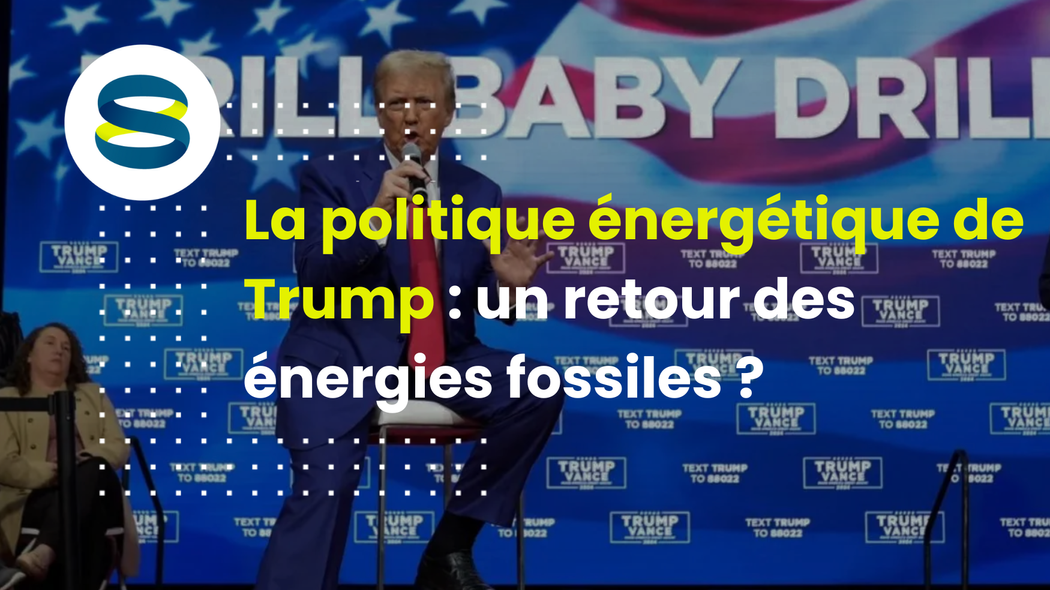
“Drill, baby, drill”. This slogan (translated by “Strong, darling, strong” In French), Donald Trump hammered it loud and clear throughout his presidential campaign. He reaffirmed this in his inauguration speech on 20 January.
A symbol of American success, black gold is regaining its place in United States energy policy, with no regard for environmental risks. Faced with the climate emergency, Donald Trump responds “energy emergency”. Are we moving towards a massive return to fossil fuels? Should we expect a record increase in American greenhouse gas emissions? What will be the consequences of this energy shift?
SirEnergies' analysis, between disaster scenarios and glimmers of hope.
26 presidential decrees. This is the record number of executive orders signed by a President of the United States on the day of his inauguration. Four of them outline the contours of the new American energy policy. Through his decisions, Donald Trump Unravels the cracks of the pro-climate strategy one by one of his predecessor Joe Biden.
Donald Trump's first measures strongly affirm his Pro positionfossil fuels. In a simplistic vision of the sector, he considers the shortage of fossil fuels to be responsible for the surge in energy prices. According to his administration, relaunching production is the only solution to defend the country's energy independence and reduce inflation.
The first executive orders of the American president go in this direction. They encourage oil and gas development throughout the American territory, including national parks. Ignoring environmental regulations, the law on protected species and public consultation, the American state intends simplify and speed up procedures on behalf of “the energy emergency”.
With its land and sea basements rich in oil and gas, Alaska, “spoils of natural resources”, is particularly endangered. Questioning the protection of the environment and the rights of indigenous communities, Donald Trump has already reversed the ban on new oil and gas projects in the Arctic. In particular, it cancelled the moratorium on the exploitation of the protected area of the National Wildlife Refuge.
The liquefied natural gas (GNL) is also popular with Donald Trump. In particular, the president has just granted conditional export authorization for an LNG project in Louisiana. This decision could restart the construction of new natural gas export terminals, stopped by Joe Biden due to emissions that are potentially catastrophic for global warming.
During his election campaign, Donald Trump announced the End of the “Green New Deal”, an investment program in favor of energy transition launched by his predecessor Joe Biden. In particular, Donald Trump intends reduce — or even suspend — financial incentives provided for by the Inflation Reduction Act (IRA).
Electric mobility is the first sector affected, with the announcement of the end of aid for the purchase of electric vehicles. In the name of the “freedom to choose”, Donald Trump also revoked the decree requiring the American industry to produce 50% of electric vehicles by 2030.
Another mode of production in Donald Trump's crosshairs:wind power. On the first day of his term, he signed a decree stopping offshore wind activities, accused of “Make whales crazy”. Onshore wind energy is still protected from this hostility, with many projects escaping the federal authorization requirement.
For its part, thesolar energy seems ignored by the American president. She is nevertheless absent from the list of energy sources whose mobilization is considered urgent. Uncertainty about its future remains. It could suffer the budget cuts brought about by the IRA law.
The exit from the Paris Agreement was the President Donald Trump's first measurement in terms of climate. As soon as he was sworn in, the President signed the executive order signifying the withdrawal of the United States. Confirmed by notification to the UN, it will be effective in one year, on January 27, 2026.
While this decision is not a surprise, it is a major blow to the international fight against global warming.
The new energy directions of the United States raise a number of uncertainties. Only one conclusion is already certain: defending fossil fuels can only have a dramatic environmental and climate impact.
Déjà Second largest emitter of CO₂ in the world behind China, Donald Trump's energy choices could push the country to the top step of the podium. They would also confirm its position as the world's leading historical polluter.
According to a study by the expertise site Carbon Brief, there are no less than An additional 4 billion tons of CO₂ that would be added to greenhouse gas emissions of greenhouse gas in the United States by 2030, equivalent to the cumulative annual emissions of Europe and Japan.
These 4 billion tons of CO₂ would cancel out twice the savings made in the world over the last five years thanks to the deployment of wind, solar and other clean technologies.
He is difficult to predict economic consequences of the new energy policy of the United States.
On the price side, Donald Trump's ambition is to promote a reduction in energy costs. But these represent only 6.5% of the price index in the United States. Moreover, this desire to increase the purchasing power of consumers could be quickly thwarted by rising customs duties.
The impact on employment is also difficult to measure. New fossil projects will inevitably create local industrial jobs. But will these creations be able to balance the destruction of jobs if renewable energies slow down? In 2023, the clean energy sector generated 142,000 new jobs in the United States, a growth of 4.2%, faster than the pace of creation of the entire job market.
In a more macro vision, Donald Trump intends, thanks to his pro fossil fuel strategy, To become a rich industrial nation again, dreaming of the great heyday of oil.
Blog - Quote
blockquote {
font-style: italic;
background: transparent;
border-left: 5px solid #e4f100;
margin: 20px 0;
padding: 10px;
font-size: 1.2em;
color: white;
}
blockquote p {
margin: 0;
}
Quote {
display: block;
margintop: 5px;
font-size: 0.9em;
color: #e4f100;
}
We will bring prices down, fill our strategic reserves to the brim again, and export American energy around the world. We will become a rich nation again, and it is this liquid gold under our feet that will help us get there. - Donald Trump
With this speech, the President of the United States reveals a outdated and simplistic vision of the energy sector. While some companies are already reaching record levels of extraction, flooding and saturating the oil and gas market could, on the contrary, cause a collapse of the global market and lead to the inevitable bankruptcy American companies.
On the eve of its tenth anniversary, the withdrawal of the United States could weaken the Paris climate agreement. Experts fear that the American disengagement will lead to the withdrawal of other countries by domino effect.
Other observers are concerned about a growing wait-and-see attitude, countries content themselves with the “bare minimum”. Through Foreign Ministry spokesperson Guo Jiakun, China expressed concern: “Climate change is a common challenge facing all of humanity, and no country can remain insensitive or solve the problem alone.”
La Suppression of aid from the United States should also undermine the financing of the international transition. The end of the American Plan for International Climate Finance, launched by Joe Biden in 2021, would mean a loss of more than 10 billion dollars per year.
Some experts denounce a “act of climate vandalism” (according to the C40 global network of 100 major cities committed to the climate crisis) or a “scientific and climate nonsense” (dixit Jean-François Julliard, director general of Greenpeace (France).
But the reactions to the American withdrawal remain on the whole. measured and optimistic, defending the strength of international solidarity, like Laurence Tubiana, Director General of the European Climate Foundation and key architect of the Paris Agreement:” The withdrawal of the United States from the Paris Agreement is unfortunate, but multilateral climate action has proven to be resilient and stronger than policies and actions taken by any country individually ”.
Some experts add nuance to this environmental picture, which has been darkened by Donald Trump's announcements. For them, worst-case scenarios remain unlikely. The energy transition is under way and Donald Trump will not be able to stop this movement in its tracks.
For some observers, economic pragmatism can be imposed in the face of Donald Trump's thunderous declarations, and counterbalance his pro fossil fuel strategy. Renewable energies have no shortage of assets, supported by a broad local consensus overcoming national political divides.
Their first advantage? One competitive and stable cost that appeals to businesses and federated states. Second argument in their favor? Their development creates numerous local industrial jobs on American territory. It is also a source of local tax revenue.
Finally, like Texas, which has become the first American state to produce wind and solar energy, it is unlikely that industries and federated states will back down in view of the amounts already invested. in the energy transition and the greening of activities.
The message sent by the Climate Alliance, a bipartite coalition of 24 governors representing nearly 60% of the American economy and 55% of the population, is reassuring in this sense: “Our states and territories continue to have broad authority under the Constitution to protect our progress and advance climate solutions that we need. This is not happening despite a change in the federal administration.”
For the most optimistic analysts, the United States cannot do without renewable energies in its energy mix.
Despite Donald Trump's announcements, the electrification of uses has begun. And fossil fuels will not be able to meet the growing electricity needs of artificial intelligence and data centers. In this context, renewable energies are emerging as a competitive, stable and safe solution. They are also defended at the level of the federated states, 38 of which require suppliers to include renewables in their energy mix to guarantee the security of supply.
Wind and solar are excluded from Donald Trump's decree calling for the urgent mobilization of certain modes of energy production. On the other hand, renewable and low-carbon energies are on the list, in particular hydroelectricity, nuclear or biomass. The American president is therefore not drawing a black and definitive line on all carbon-free energies.
During his previous term, Donald Trump in particular showed a opinion rather favorable to nuclear, by supporting the research and development of new generation small reactors (SMRs). The nuclear sector is showing optimism after its re-election, benefiting from the bipartisan support of Congress, and despite budgetary uncertainties linked to the questioning of the IRA law.
To conclude...
Climate sceptic? The term remains a euphemism to define Donald Trump's energy policy, as it is marked by fossil ideology and climate denialism.
The strategy focuses on short-term economic interests at the expense of the environment, climate and populations. The first measures of the American president raise concerns and threats. But this rush in favor of fossil fuels could be hampered by the commitment and pragmatism of federated states, businesses and populations.
If the whole world looks at the United States, every decision made shapes the future of our planet. The resilience of renewable energies and collective awareness could be the key to countering the new American trajectory. The future is still in our hands.
Let's build it together.
Do you want to know more about the evolution of the energy transition?
Join the Sirenergies community.
In a few clicks, organize an exchange with one of our experts.


weekly newsletter subscribers

4.9

.png)

To calculate Scope 2 emissions, use the following formula:
Energy quantity (kWh) × Emission factor (kg CO₂ e/kWh).
Use databases like ADEME for precision.
La réussite d'un projet collectif énergie repose sur trois piliers fondamentaux :
Le calendrier 2026 impose deux échéances majeures :
Pour simplifier ces démarches, vous pouvez centraliser vos données de consommation avec la plateforme Pilott de Sirenergies, garantissant ainsi la conformité de vos rapports réglementaires.
Yes. The supplier guarantees an offer 100% renewable via the official Guarantees of Origin (GO) mechanism.
For the most demanding companies, the offer GREENVOLT+ ensures very low carbon intensity electricity, sourced exclusively from independent French producers (hydraulic, wind, solar).
It allows you to prove your commitment to the energy transition and to meet regulatory requirements.
Les coopératives de taille ETI ou grande entreprise peuvent être soumises à l'audit énergétique réglementaire (norme NF EN 16247). Sirenergies n'a ni la compétence ni l'accréditation pour réaliser cet audit : nous vous orientons vers un bureau d'études partenaire accrédité, et vous accompagnons en amont sur vos achats et en aval sur le pilotage.