




Summarize with AI

January 26, 2026
8
Min reading
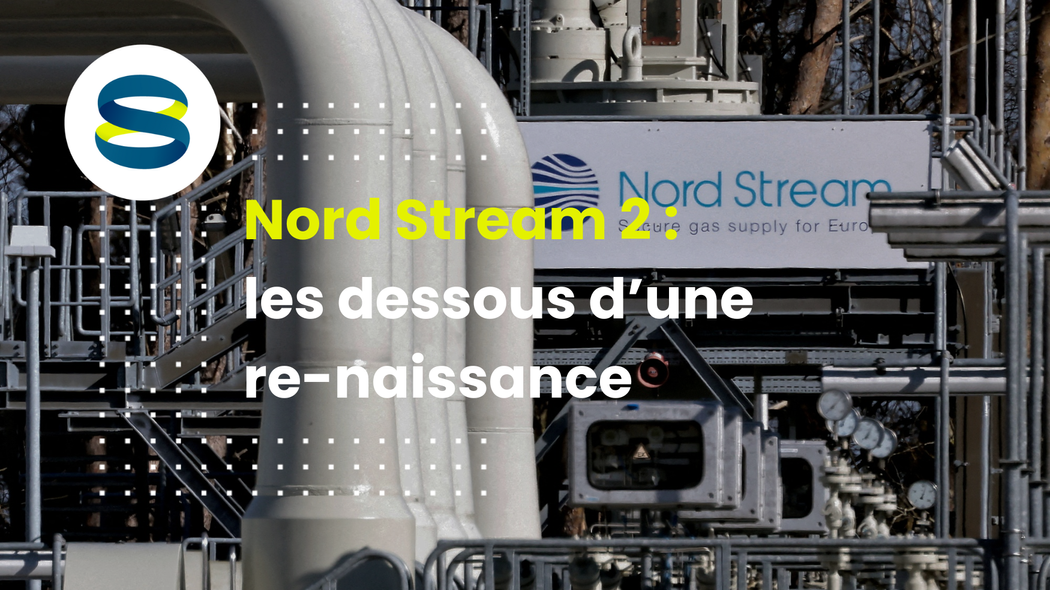
March 2025 marks a rebound in the soap opera Nord Stream 2.
Never put into service, could the gas pipeline finally become operational? This is what recent confidential discussions between Russia and the United States suggest. While there are many obstacles in the way of Nord Stream 2, the latest strategic changes by the major powers show that energy is a powerful geopolitical weapon.
Between unexpected alliances, environmental controversies, behind-the-scenes negotiations and strategic turnarounds, dive into the heart of energy geopolitics.
Nord Stream is a Russian-European project that was born in 1997.
Its objective: to secure the transport of Russian natural gas to Germany. After the commissioning of the Nord Stream 1 gas pipeline in 2012, Nord Stream 2 aims to increase gas supply in Europe.
The Nord Stream gas pipeline Connects Russia to Germany under the Baltic Sea. It consists of two parallel pipelines.
Nord Stream 1 is the first subsea pipeline commissioned in 2012, after six years of work. Before its sabotage in September 2022, Nord Stream 1 carried up to 55.5 billion m³ of gas per year, over 1,224 kilometers.
Nord Stream 2 is its twin pipe.
Its objective? Doubling total natural gas delivery capacity from Russia to Europe, i.e. 110 billion m³ per year. Although completed in 2021, Nord Stream 2 was never operational...
The Nord Stream gas pipeline project was born from a Russian-European energy alliance :
This win/win strategic alliance between Europe and Russia lasted for fifteen years. Pillar of European energy security, Nord Stream 1 guarantees the supply of natural gas to Europe until 2022. Before the war in Ukraine, the gas pipeline carried 55% of German gas imports, 40% of which were sold to other European countries.
In return, Russia asserts its supremacy on the European gas market, forging a close link with Europe. This relationship — admittedly imperfect — contributes to maintaining geopolitical stability in Europe, interrupted by the invasion of Ukraine.
The year 2022 marks the end of European imports of Russian natural gas through submarine pipelines. In February, Germany suspended the commissioning of Nord Stream 2. In September, the sabotage of the Nord Stream 1 gas pipeline put an end to its operation.
On February 24, 2022, Russia invaded Ukraine. It is the start of a escalation of sanctions and counter-sanctions between Europe and Russia.
Energy is becoming a geopolitical weapon.
On February 25, the European Union announced a first package of sanctions. At the end of February, the cleaver fell on Nord Stream 2. Germany is suspending its certification. Russia is responding by reducing its gas supplies to Germany via Nord Stream 1.
In September 2022, the operation to sabotage the Nord Stream 1 gas pipeline brings the final stop to the delivery of Russian gas by submarine route. The European Union is reorienting its purchases towards liquefied natural gas (LNG) and new suppliers to reduce its dependence on Russian energy.
As soon as it was built, the Nord Stream 2 gas pipeline drew criticism. Until 2022, the United States takes a dim view of the strengthening of the energy alliance between Russia and Europe.
Fearing Russian competition for its liquefied natural gas exports (GNL), President Donald Trump took sanctions in 2019. The freezing of assets and the revocation of American visas for companies are temporarily halting work. An agreement was reached in 2021 between Germany and the United States. It guarantees the continuation of the transit of natural gas via Ukraine.
The Nord Stream 2 company is fighting to avoid bankruptcy. But in March 2025, Russian-American discussions revived the idea of a hypothetical commissioning.
The second Trump administration seems to have changed tack. After strongly opposing Nord Stream 2, the United States would bet on its future. According to several sources, the gas pipeline is at the heart of bilateral American-Russian negotiations on the war in Ukraine.
In March 2025, discussions would have raised the possible purchase of Nord Stream 2 by an American investor. In a context where the future of American LNG remains uncertain, the ownership of the gas pipeline would allow the United States to controlling natural gas flows in Europe. By bringing the American state closer to Russia, this purchase could also distance the Chinese rival.
Germany's attitude will be decisive for the future of the Nord Stream 2 gas pipeline. It can relaunch its commissioning by lifting the suspension of certification.
All eyes are now on German conservatives. Can their victory in the February 2025 federal election change the situation?
Parliamentarians are relaunching the debate, such as Thomas Bareiss in a post on social networks: “When peace is restored and the arms go quiet between Russia and Ukraine, relationships will normalize, embargoes will be lifted sooner or later and, of course, gas will be able to flow again, perhaps this time in a pipeline under American control.”
This position is supported by the German industrialists. Nord Stream 2 gives rise to hope fora drop in gas prices and an economic recovery. It would also allow Germany to reaffirm its geopolitical role in Europe, as a gas hub.
Despite these initial positions, uncertainty persists. The position of the future German Chancellor Friedrich Merz will be decisive. If in 2022, he called for the immediate end of energy dependence on Russia, a change in position would mark a historic reversal by the Conservatives.
Faced with the possible restart of Nord Stream 2, Europe is balancing concerns, oppositions and pragmatism. Few countries have spoken out following the Russian-American discussions.
Wary of Russia, The countries of the East (Poland, Baltic countries, Slovakia, Czech Republic...) should confirm their historic opposition to Nord Stream 2 which bypasses the transit of gas through Ukraine.
The European Union is also an obstacle. In 2018, the European executive declared that the” Nord Stream 2 did not contribute to EU energy policy goals such as energy security or the diversification of supplies. ” If the current European Presidency has not spoken, a directive imposes binding rules on Gazprom. In the name of competition, it requires the opening up of the use of the gas pipeline to other companies. In November 2024, the European Court of Justice confirmed this obligation by rejecting Gazprom's appeal against this directive.
The potential commissioning of the Nord Stream 2 gas pipeline crystallizes tensions. Economic, geopolitical and ecological interests are opposed.
Fuelled by the war in Ukraine, the surge in energy prices has destabilized European economies. Germany has been hit hard, with an economy that has been in recession for three years and a manufacturing industry in crisis.
From a strictly economic perspective, the commissioning of Nord Stream 2 raises hope. Reopening the Russian tap could lower natural gas prices and reduce consumers' energy bills.
How to adapt your company's energy strategy in the face of uncertainty?
💡The energy consulting and sourcing firm, Sirenergies supports businesses for Decrypt their supply contract, select the best supplier and To pilot the energy strategy. Contact us
Real electroshock, the war in Ukraine revealed the limits of energy sovereignty of Europe.
Since 2022, the European Union has been acting to reduce its dependence on Russian natural gas by 2027. The RepowerEU map combines two strategies:
Would the commissioning of Nord Stream 2 mean a going back? Could it threaten Europe by recreating a double dependence on energy to Russia, a contested partner, and to the United States, an ally that has become unpredictable?
Natural gas has a high environmental impact. According to ADEME, it emits 243 g eQ.co2/kWh, compared to 44 g eq.CO2/kWh for photovoltaic electricity and 14 g eQ.co2/kWh for onshore wind.
The resumption of the delivery of Russian natural gas to Europe would be bad news for the environment. By facilitating access to polluting fossil gas, Nord Stream 2 would send a negative signal for the climate.
Less pressurized, European countries could Favoring natural gas again at the expense of the energy transition and renewable energies. Nord Stream 2 could mean a step backwards for the planet.
To conclude...
The commissioning of Nord Stream 2 remains hypothetical in the face of numerous technical, financial, legal and geopolitical obstacles. But this pipeline illustrates the central role of energy in the global geopolitical and economic debate. In a world where powers are reshuffling their cards, the future is uncertain. The opening of Nord Stream 2 highlights contradictions and poses fundamental questions about the hierarchy of global priorities: geopolitics, economy, energy sovereignty or climate?
In a few clicks, organize an exchange with one of our experts.


weekly newsletter subscribers

4.9

.png)

Le prix Forward est fixé à l'avance (sécurité budgétaire), tandis que le prix Spot varie heure par heure selon le marché (opportunité mais risque élevé).
Absolument. La réforme des heures creuses vise à absorber la surproduction solaire en milieu de journée. Les créneaux d'heures creuses se déplacent progressivement vers la plage 11h00 – 17h00, notamment en été. C'est une opportunité majeure pour les sites industriels ou tertiaires capables de flexibilité.
Conseil stratégique :
L'impact dépendra des prix de marché. Le mécanisme prévoit une redistribution si les prix dépassent 78 €/MWh. Cependant, si les cours restent bas (actuellement autour de 60 €/MWh), le dispositif ne s'activera pas. La facture sera alors indexée à 100% sur les prix de marché, rendant le choix du fournisseur et du moment d'achat critiques.
Chaque modèle d'IA répond à un besoin spécifique du cycle d'achat :
L'expertise humaine reste néanmoins indispensable.
Ce seuil est jugé élevé par rapport aux prévisions actuelles du marché. Si le prix de l'électricité reste en dessous de 78 €/MWh, les entreprises ne bénéficieront d'aucune redistribution. Cela signifie que la protection promise par la réforme pourrait être inexistante dans un marché baissier, d'où l'importance de stratégies de sourcing agiles et d'outils de monitoring comme Pilott.
Car les marchés dépendent de facteurs exogènes imprévisibles (géopolitique, météo soudaine, politique) que les modèles basés sur l'historique ne peuvent pas anticiper, tout comme on ne prédit pas le Loto.
La Vente de Nucléaire Universelle (VNU) est le nouveau mécanisme de régulation des prix de l'électricité en France. Contrairement à l'ARENH, il ne s'agit plus d'un volume fixe à prix réduit, mais d'une redistribution financière des revenus excédentaires d'EDF aux consommateurs, basée sur les prix de marché et les coûts de production du nucléaire historique.
Non. L'IA traite la donnée (data processing), mais l'analyste apporte la compréhension du contexte (market sentiment) et la prise de décision stratégique.
La Multiannual Energy Programming (PPE) is the strategic management tool for France's energy policy. Established by the 2015 law on energy transition for green growth (LTECV), it serves as a compass for the State, communities and businesses.
Concretely, the PPE sets the priorities for action of the public authorities for the management of all forms of energy on the national territory. It covers a period of ten years, divided into two periods of five years, and must be revised periodically to adapt to technological and economic developments.
It deals with major topics such as:
It is crucial not to confuse it with National Low Carbon Strategy (SNBC). While SNBC sets carbon budgets (the ceilings for greenhouse gas emissions by sector), the PPE determines the technical and energy resources to achieve them.
In 2025, the supplier had a NPS (Net Promoter Score) of +16 and a note of 4,17/5.
Satisfaction is based on a “zero solicitation” model and 100% in-house customer service in Toulon, guaranteeing proximity and responsiveness that cannot be found with major historical suppliers.
The range E @sy is available in four pricing structures to adapt to each risk profile:
The central objective of PPE 3 is to engage France towards carbon neutrality by 2050 by breaking the country's historical dependence on fossil fuels.
Today, approximately 60% of final energy consumption in France still relies on imported oil and natural gas. PPE 3 aims to radically reverse this trend by setting an ambitious target: to reach 60% of carbon-free energies in final consumption by 2030.
To achieve this, PPE 3 pursues three major sub-objectives:
Instauré en 2017, ce dispositif répond à un enjeu de sécurité nationale.
L'électricité ne se stockant pas à grande échelle, le réseau doit être capable de répondre instantanément à la demande, même lors des pics de froid hivernaux. Le mécanisme incite financièrement les producteurs à maintenir leurs centrales disponibles et les entreprises à réduire leur consommation (effacement) lors de ces périodes critiques.
La fin de l'ARENH (Accès Régulé à l'Électricité Nucléaire Historique) marque l'arrêt de la fourniture d'électricité à prix fixe garanti (42 €/MWh).
Dès le 1er janvier 2026, les entreprises sont exposées aux prix de marché, mais deux nouveaux mécanismes de régulation prennent le relais, bien que leur logique soit différente :
Conseil stratégique : Ne comptez pas sur le VNU pour réduire votre facture en 2026 si les marchés restent stables. Auditez vos contrats dès maintenant pour intégrer une part de prix fixe ou explorer des "Power Purchase Agreements" (PPA) pour sécuriser vos coûts sur le long terme.