




Summarize with AI

March 6, 2026
9
Min reading

Presented as a major technological revolution,AI promises to transform in depth the way we work, analyze and decide.
The energy sector is no exception to this dynamic.
But behind the enthusiastic speeches, is AI really the magic solution for predicting prices and securing energy purchases?
This is the question raised by the co-founders of Sirenergies at the last Gazelec Congress in October 2025.
Beyond the hype, is artificial intelligence actually transforming energy purchases? What are the strengths and limitations of different AI models? Can they replace human expertise?
Sirenergies shares its clear and assertive analysis, through the voice of its president, Emmanuel Sire, and its CEO and CTO, Raphaël Barbate.
Video: “AI and energy price forecasting: myth or reality?” — SirEnergies Business Session - Gazelec 2025
Generative, probabilistic or deterministic AI: AI models are multiplying at a rapid pace.
Behind the generic term “artificial intelligence” there are very different tools, with distinct strengths and limitations.
Some models excel at analysis, others at forecasting or risk management. An efficient energy purchase decision is based on an intelligent combination of tools, guided by thehuman expertise.
In 2022, the stunning arrival of ChatGPT propelled generative AI to the forefront. Since then, it has gradually become an integral part of the daily lives of businesses and the general public.
Generative AI is based on LLMs (Large Languages Model) to write, summarize, dialogue and structure natural reasoning.
It feeds on colossal amounts of data to statistically predict the most likely word (or token)
This strength is also its weakness.
Based on probabilities, generative AI can confidently assert answers... completely false. These Famous hallucinations are becoming problematic when they concern energy purchases. Raphaël Barbate alert :
“The AI that invents a recipe for a sheep's egg omelette is funny. If it invents a market price, it's dangerous for your budget.”
Generative AI acts like an ultra-fast junior, capable of extracting usable synthesis from massive volumes of energy data.
With an advanced search engine (Deep Search), ask for:
“Give me an analysis of the electricity and gas market in Germany over the past week.”
In a few seconds, generative AI intersects twenty sources and produces a structured synthesis.
A watch that required several hours is carried out in less than 30 minutes. The Productivity gain is undeniable.
But that power has its limits.
Generative AI remains a Compiling machine, cold and factual, without business intuition. Precious to understand, it is to be avoided when calculating prices or taking buying positions:

Raphaël Barbate recalls that with generative AI:
“1 + 1 = 2... 90% of the time”
Deterministic AI is based on a Strictly mathematical logic. No coincidence, no interpretation: 1 + 1 will always equal 2.
Models like SARIMAX and SARIMA extrapolate the future from the past.
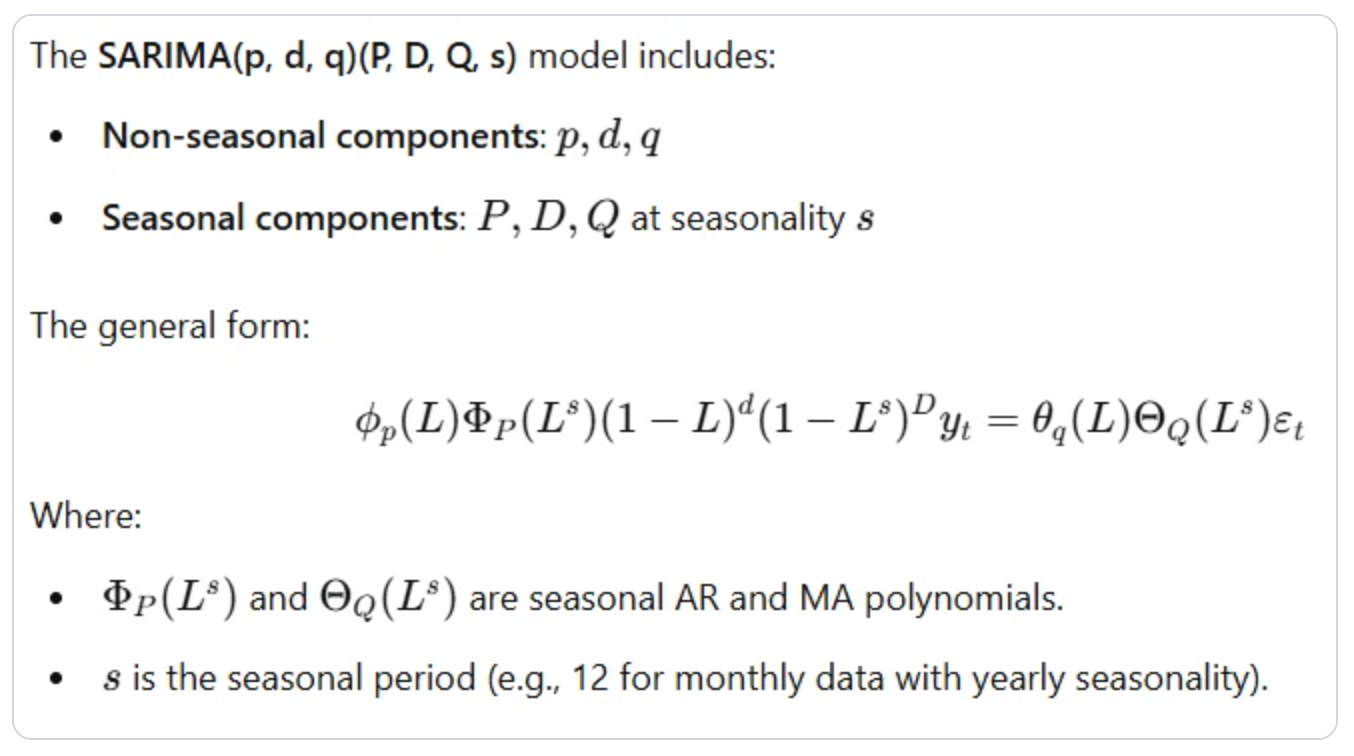
They reproduce logical diagrams by analyzing time series that have already been observed.
They allow you to:
In forecasting energy consumption (forecast), reliability is the priority.
This is the area of excellence in deterministic AI.
For energy purchases, this model makes it possible to precisely size the consumption volumes to be covered by cross-referencing recurring data:
With the same data, deterministic AI always produces the same result.
This reproducibility guarantees the traceability of forecasts. It reinforces confidence in decisions and secures energy purchase budgets.
Monte Carlo simulation, Bayesian networks...: less known to the general public, these probabilistic AI models are pillars of risk analysis.
Probabilistic AI answers questions like: “What is the probability of this event happening?” ”
It does not seek to give a single answer, but explores several possible scenarios, based on hypotheses and input data.
In energy markets where volatility has become the norm, probabilistic AI is unleashing its full potential. It does not attempt to predict an exact price. She quantify uncertainty. It allows you to:
Probabilistic AI will never say: “The price will be €68/MWh.” She will answer: “There is a 70% chance that the price will be between 65 and 70 €/MWh, with a risk of being exceeded in the event of a late cold spell.”
As effective as they are, artificial intelligence models depend on the data available and the hypotheses formulated.
No algorithm can predict the future.
In the energy purchases, confusing forecasting — based on data — and prediction — almost divinatory — can lead to costly decisions.
“You can't predict the Loto numbers before the draw. For tomorrow's Spot Prize, it's the same.”
In both cases, all combinations remain possible.
This comparison by Raphaël Barbate recalls the obvious: AI does not know how to neutralize the part of chance which affects energy prices in the short term.
A future price curve built by AI is never true. It is a mathematical modeling that changes according to assumptions, models, histories, and parameters. AI will never be able to guarantee the price that will actually be charged.
Artificial intelligence ignores operational context of your business or community.
She does not know that:
AI forecasting remains above ground.
Coupling with an energy management tool personalizes the analysis, thanks to the injection of business data.
Pilott combines modeling technologies and human expertise to secure your energy purchasing decisions.
The combined analysis of consumption and prices clarifies your budgetary vision.
{{ask-demo=” /ctas "}}
Artificial intelligence fascinates with its power of analysis, synthesis and calculation.
However, even the most advanced AIs run up against structural blind spots.
La complexity of energy markets, combined with emotional dynamics, requires human expertise to take a step back and decide.
AI is learning from the past.
She is good at identifying recurring patterns in data (such as the W or M patterns that are well known in stock markets).
But she stays helpless in the face of the unpredictable.
Energy markets are regularly disrupted by exogenous events that cannot be fully modelled. However, they are decisive in the formation of electricity and gas prices:
As Raphaël Barbate explains:
“Analyzing the energy market is one thing. Deciding is another.”
The major difference between AI and human expertise lies in this ability to take a stand.
Artificial intelligence describes and quantifies. It outlines scenarios and probabilities. But its conclusion is neutral.
She is not clear: “The market could move up or down depending on the available indicators.”
On the other hand, the human expert assumes his position. It interprets weak signals and transforms analysis into concrete decisions. Like Emmanuel Sire in his weekly column, he is committed to:
“It doesn't smell good, the indicators are in the red, we have to cover 50% now.”
This ability to arbitrate in uncertainty is nourished by elements that AI does not control: detailed knowledge of the market, the experience of previous situations, the understanding of customer issues, and the intuition forged by experience.
If AI provides the dashboard, it is the human who is behind the wheel.
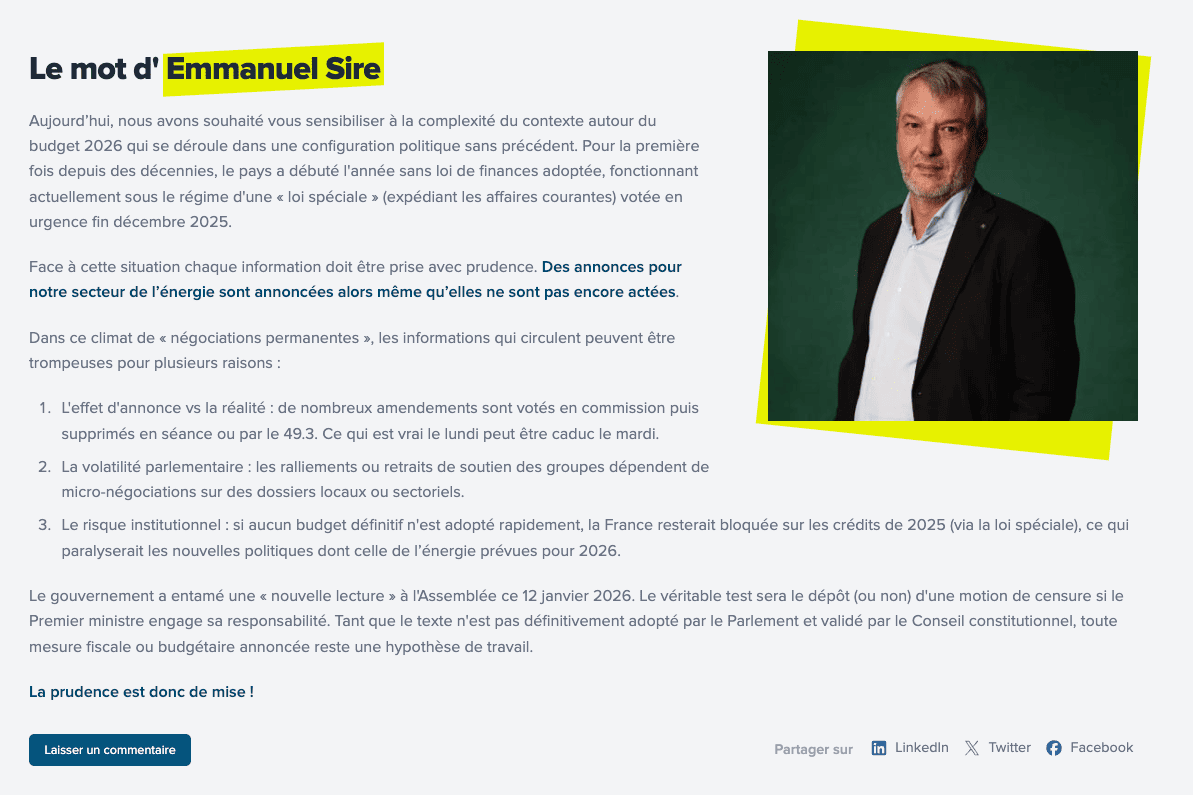
Every Tuesday, our president Emmanuel Sire gives you his analysis of the energy markets (electricity, gas, CO₂) with graphs, clear trends and concrete recommendations. A concentrate of market intelligence, accessible to all.
AI is a powerful tool for energy purchases. But it does not replace judgment or experience.
Artificial intelligence sheds light, structures, and calculates, within the limits of known data.
But only humans can arbitrate, decide and assume fiscal risk. The balanced alliance between artificial intelligence and human intelligence is the key to an efficient, secure and resilient energy procurement strategy.
At Sirenergies, AI is a decision support tool, never a decision maker.
{{ask-advice=” /ctas "}}
In a few clicks, organize an exchange with one of our experts.


weekly newsletter subscribers

4.9

.png)

La Vente de Nucléaire Universelle (VNU) est le nouveau mécanisme de régulation des prix de l'électricité en France. Contrairement à l'ARENH, il ne s'agit plus d'un volume fixe à prix réduit, mais d'une redistribution financière des revenus excédentaires d'EDF aux consommateurs, basée sur les prix de marché et les coûts de production du nucléaire historique.
Absolument. La réforme des heures creuses vise à absorber la surproduction solaire en milieu de journée. Les créneaux d'heures creuses se déplacent progressivement vers la plage 11h00 – 17h00, notamment en été. C'est une opportunité majeure pour les sites industriels ou tertiaires capables de flexibilité.
Conseil stratégique :
La Multiannual Energy Programming (PPE) is the strategic management tool for France's energy policy. Established by the 2015 law on energy transition for green growth (LTECV), it serves as a compass for the State, communities and businesses.
Concretely, the PPE sets the priorities for action of the public authorities for the management of all forms of energy on the national territory. It covers a period of ten years, divided into two periods of five years, and must be revised periodically to adapt to technological and economic developments.
It deals with major topics such as:
It is crucial not to confuse it with National Low Carbon Strategy (SNBC). While SNBC sets carbon budgets (the ceilings for greenhouse gas emissions by sector), the PPE determines the technical and energy resources to achieve them.
Chaque modèle d'IA répond à un besoin spécifique du cycle d'achat :
L'expertise humaine reste néanmoins indispensable.
La fin de l'ARENH (Accès Régulé à l'Électricité Nucléaire Historique) marque l'arrêt de la fourniture d'électricité à prix fixe garanti (42 €/MWh).
Dès le 1er janvier 2026, les entreprises sont exposées aux prix de marché, mais deux nouveaux mécanismes de régulation prennent le relais, bien que leur logique soit différente :
Conseil stratégique : Ne comptez pas sur le VNU pour réduire votre facture en 2026 si les marchés restent stables. Auditez vos contrats dès maintenant pour intégrer une part de prix fixe ou explorer des "Power Purchase Agreements" (PPA) pour sécuriser vos coûts sur le long terme.
Instauré en 2017, ce dispositif répond à un enjeu de sécurité nationale.
L'électricité ne se stockant pas à grande échelle, le réseau doit être capable de répondre instantanément à la demande, même lors des pics de froid hivernaux. Le mécanisme incite financièrement les producteurs à maintenir leurs centrales disponibles et les entreprises à réduire leur consommation (effacement) lors de ces périodes critiques.
Le prix Forward est fixé à l'avance (sécurité budgétaire), tandis que le prix Spot varie heure par heure selon le marché (opportunité mais risque élevé).
The central objective of PPE 3 is to engage France towards carbon neutrality by 2050 by breaking the country's historical dependence on fossil fuels.
Today, approximately 60% of final energy consumption in France still relies on imported oil and natural gas. PPE 3 aims to radically reverse this trend by setting an ambitious target: to reach 60% of carbon-free energies in final consumption by 2030.
To achieve this, PPE 3 pursues three major sub-objectives:
The range E @sy is available in four pricing structures to adapt to each risk profile:
Ce seuil est jugé élevé par rapport aux prévisions actuelles du marché. Si le prix de l'électricité reste en dessous de 78 €/MWh, les entreprises ne bénéficieront d'aucune redistribution. Cela signifie que la protection promise par la réforme pourrait être inexistante dans un marché baissier, d'où l'importance de stratégies de sourcing agiles et d'outils de monitoring comme Pilott.
Car les marchés dépendent de facteurs exogènes imprévisibles (géopolitique, météo soudaine, politique) que les modèles basés sur l'historique ne peuvent pas anticiper, tout comme on ne prédit pas le Loto.
In 2025, the supplier had a NPS (Net Promoter Score) of +16 and a note of 4,17/5.
Satisfaction is based on a “zero solicitation” model and 100% in-house customer service in Toulon, guaranteeing proximity and responsiveness that cannot be found with major historical suppliers.
L'impact dépendra des prix de marché. Le mécanisme prévoit une redistribution si les prix dépassent 78 €/MWh. Cependant, si les cours restent bas (actuellement autour de 60 €/MWh), le dispositif ne s'activera pas. La facture sera alors indexée à 100% sur les prix de marché, rendant le choix du fournisseur et du moment d'achat critiques.
Non. L'IA traite la donnée (data processing), mais l'analyste apporte la compréhension du contexte (market sentiment) et la prise de décision stratégique.

Non. L'IA traite la donnée (data processing), mais l'analyste apporte la compréhension du contexte (market sentiment) et la prise de décision stratégique.
Chaque modèle d'IA répond à un besoin spécifique du cycle d'achat :
L'expertise humaine reste néanmoins indispensable.
Car les marchés dépendent de facteurs exogènes imprévisibles (géopolitique, météo soudaine, politique) que les modèles basés sur l'historique ne peuvent pas anticiper, tout comme on ne prédit pas le Loto.