




Summarize with AI

January 28, 2026
8
Min reading
The history of nuclear energy in France really began at the end of the Second World War. In 1945, General De Gaulle decided to create the Atomic Energy Commission (CEA) in order to accelerate the industrialization of this technology.
This great economic and industrial company will raise France to 2nd place in the world in terms of nuclear control and installed capacities.
As we know, periods of political instability often bring issues to the forefront. energy independence. As we will see, the various oil shocks have largely contributed to the acceleration of nuclear development in France.
The first research concerning radiation and its effects dates back to the beginning of the 20th century. The First World War then greatly slowed down research on the subject, so we had to wait until the 1930s before discovering in particular The principle of nuclear fission. During the decade 1930-1940, things accelerated, scientists from all over the world then took up the subject of atomic energy.
In 1939, the four French researchers Joliot-Curie, Von Halban, Perrin and Kowarski wrote a major article and filed several patents concerning nuclear fission.
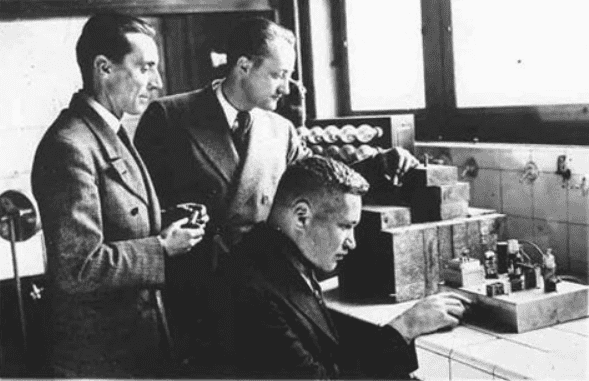
Joliot-Curie, Von Halban, Perrin and Kowarski — Source: Wikipedia
Nuclear fission technology consists in projecting a neutron onto an unstable heavy atom. The latter will then explode into two lighter atoms.
This nuclear fission reaction will release a significant amount of energy which will cause new atom fissions, and so on. It is a chain reaction which follows.
It was from this moment that the public authorities gained confidence and allowed Frédéric Joliot-Curie to begin large-scale research work. The two uses envisaged are obviously energy production but also armaments.
Unfortunately the Second World War stopped this momentum. France was then excluded from Anglo-Saxon research for economic and military reasons. It is therefore in complete autonomy and independence that the work will resume at the end of the war.
France then began a nuclear program that was both civilian and military in parallel. We will focus only on the civilian component of the program in this article.
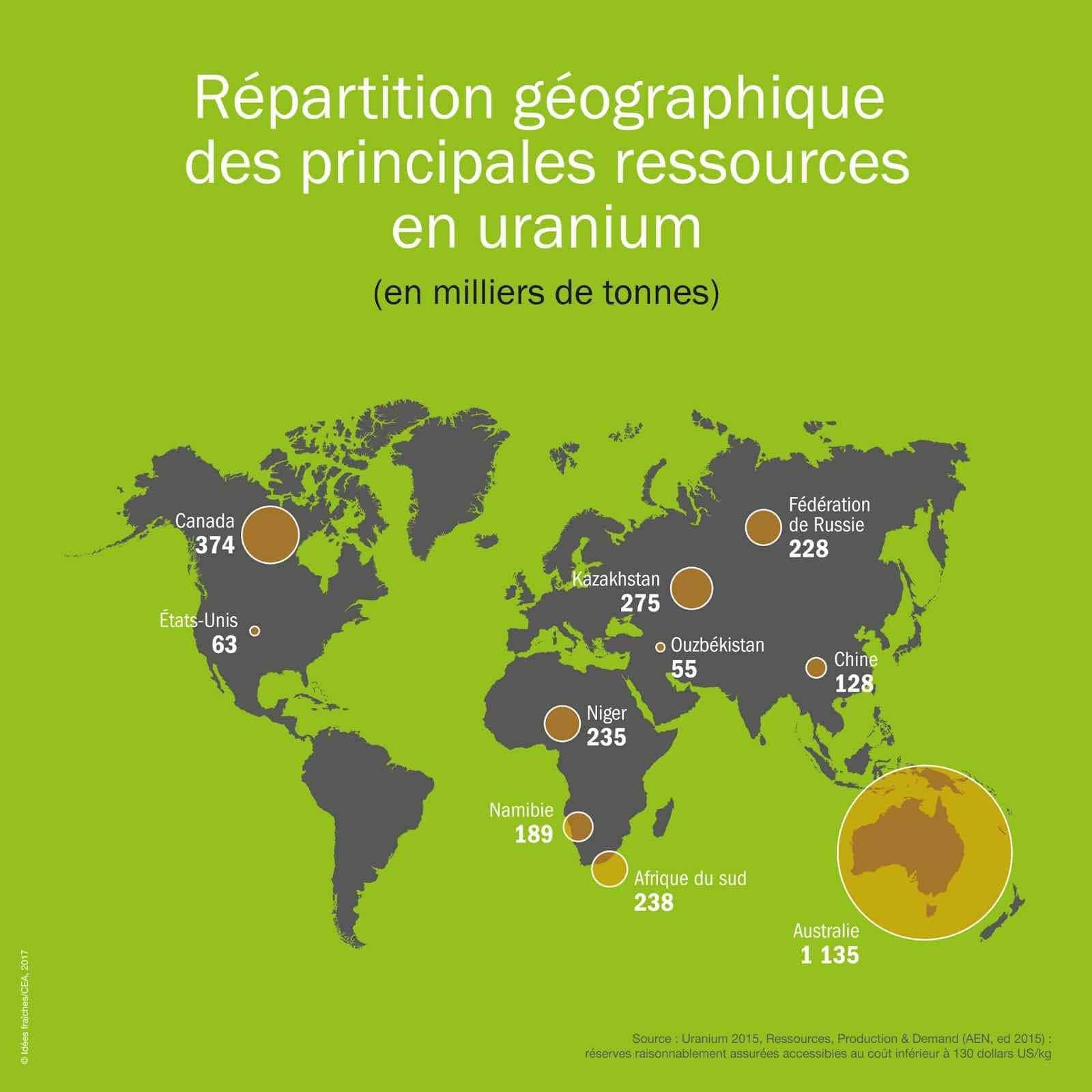
The first question addressed is that ofuranium supply. It is essential to be able to dispose of them at will in order to be able to carry out the tests successfully.
Source: CEA
A great deal of research has been launched on French territories (mainland and overseas), initially exclusively conducted by the CEA then opened to private companies to stimulate discoveries.
In a second step, the construction of a atomic battery (Zoé) is one of the CEA's missions. Before the 1970s, the French nuclear program consisted of many different technologies:
France does not yet control the complete cycle of production and enrichment of uranium. It is because of major geopolitical events that France will accelerate its program to nuclearize the French energy landscape.
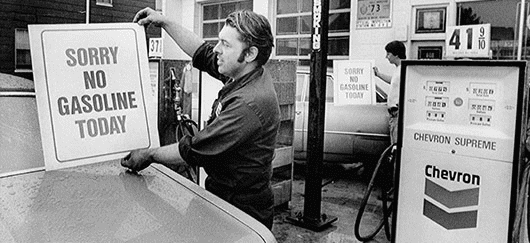
In 1973, following the Yom Kippur War, a Major oil crisis begins. The countries of OPEC (Organization of Petroleum Exporting Countries) are organizing to raise oil prices in retaliation for the occupation of territories by Israel since 1967.
France's oil bill has thus quadrupled in the space of two years (from 1972 to 1974).
Consequences of the 1st oil shock — Source: ConnNAISSANCE DES ÉNERGIES
On March 6, 1974, Pierre Messmer, then Prime Minister, announced the famous” Plan Messmer ”.
The aim is to restore France's energy independence by building more than 13 nuclear power plants of 1,000 MW each.
In France we don't have oil, but we have ideas!
Valéry Giscard d'Estaing's famous sentence refers explicitly to the implementation of these measures (but also to the time change). The desire of the public authorities is to reduce the consumption of petroleum products in favor of Electricity. This is the real beginning of the French nuclear power program.
As Bertrand Barré (former director of reactors at the CEA) describes very well, before this crisis, the technologies used were numerous and there were several experimental reactors. In order to successfully carry out this large-scale project, it was necessary to select the technologies and to select only the most effective in economic terms.
After numerous negotiations and negotiations between manufacturers and the French government, it is finally The pressurized water model who is being held. EDF therefore decided to develop the technology supported by the Framatomet group.
A real industrial machine is then started, with for example the construction of several identical nuclear units in order to increase the rates and the efficiency of the production chain.
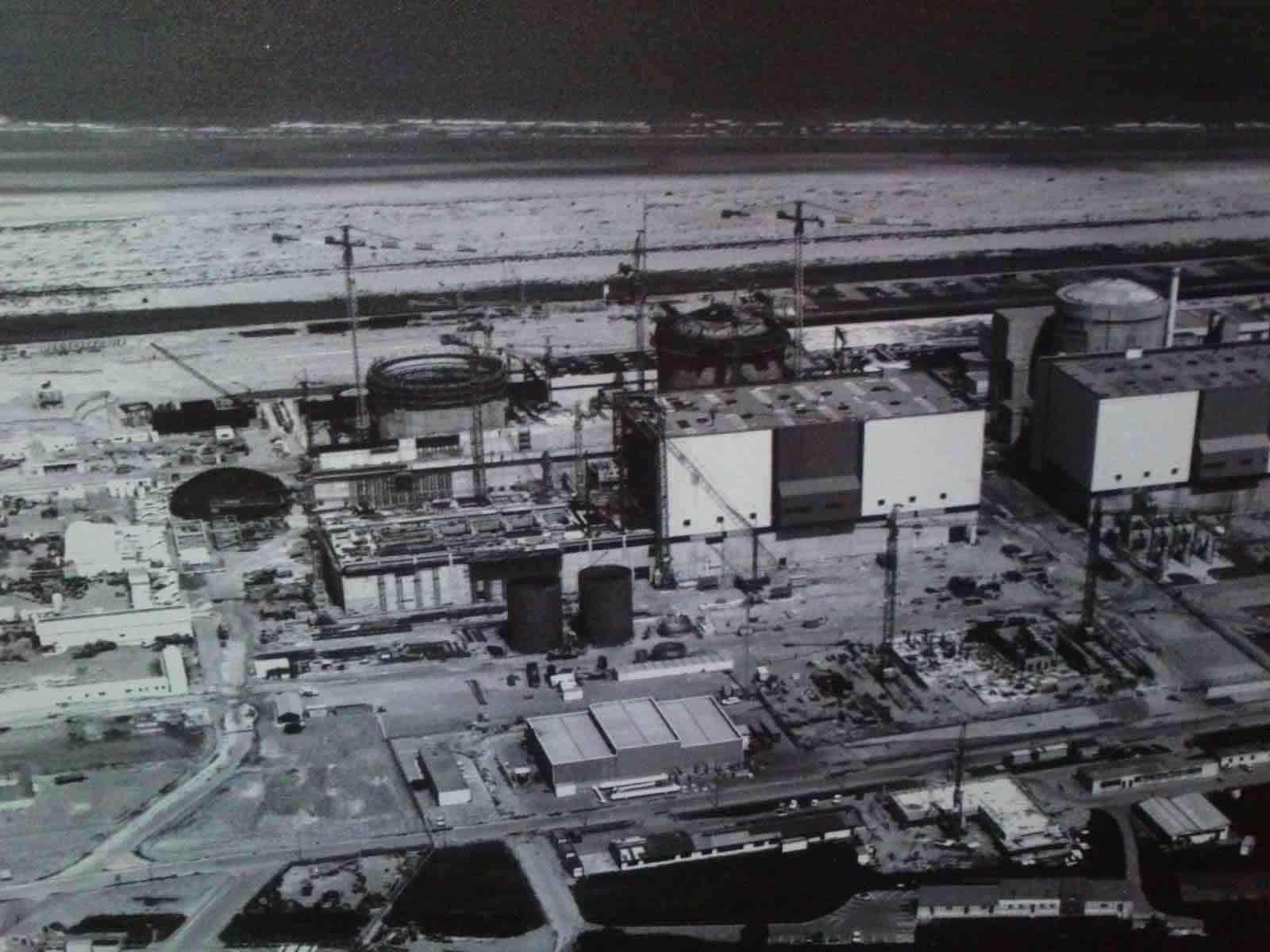
Construction of the Graveline power plant — Source: Wikipedia
As a reminder, no country in the world (except the United States) at that time invested as much effort and resources in nuclear production.
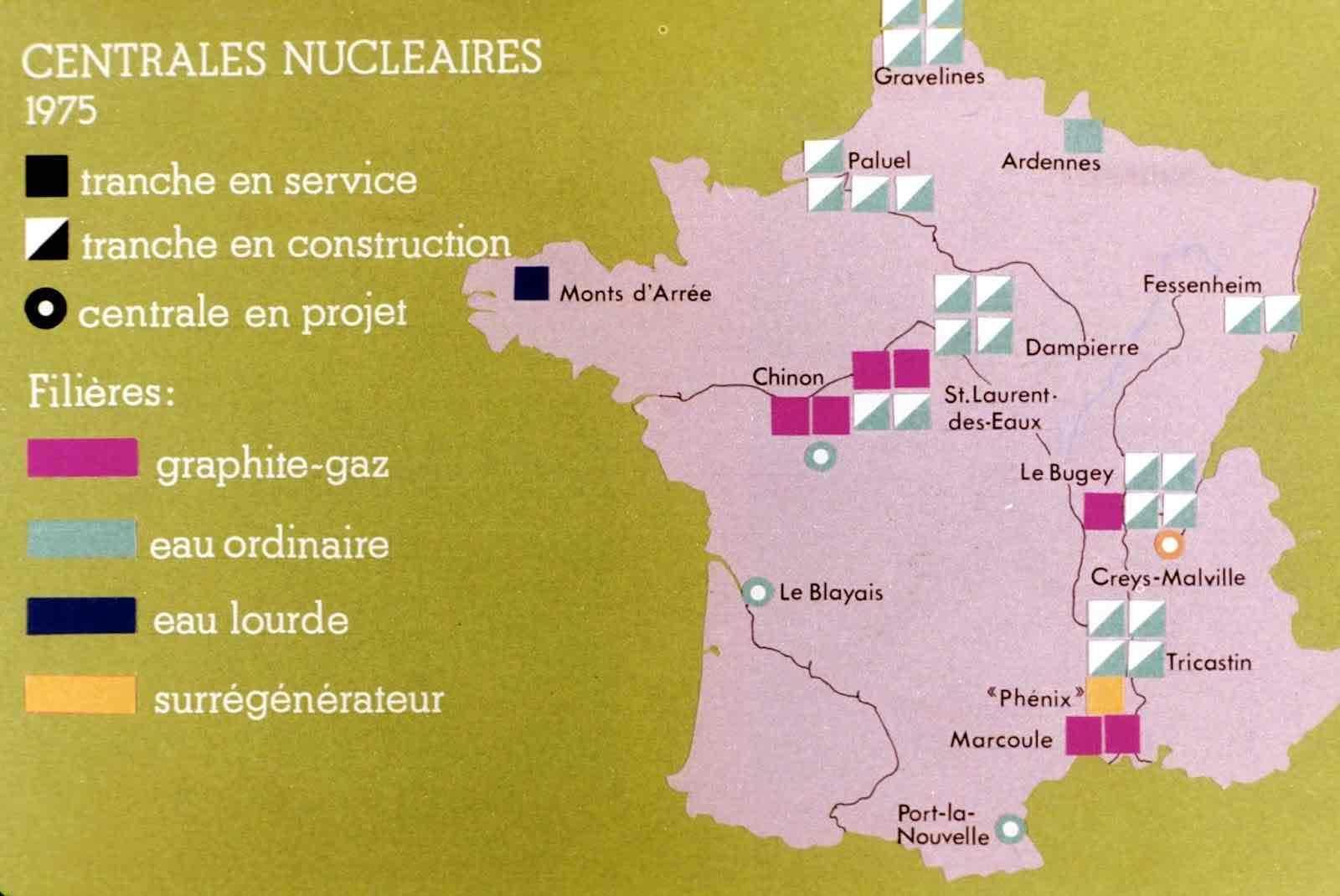
France is therefore pursuing its industrial project and must adapt its infrastructures. The question of waste management is central to any nuclear policy. This is why the waste treatment center in La Hague has been modified in order to accommodate highly more radioactive waste.
During this period, The share of nuclear power in electricity production rose from 37% in 1981 to 55% in 1984. This evolution is phenomenal, nowadays no means of production has experienced such an expansion in such a short period of time.
Construction is continuing at a significant pace. For example, eight nuclear units ordered between 1975 and 1982 went into service from 1984 to 1987. These include the Paluel and Flamanville power plants.
The installed capacity of these power plants is still increasing to 1,300 MW. Between 1985 and 1995, most countries in the world slowed down their nuclear programs.
As early as 1975, some environmental organizations lobbied to reduce installed capacity.
France committed itself to a nuclear program following the Liberation, but especially following the oil shocks. It is therefore inevitably the geopolitical situation in France that caused these massive investments.
If we put aside liberalization of electricity markets (for which it is very difficult to draw a conclusion today) occurred in the 2000s, French nuclear power was a total success. France has acquired the power to meet its energy needs and to export electricity.
France has thus spread throughout the world and has been able to sign numerous contracts in Iran, South America, China, etc.
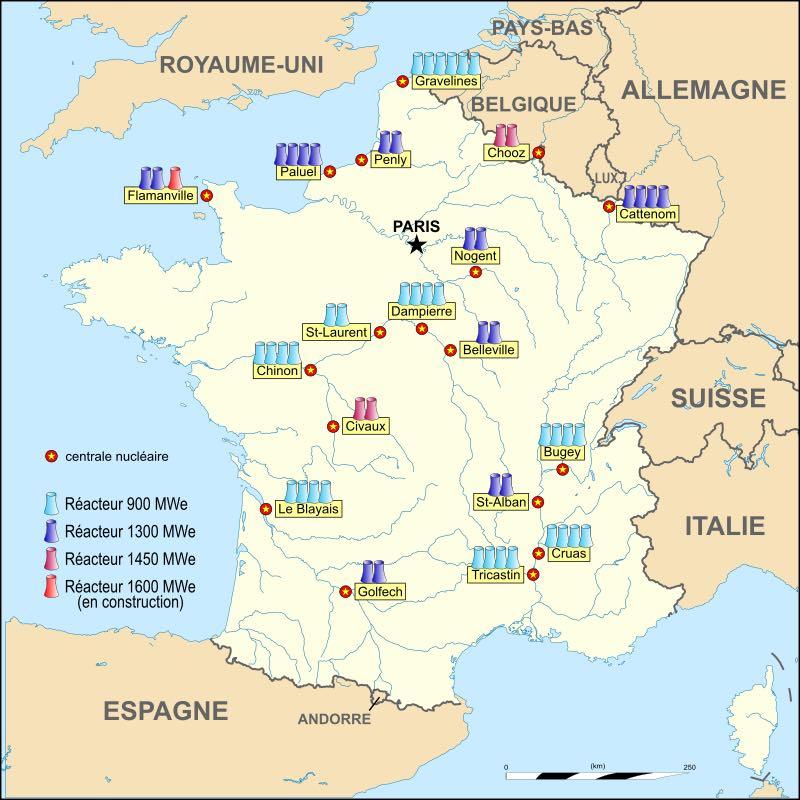
Currently, France has 56 reactors in working condition. The ASN (Nuclear Safety Agency) carries out maintenance operations every year, which reduces the availability rate of these power plants.
Since 2005, ASN has carried out more than 786 scheduled reactor shutdowns.
To find out more do not hesitate to consult our article: Nuclear safety: How to ensure the safety of nuclear power plants?
As an avid reader of SirEnergies, you know that Nuclear energy represents a very important part of the electricity produced in France.
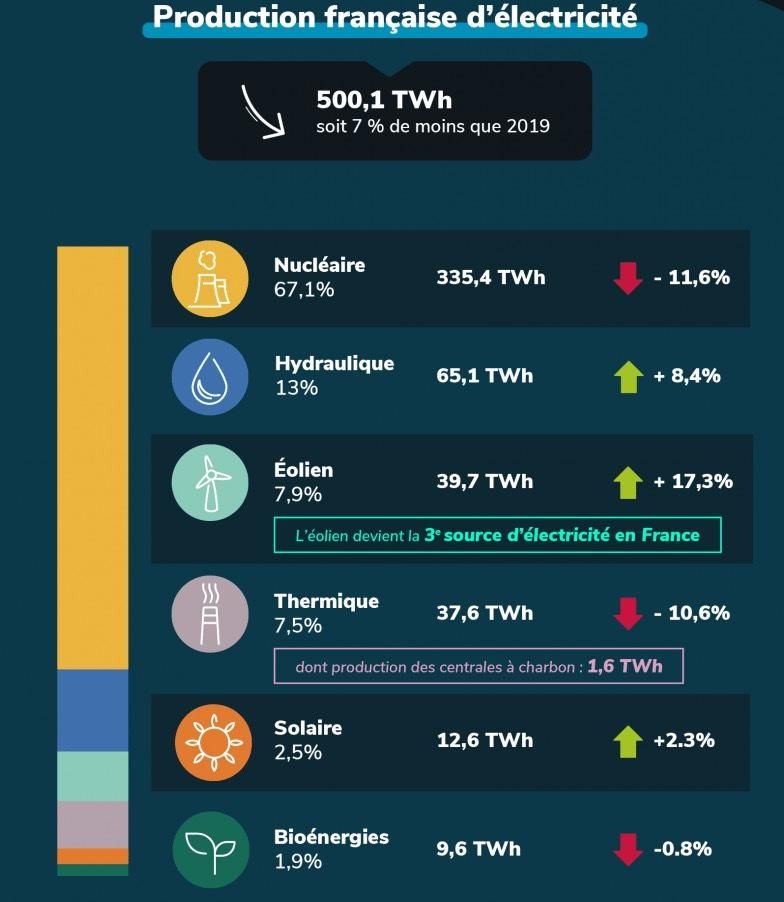
In 2020, Nuclear power represented more than 67% of the electricity produced in France, the renewables continuing to develop.
However, to ensure the energy transition that is in front of us, nuclear power seems to be the essential transition energy thanks to its abundance and the fact that it does not emit CO2 in the atmosphere.
France has been able to develop an entire generation of research engineers, managers and qualified technicians. It is this generation that was able to successfully carry out this large-scale industrial project, which is unequalled in the world.
Today the situation is very different. The EDF group had to deal with the retirement of this generation, and this explains the numerous delays observed on the Hinkley Point or Olkiluoto (Norway) construction sites. During the 2010s, it was the very idea of one day seeing this new type of reactor functioning that seemed to go away.
Today, China and other countries can boast of having a working EPR. France, through EDF, has contributed to its projects around the world.
EDF recently once again pushed back the provisional commissioning date for our Flamanville EPR. We will have to wait until mid-2023 (at least) before seeing it deliver its first kWh.
The history of the nuclear industry in France has not finished being written. Very recently, during the presentation of the France 2030 recovery plan, Emmanuel Macron announced that he wanted to make SMR the spearhead of nuclear power in France. These Small Modular Reactors would have a power of between 50 and 300 MW.
Their reduced size could make it possible to reduce all waste production and management costs. The recovery plan also presents six projects concerning the new EPR model (EPR 2) by 2050.
To go further, do not hesitate to read our article: What are the differences between an EPR and an SMR?
The quantity of ARENH (Regulated Access to Historic Nuclear Energy) that a site can benefit from depends on its consumption profile, and more precisely on its consumption during the hours called “ARENH”.
SirEnergies advises you for Advance your ARENH law and increase the possible share of ARENH in your price formula. This will have a direct impact on Lower your electricity bill.
Our tools analyze your past consumption to give you advice for optimizing your ARENH right.
Click below for more information:
In a few clicks, organize an exchange with one of our experts.


weekly newsletter subscribers

4.9

.png)

En 2025, la France a atteint un solde exportateur net de 92,3 TWh, battant le précédent record de 2024 (89 TWh).
Tertiary companies must manage their energy costs while guaranteeing the comfort of users (offices, shops, services). Consumption is often linked to heating, air conditioning and lighting, which requires precise monitoring to avoid budgetary excesses.
One invoice consists of several elements: consumption, supplier share, taxes and contributions. The analysis of each line makes it possible to identify possible errors and to check the consistency with the signed contract.
The industry is concerned by TICFE, TICGN and other contributions that may represent an important part of invoices. Sirenergies identifies cases of exemption and accompanies the procedures to benefit from them.
La réussite d'un projet collectif énergie repose sur trois piliers fondamentaux :
The range E @sy is available in four pricing structures to adapt to each risk profile:
Le transport (RTE) correspond aux "autoroutes" de l’électricité. Il s’agit de transporter de très grandes quantités d'énergie sur de longues distances, depuis les centrales de production (nucléaires, barrages, parcs éoliens offshore) vers les régions de consommation.
La distribution (Enedis) s'apparente aux "routes départementales" et aux rues. Elle récupère l'électricité à la sortie du réseau de transport pour la livrer directement chez le client final, en abaissant la tension pour qu'elle soit utilisable par vos appareils.
Parce que la puissance souscrite en kVA détermine le prix de l'abonnement et que tout dépassement peut entraîner des surcoûts importants.
C'est l'indicateur d'efficacité d'un appareil électrique ; il représente le ratio entre la puissance active (utile) et la puissance apparente (totale).
Le kVA mesure la capacité maximale que votre compteur peut supporter à un instant T, tandis que le kWh mesure la quantité d'énergie consommée sur une durée.
L'abondance de production française tire les prix du marché de gros vers le bas.
En vertu du mécanisme de l'Ordre de Mérite (Merit Order), les centrales les moins coûteuses (nucléaire, renouvelables) couvrent la demande plus souvent, évinçant les centrales à gaz ou charbon plus onéreuses.
Cela multiplie les épisodes de prix bas, voire négatifs, sur le marché spot.
Oui, elle est considérée comme une énergie renouvelable à faibles émissions de gaz à effet de serre.
De plus, l'eau ne subit aucune transformation chimique durant le cycle de production et réintègre son milieu naturel en aval.
Cependant, la construction de barrages nécessite des mesures pour protéger les écosystèmes (débit minimum, passes à poissons).
Le processus repose sur l'utilisation de la force de l'eau (énergie cinétique) issue des courants, des chutes d'eau ou des dénivelés. Le fonctionnement suit trois étapes clés :
Ce record de 92,3 TWh s'explique par la conjonction de trois facteurs :
This makes it possible to choose the right time to contract, secure your budgets and anticipate increases.
Exceeding capacity leads to financial penalties and can impact the size of the contract. Adjust the correctly subscribed power makes it possible to avoid these additional costs.
Some businesses may obtain a partial or total exemption from the TICFE or the TICGN, depending on their activity and energy intensity. The support of an expert makes it possible to identify the eligibility criteria and to put together the file.
Le dispositif ARENH a laissé place au VNU (Versement Nucléaire Universel).
Ce changement structurel expose davantage les entreprises aux prix de gros, rendant la gestion des risques plus complexe qu'auparavant.
Il devient alors indispensable de définir une stratégie d'achat d'électricité avec Sirenergies pour lisser l'impact de la volatilité des marchés sur votre budget.
Among the taxes include TICFE, TICGN, CTA, CJA and TURPE. They represent a significant part of the bill and vary according to consumption profiles. Understanding them well is essential to optimize costs.
In 2025, the supplier had a NPS (Net Promoter Score) of +16 and a note of 4,17/5.
Satisfaction is based on a “zero solicitation” model and 100% in-house customer service in Toulon, guaranteeing proximity and responsiveness that cannot be found with major historical suppliers.
Tertiary companies are concerned by taxes such as TICFE or TICGN. Sirenergies checks the accuracy of invoices, identifies possible exemptions, and helps correct errors to sustainably reduce costs.
Sourcing consists in identifying and analysing the offers of several electricity and gas suppliers. This approach makes it possible to obtain contracts adapted to the consumption profile and budgetary constraints of the company.
C'est le levier le plus rapide pour obtenir des résultats visibles. L'éclairage représente environ 40 % de la consommation d'électricité d'une commune.
Passer au LED avec pilotage intelligent permet de réduire la facture de 50 à 80 %, avec un retour sur investissement (ROI) rapide, souvent estimé à 2 ou 3 ans.
The €/MWh is a price unit used in wholesale markets, while kWh is the unit visible on your bills.
Le calendrier 2026 impose deux échéances majeures :
Pour simplifier ces démarches, vous pouvez centraliser vos données de consommation avec la plateforme Pilott de Sirenergies, garantissant ainsi la conformité de vos rapports réglementaires.
It allows you to prove your commitment to the energy transition and to meet regulatory requirements.
Farms are subject to taxes such as TICFE or TICGN. Sirenergies verifies their application, identifies cases of exemption and accompanies the procedures to reduce the tax burden.
To calculate Scope 2 emissions, use the following formula:
Energy quantity (kWh) × Emission factor (kg CO₂ e/kWh).
Use databases like ADEME for precision.
Un appel d’offres permet de mettre en concurrence plusieurs fournisseurs d’électricité et de gaz afin d’obtenir des conditions contractuelles optimisées. C’est une démarche transparente qui permet de choisir l’offre la plus adaptée aux besoins budgétaires et techniques de l’organisation.
Yes. The supplier guarantees an offer 100% renewable via the official Guarantees of Origin (GO) mechanism.
For the most demanding companies, the offer GREENVOLT+ ensures very low carbon intensity electricity, sourced exclusively from independent French producers (hydraulic, wind, solar).
These are signals sent by RTE during periods of tension on the electrical network. The Sirenergies tool informs you in real time to anticipate your uses.
The subscribed power must be calculated according to the consumption profile and uses (heating, industrial processes, tertiary equipment). One fine analysis makes it possible to ensure the adequacy between real need and contract.
Communities are subject to taxes such as TICFE or TICGN. Sirenergies analyzes invoices, identifies exemption possibilities and fixes possible errors to reduce the tax burden.