




Summarize with AI

February 13, 2026
5
Min reading
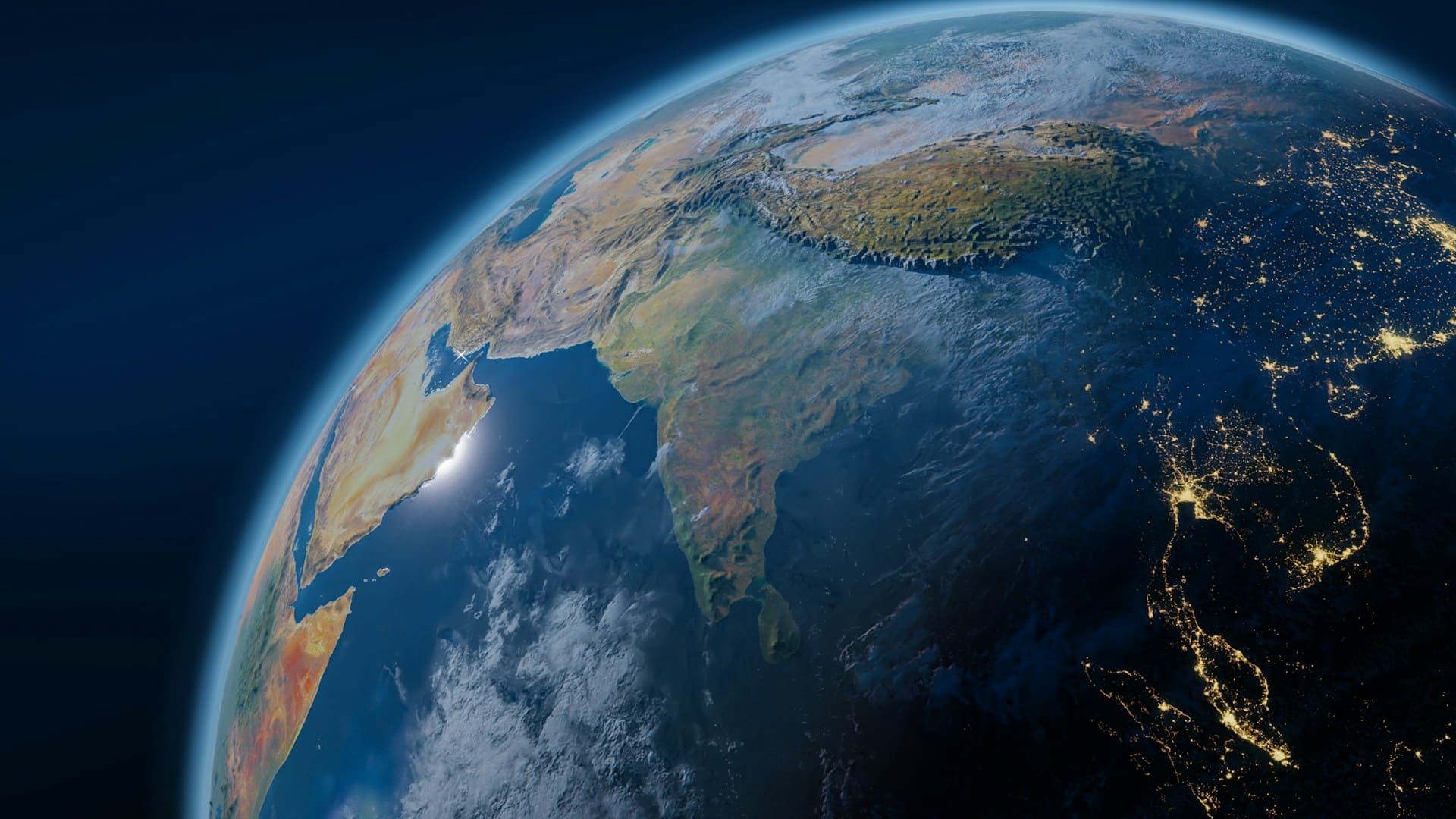
The Earth rotates on itself around its axis and around the Sun. It is thanks to a flow of energy that this is possible. Energy that comes from different sources. SirEnergies explains everything about this phenomenon.
If the Earth rotates on itself, it is in part thanks to The energy that is in its core. It was during her training that she stored all this energy.
The first phase of Earth's existence took place 4.5 billion years ago. At that moment, on the outskirts of our galaxy, which is the Milky Way, was a vast Gas and Dust Cloud. This cloud called a molecular cloud was formed from the debris of stars that belonged to a primitive universe that exploded. This led to the dispersion of numerous particles including heavy elements such as iron, aluminum...
Gravity kept them in space and made them rotate around themselves. In This Rotational movement, also called revolution, they came closer to each other. This is how the formation of the solar system began.
The particles then compressed little by little and their accumulation increased the speed of rotation of the cloud. A good part of the energy provided by the various materials was concentrated in the center. It was she who became the Sun.
The Heaps of Debris Continued to Clump Together Around the Sun, which gave rise to protoplanets. These planet embryos later merged to become larger and form the current planetary system: Earth, Mars... Being Made Up of Rocks Which were already spinning, the rotational movement continued.
After its formation, Earth was still in a primitive stage with a Temperature that reached 4700°C. This heat is due to collisions between the protoplanets that constitute it. Over the years, it cooled and the lightest elements came to the surface. Those like iron that were heavier have sunk in and are now the core.
One of the shocks that were between the Moon and the Earth caused the two nuclei to merge. There was then an alloy between iron and liquid nickel giving a denser composition. This one migrated to the center and carried silicon, gold, oxygen, tungsten in its path... This Accumulation of materials Produces energy that gives Earth a force and a gravitational pull. It also participates in its rotational movement.
The collision also made it possible to differentiate and organize the different layers of our planet. At the center, there is the heart, which is made up of a solid internal part and another that is liquid. Then there are the Internal and external coats Then finally the Earth's crust which is on the surface.
4.535 million years ago, when it was entirely liquid, this core saved our planet from a solar storm. He prevented it from disappearing by creating a magnetic shield that allowed it to maintain its atmosphere.
The Earth rotates around its axis, but also revolves around the Sun. This rotational movement is not unique to our planet alone. Everyone in the solar system also revolves around this energy ball. This phenomenon is explained by theGravitational attraction That exists between the different stars.
At its creation, the Earth received a rectilinear impulse. It means that it was rotating on itself and following a straight line. At the same time, the Sun, while performing its rotational movement, attracts it towards itself thanks to gravity.
However, it is confronted with the magnetic force that the Earth's core also deploys. This Energy Exchange Allows our planet to stay a good distance from the Sun.
In addition to its rectilinear trajectory, there is this attraction, which is perpendicular. It is the addition of these two opposite movements that causes it to have a circular motion around the Sun. In addition, the revolution of the Earth around this big ball of energy is possible due to theAbsence of Obstacles in Space.
The stars are now very far apart. This avoids any risk of collisions or friction that could prevent them from turning. This distance also makes the attraction weak, as part of Solar Energy dispersed before reaching Earth. She is then Distributed in the Atmosphere, in the ground, in the trees... It is also it that allows us to have the different seasons that we observe.
Earth's Revolution is generally influenced by the movements of ice, air, water, and Earth's core. Some periods, it rotates quickly and others, its movement is slow.
According to some studies conducted by scientists, 80% of the variations come from the transport of masses in the atmosphere. The more violent the winds, the more the speed of the Earth's rotation increases. There are also the Tides that deform the oceans and therefore our planet. They usually slow down its rotation, because the movements of the bodies of water disperse some of its energy.
With regard to the Moon, some scientists think that when it moves away, The Earth's Movement Is Continuing Down. As it gets closer, the revolution accelerates. The distance between these two stars would also cause variations.
Other observations have shown that seismic phenomena also affect the rotation speed of our planet. For example, in 2010, NASA noticed that it was spinning slower on itself. This observation was made following a powerful earthquake that occurred in Chile on 24 February 2010. According to their analyses, this earthquake, which was on a scale of 8.8, shook the planet a lot and deviated it by 8 cm from its axis.
Added to all this is rock debris and terrestrial dust. Some continue to fall to Earth in small fragments while others pass right by it.
All these variations on its speed of rotation Influence the Length of the Days. The faster it turns the more quickly the days go by. However, the increase or decrease in time is generally a few milliseconds.
Do not hesitate to consult our article on: Metals and Rare Earths: The Invisible Part of the Energy Transition
In a few clicks, organize an exchange with one of our experts.


weekly newsletter subscribers

4.9

.png)

Le calendrier 2026 impose deux échéances majeures :
Pour simplifier ces démarches, vous pouvez centraliser vos données de consommation avec la plateforme Pilott de Sirenergies, garantissant ainsi la conformité de vos rapports réglementaires.
It allows you to prove your commitment to the energy transition and to meet regulatory requirements.
To calculate Scope 2 emissions, use the following formula:
Energy quantity (kWh) × Emission factor (kg CO₂ e/kWh).
Use databases like ADEME for precision.
Yes. The supplier guarantees an offer 100% renewable via the official Guarantees of Origin (GO) mechanism.
For the most demanding companies, the offer GREENVOLT+ ensures very low carbon intensity electricity, sourced exclusively from independent French producers (hydraulic, wind, solar).
La réussite d'un projet collectif énergie repose sur trois piliers fondamentaux :