




Summarize with AI

March 6, 2026
6
Min reading
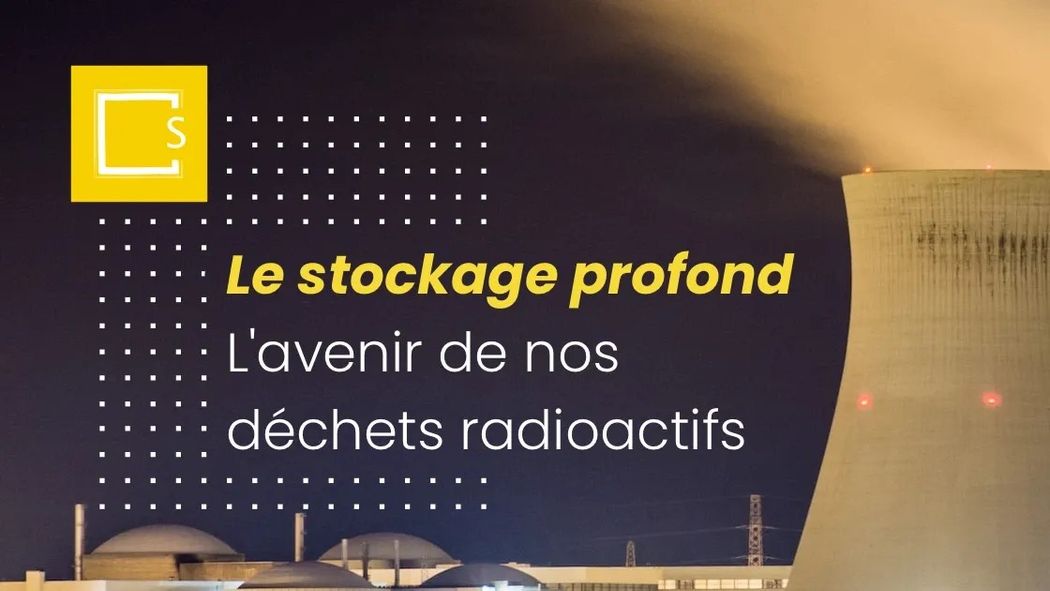
Deep storage is an increasingly important topic for our modern society, which is facing the increasing production of radioactive waste.
Deep storage involves burying radioactive waste at considerable depths, often Several kilometers under the ground, to isolate them from the environment and protect them from future natural phenomena such as earthquakes, floods and volcanic eruptions.
This storage technique has been widely used around the world and is considered to be one of the most viable solutions for managing radioactive waste in the long term. These materials can be of low, medium or high activity, with a long or short lifespan.
So what is the principle of deep storage? How are the locations for the installations selected?
Deep storage is considered to be a long term solution to manage radioactive waste, as it can release radioactivity for thousands of years. So the purpose of deep storage is to protect the environment And the people the harmful effects of radioactivity during this period.
The deep storage process involves several key steps. First, radioactive waste is carefully packed and stored in sturdy containers. These containers are then transported to the deep storage site and deposited at considerable depths in underground cavities specially designed to accommodate them.
Subterranean cavities are often dug into rocks that are very hard and stable, such as granite, to minimize the risks of leaks and environmental contamination. Once the radioactive waste is in place, layers of rock are added on top of it to protect and insulate it from the surface.
Deep geological disposal does not concern all radioactive waste. In addition, the place to bury them must be built so that safety is ensured over a long period of time in a passive manner. This means that he should not require human supervision no institutional control. Added to this is The principle of reversibility waste storage.
Deep geological storage is designed to receive the ultimate radioactive materials and wastes. They are radioactive substances which can no longer be processed under the processing conditions at the time. This is generally:
For reasons of safety and radiation protection, these radioactive materials cannot be stored on the surface. Nor can they remain in a long-lived low-activity radioactive waste facility. Radiation protection is the set of measures taken to protect humans and their environment the harmful effects of waste.
The reversibility of deep storage is raised in the Environmental Code in article L542-1-1. To respect this principle, the installation site is designed progressively according to the arrival of the waste packages. Which means thatIt is not permanently closed. However, measures are taken to ensure that it remains safe and without consequences for humans and the environment.
When the storage is full or contains sufficient radioactive waste, it is closed with a soft and durable material such as clay. This will allow future generations to act on the decisions made today on the long-term management of waste. They may choose to continue with deep storage or adopt other secure management methods.
Before building deep storage on a site, many analyzes are carried out. They relate to:
These investigations follow rigorous protocols and make it possible to know if the geological environment can accommodate this type of installation.
The site must be highly stable and able to withstand possible changes in the initial conditions. During the verification, it is therefore necessary to take into account the impact that natural phenomena such as earthquakes, glaciation could have... Deep storage is built to receiving radioactive waste over hundreds of years. It is therefore necessary to ensure that the stability of the soil will remain the same for at least 10,000 years.
It is important to have a very good depth, as it contributes to safety and radiation protection. If radioactive materials are buried far into the ground, they will not be affected by natural phenomena. In addition, they will be sufficiently far from the environment and humans, which will prevent any risk of exposure.
To know the hydrogeology of the soil, experts check its permeability level as well as that of the hydraulic load gradient. Hydraulic gradient is the loss of hydraulic pressure or the loss of pressure along a flow line. These two technical elements must be weak for deep storage to be installed in a geological environment. The scope delimited for this type of analysis is broad, since it is necessary to provide underground tunnels for the transport of waste.
It is also necessary to identify and take into account the impacts that nature and geometry (water-conducting elements) can have on the host rock.
The ecological environment chosen should not be close to an area rich in extractable underground resources. The use of this mineral wealth would become impossible at the risk of putting the environment in danger. Apart from these criteria, the rock must be compatible with closure and reversibility goals storage.
Waste must be studied carefully in order to design installations compatible with its characteristics. This will make it possible to take the necessary measures to ensure a good storage safety. These evaluations must be done by package family. It will be about:
Apart from the characteristics, long-term behavior studies are also carried out on packages. They make it possible to know if they will be affected by the rock, by the materials of the worked components...
A deep storage facility is in progress at Bure In the Meuse, this is the project Cigéo. The objective is to bury all of France's nuclear waste on this site by 2030. To do this, the National Agency for Radioactive Waste Management (ANDRA) has already started the first installations.
The rock was dug 500 meters away deep and nearly 300 kilometers of tunnels have been built. This project raises some questions, most of which are linked to the definitive end of nuclear reactors, to their dismantling...
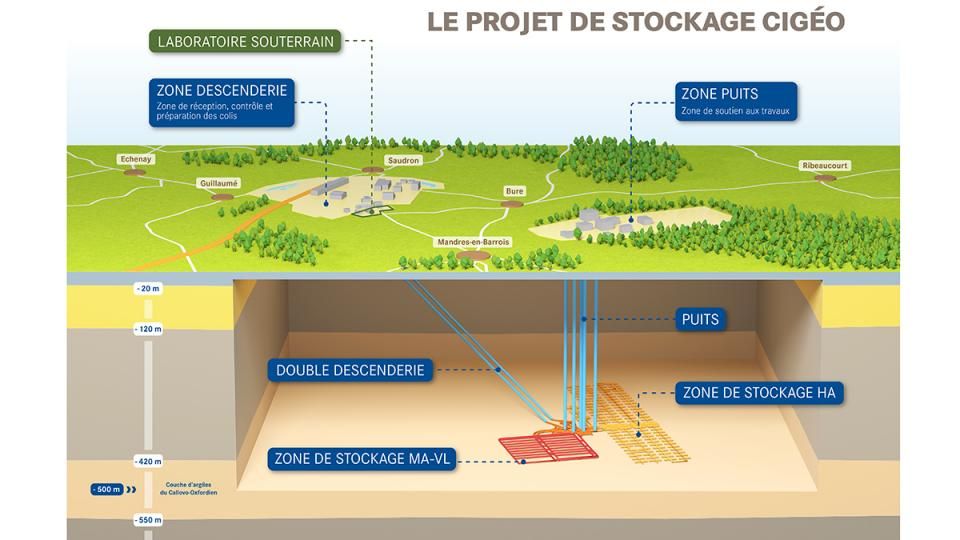
Cigéo storage project — Source: Ouest France
Prior to the closure of the site, arrangements are made to limit the damage to the rock and restore its containment capacity. They are called engineered components and participate in safety functions. They consist in reducing the voids present in the galleries and cells built to transport waste packages. This allows:
The components are made according to numerous calculations and under rigorous conditions. For example, account must be taken of the force caused by technical constraints, the evacuation of heat and gases from the packages...
Deep storage is considered to be the future of radioactive waste management. It offers a sustainable solution to protect the environment and future generations from the potential dangers of radioactivity.
However, it is important to continue to develop safe and reliable storage methods to ensure long-term safety. Governments and manufacturers need to work together to invest in the research and development of advanced storage technologies.
To go further, do not hesitate to read our article: What are the differences between an EPR and an SMR?
In a few clicks, organize an exchange with one of our experts.


weekly newsletter subscribers

4.9

.png)

Some businesses may obtain a partial or total exemption from the TICFE or the TICGN, depending on their activity and energy intensity. The support of an expert makes it possible to identify the eligibility criteria and to put together the file.
Le dispositif ARENH a laissé place au VNU (Versement Nucléaire Universel).
Ce changement structurel expose davantage les entreprises aux prix de gros, rendant la gestion des risques plus complexe qu'auparavant.
Il devient alors indispensable de définir une stratégie d'achat d'électricité avec Sirenergies pour lisser l'impact de la volatilité des marchés sur votre budget.
Ce record de 92,3 TWh s'explique par la conjonction de trois facteurs :
C'est le levier le plus rapide pour obtenir des résultats visibles. L'éclairage représente environ 40 % de la consommation d'électricité d'une commune.
Passer au LED avec pilotage intelligent permet de réduire la facture de 50 à 80 %, avec un retour sur investissement (ROI) rapide, souvent estimé à 2 ou 3 ans.
Le transport (RTE) correspond aux "autoroutes" de l’électricité. Il s’agit de transporter de très grandes quantités d'énergie sur de longues distances, depuis les centrales de production (nucléaires, barrages, parcs éoliens offshore) vers les régions de consommation.
La distribution (Enedis) s'apparente aux "routes départementales" et aux rues. Elle récupère l'électricité à la sortie du réseau de transport pour la livrer directement chez le client final, en abaissant la tension pour qu'elle soit utilisable par vos appareils.
The subscribed power must be calculated according to the consumption profile and uses (heating, industrial processes, tertiary equipment). One fine analysis makes it possible to ensure the adequacy between real need and contract.
The €/MWh is a price unit used in wholesale markets, while kWh is the unit visible on your bills.
Among the taxes include TICFE, TICGN, CTA, CJA and TURPE. They represent a significant part of the bill and vary according to consumption profiles. Understanding them well is essential to optimize costs.
Tertiary companies are concerned by taxes such as TICFE or TICGN. Sirenergies checks the accuracy of invoices, identifies possible exemptions, and helps correct errors to sustainably reduce costs.
Parce que la puissance souscrite en kVA détermine le prix de l'abonnement et que tout dépassement peut entraîner des surcoûts importants.
Exceeding capacity leads to financial penalties and can impact the size of the contract. Adjust the correctly subscribed power makes it possible to avoid these additional costs.
Yes. The supplier guarantees an offer 100% renewable via the official Guarantees of Origin (GO) mechanism.
For the most demanding companies, the offer GREENVOLT+ ensures very low carbon intensity electricity, sourced exclusively from independent French producers (hydraulic, wind, solar).
One invoice consists of several elements: consumption, supplier share, taxes and contributions. The analysis of each line makes it possible to identify possible errors and to check the consistency with the signed contract.
The range E @sy is available in four pricing structures to adapt to each risk profile:
En 2025, la France a atteint un solde exportateur net de 92,3 TWh, battant le précédent record de 2024 (89 TWh).
These are signals sent by RTE during periods of tension on the electrical network. The Sirenergies tool informs you in real time to anticipate your uses.
Communities are subject to taxes such as TICFE or TICGN. Sirenergies analyzes invoices, identifies exemption possibilities and fixes possible errors to reduce the tax burden.
Sourcing consists in identifying and analysing the offers of several electricity and gas suppliers. This approach makes it possible to obtain contracts adapted to the consumption profile and budgetary constraints of the company.
Oui, elle est considérée comme une énergie renouvelable à faibles émissions de gaz à effet de serre.
De plus, l'eau ne subit aucune transformation chimique durant le cycle de production et réintègre son milieu naturel en aval.
Cependant, la construction de barrages nécessite des mesures pour protéger les écosystèmes (débit minimum, passes à poissons).
In 2025, the supplier had a NPS (Net Promoter Score) of +16 and a note of 4,17/5.
Satisfaction is based on a “zero solicitation” model and 100% in-house customer service in Toulon, guaranteeing proximity and responsiveness that cannot be found with major historical suppliers.
Un appel d’offres permet de mettre en concurrence plusieurs fournisseurs d’électricité et de gaz afin d’obtenir des conditions contractuelles optimisées. C’est une démarche transparente qui permet de choisir l’offre la plus adaptée aux besoins budgétaires et techniques de l’organisation.
Le processus repose sur l'utilisation de la force de l'eau (énergie cinétique) issue des courants, des chutes d'eau ou des dénivelés. Le fonctionnement suit trois étapes clés :
Farms are subject to taxes such as TICFE or TICGN. Sirenergies verifies their application, identifies cases of exemption and accompanies the procedures to reduce the tax burden.
Tertiary companies must manage their energy costs while guaranteeing the comfort of users (offices, shops, services). Consumption is often linked to heating, air conditioning and lighting, which requires precise monitoring to avoid budgetary excesses.
Le kVA mesure la capacité maximale que votre compteur peut supporter à un instant T, tandis que le kWh mesure la quantité d'énergie consommée sur une durée.
This makes it possible to choose the right time to contract, secure your budgets and anticipate increases.
L'abondance de production française tire les prix du marché de gros vers le bas.
En vertu du mécanisme de l'Ordre de Mérite (Merit Order), les centrales les moins coûteuses (nucléaire, renouvelables) couvrent la demande plus souvent, évinçant les centrales à gaz ou charbon plus onéreuses.
Cela multiplie les épisodes de prix bas, voire négatifs, sur le marché spot.
The industry is concerned by TICFE, TICGN and other contributions that may represent an important part of invoices. Sirenergies identifies cases of exemption and accompanies the procedures to benefit from them.
C'est l'indicateur d'efficacité d'un appareil électrique ; il représente le ratio entre la puissance active (utile) et la puissance apparente (totale).