





Summarize with AI

January 26, 2026
4
Min reading

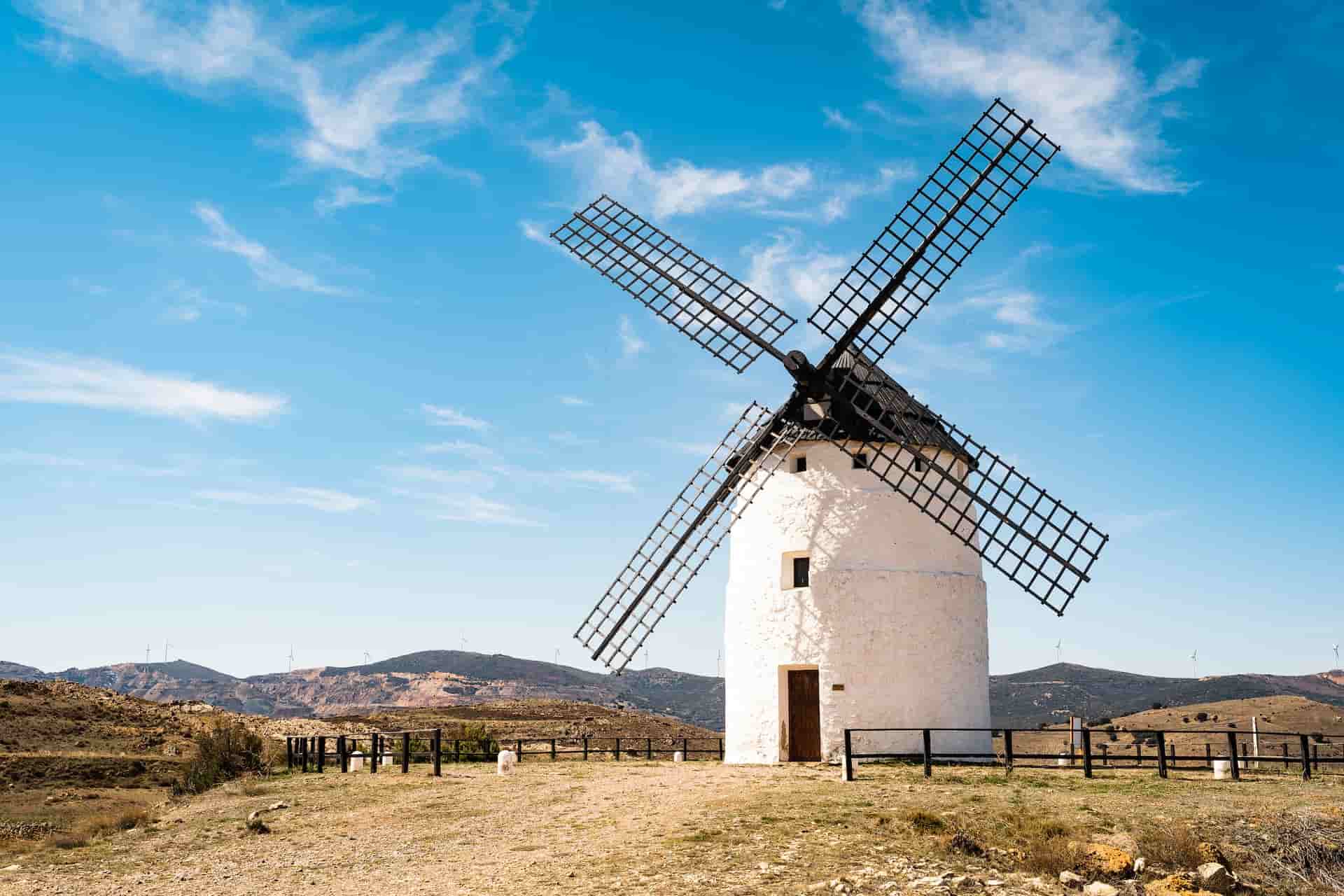
Recognizable by their four slowly rotating branches at the top of a building, windmills are constructions that date from another era. They have practically disappeared and there are very few left that are still visible on French territory.
Although they are similar to wind turbines in many ways, their history and mode of operation remain fairly unknown. SirEnergies sheds light on the role of windmills and the reasons why they disappeared.
Before discussing the functional aspects of windmills, a small point about their history is in order. The aim here is to know where the first windmills appeared in the world and in France.
According to scientists, the first windmills appeared In the VIIE Century in Persia, in the west of present-day Afghanistan. The ancestor of the wind turbine is the result of a new use of navigation technology using sails.
The Persians took a vertical axis on which wings covered with canvas were attached. This is how the first windmills were born.
The spread of this technological marvel of Antiquity occurred through Arabs who traded with the West. Western windmills were characterized by a horizontal axis and were particularly adopted during the XE century.
On French territory, the first windmill would be Appeared in 1170 in the city of Arles. This is what one of the charters of the city of Arles reveals. Afterwards, the windmill spread very quickly to coastal regions, where the wind was strong and permanent. Thus, we encounter mills in Cotentin and the Pays de Caux in Normandy, or even in Brittany.
The operation of windmills installed in France and the West is based on Wind energy. To understand this, you must first focus on the structure of the building. Tower mills are in fact composed of two parts.
The first part is the fixed brick or stone body and the roof is the second part of the windmill. The latter has the capacity to Pivot independently and to do full rotations. It is in this part that the windmill's motor mechanism is located, composed of:
To position the wings of the mill facing the wind, a tail is placed at the back of the building. It generally goes down to the ground and a lever can also be operated from inside the windmill to adjust the position of the wings.
Regarding the actual functioning of the ancestor of The wind turbine, it starts with the circular movement of the wings in contact with the wind.
The motor shaft also starts to rotate thanks to The kinetic energy of the wind, which will thus drive the impeller and the pinion through a gear system. It is this movement that also makes the running wheel rotate, as well as the dormant one, to crush the grain that arrives in the middle of them.
It should be noted that the wind must be strong enough for the wings to start moving. A wind with a speed between 40 and 60 km/h is suitable. The windmill with a vertical axis as designed by the Persians is much more efficient than the Western model.
The main function of the windmill has always been to Grind cereals and grains. It was for this purpose that this ingenious machine was built and it was for this purpose that it was mainly used in the Middle Ages. Its use made it possible to obtain flour.
Over time, other functions were attributed to the ancestor of the wind turbine. For example, this is the pumping of water, using a wind pump. This system was used in particular in the Middle Ages to dry up swampy areas and polders.
The windmill also made it possible to irrigate fields and crops. Its use has also been used in the production of oil, the manufacture of sugar cane juice or plaster.
For others, the windmill was a wonderful machine for crushing fabrics and operating sawmills. They are currently exposed to renewed interest, in the context of the promotion of renewables.
It is in fact possible to rehabilitate windmills to make them sources of green electricity production. The only condition is to have a tower-type building, capable of adjusting its wings to the wind independently and without the supply of external electrical energy.
The disappearance of windmills has begun During the 19th centuryE century. This is due to the industrial revolution with its share of steam engines, more modern and efficient than those operating with wind.
The economic restructuring of the time also had a profound impact on the development of windmills and contributed to their disappearance. To all this, we must also add the replacement of millstones by shredders equipped with metal cylinders for wheat mills.
This change then required larger buildings to accommodate the machines. As a result, windmills were very massively abandoned for other constructions, unlike watermills. The latter survived better thanks to their structure similar to those of typical rural buildings and were reused for other purposes.
Windmills are ingenious machines built primarily to use the kinetic energy of the wind to carry out certain agricultural tasks. These mills were mainly used to mill cereals or grain. They appeared in Persia in the 7thE century, then in France in 1120.
After great success, the ancestor of the vertical axis wind turbine experienced a rapid decline during the 19th century.E century, due to the industrial revolution. However, it is possible to restore a windmill to make it a renewable source of electrical energy.
In a few clicks, organize an exchange with one of our experts.


weekly newsletter subscribers

4.9

.png)

Yes. The supplier guarantees an offer 100% renewable via the official Guarantees of Origin (GO) mechanism.
For the most demanding companies, the offer GREENVOLT+ ensures very low carbon intensity electricity, sourced exclusively from independent French producers (hydraulic, wind, solar).
The range E @sy is available in four pricing structures to adapt to each risk profile: