






Summarize with AI

March 6, 2026
4
Min reading

The energy transition forces us to look for the cleanest possible means of production. Heat networks are one of the most interesting solutions in this field. It is one of the most ecological ways to bring energy to buildings, public services or businesses.
A heating network is a centralized heat production system, transported by pipes and substations. It is a technology that can be ecological by recovering heat and using renewable energies. However, these networks can also be powered by fossil fuels such as gas.
We will therefore see how it is possible to take advantage of this system in the context of the energy transition. We will also see who are the players in this market and its extent in France.
To begin with, we can define what a heating network is. It is a system for distributing heat produced from a centralized production facility.
This makes it possible to supply collective heating systems (individuals or businesses), also to provide domestic hot water or other uses. The principle is to transmit heat through a heat transfer fluid (water or steam).
This installation has the advantage of supplying several customers through a system of networks and pipes. The customers are therefore multiple, they can be hospitals, shopping centers or even factories.
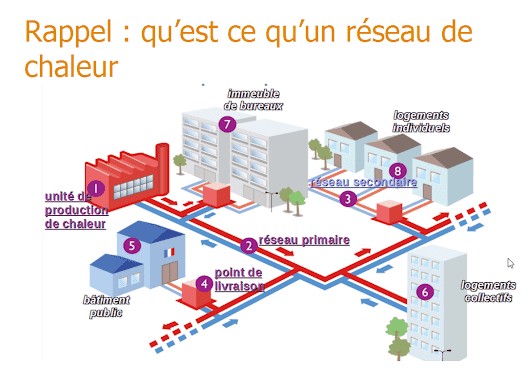
Source: Cerema heat networks
Generally, the investors in this type of project are public organizations. The public authorities then grant a right of concession to a company for the management and maintenance of the structure.
Like refrigeration networks, heating networks are mainly local networks. That is to say, they usually extend to the level of a city for the largest of them. There are interchange stations that extend across the entire network. These allow you to pass between the primary network and the secondary network (the sub-network of the building concerned).
First of all there is a Main boiler which is responsible for producing heat by heating water. This water then transits through the network of pipes. Unlike electricity or gas distribution networks, these are not national networks capable of transporting this energy: the losses would be too significant.
Today, heating networks represent a small part of the total heat produced in France (around 5%); in housing equivalent, this gives 2 million homes. However, at a time of sustainable development, it may be interesting to take advantage of this energy system.
In a heating network, there is a initial energy source, which allows the boiler to work, by heating water that is then transported. However, the question arises as to the origin of this energy.
Indeed, if the primary source of energy is of renewable origin, then the whole system is virtuous. For example, we can cite energies such as wood energy (or biomass) or geothermal energy.
For example, let's imagine a waste incineration plant. The latter produces heat that can be recovered. In France, it is possible to start the so-called “ranking” procedure. In other words, it is possible to make it mandatory to connect to this network for all new constructions in the sector.
This is very interesting for the company that manages this network. However, there are several conditions:
This is an interesting incentive that can push for the creation of new urban heating networks (RCUs).
In France there is the Chaleur Fund managed by ADEME. This Chaleur Fund allows the development of renewables and heating networks. These are the kinds of initiatives that can be essential to the French energy future. In particular, this could make it possible to replace electric heating, which is still massive in France.
One of the benefits that is also important is the centralization of the system. Indeed, it is easier to act on the entire network and buildings from a central boiler. Thus, maintenance and upkeep are facilitated.
The Paris heating network is the largest in France. The pipes are long more than 500 km.
“This network, which heats the equivalent of 500,000 homes, is strategic for Paris and the city's energy transition,” as announced by Dan Lert, deputy mayor of Paris.
Currently, only 50% of the heat transported comes from the use of renewable energy. The aim is to increase this share to 100% by 2050. It is also a question of increasing its production capacity. Today, it alone represents nearly 20% of the French heat network market.
This is a huge project that could cost around 1.6 billion euros. As previously announced, this type of project is carried out by the public authorities. The city of Paris will hold 34% of the shares in the project. This type of project can have a very significant impact on the energy mix and therefore, ultimately, on the climate.
Heating networks are therefore an alternative to fossil fuels promising. However, it should be borne in mind that heating networks cannot be developed everywhere. It depends on many factors such as urban density, the urban environment, the presence of important buildings (hospitals, etc.), a local renewable energy source... Its implementation is therefore subject to conditions, but could be a solution of choice in the years to come.
In a few clicks, organize an exchange with one of our experts.


weekly newsletter subscribers

4.9

.png)

Yes. The supplier guarantees an offer 100% renewable via the official Guarantees of Origin (GO) mechanism.
For the most demanding companies, the offer GREENVOLT+ ensures very low carbon intensity electricity, sourced exclusively from independent French producers (hydraulic, wind, solar).
L'augmentation s'explique par la revalorisation de l'Accise sur le gaz à 16,39 €/MWh et la hausse de 3,41 % du tarif de transport (ATRT 8).
S'y ajoute l'entrée en vigueur des Certificats de Production de Biogaz (CPB), un nouveau coût réglementaire pour soutenir le biométhane.
Face à ces évolutions, Sirenergies vous accompagne dans l'achat de gaz naturel pour sécuriser vos prix malgré la volatilité du marché.
It allows you to prove your commitment to the energy transition and to meet regulatory requirements.
La réussite d'un projet collectif énergie repose sur trois piliers fondamentaux :
Le calendrier 2026 impose deux échéances majeures :
Pour simplifier ces démarches, vous pouvez centraliser vos données de consommation avec la plateforme Pilott de Sirenergies, garantissant ainsi la conformité de vos rapports réglementaires.
Les coopératives de taille ETI ou grande entreprise peuvent être soumises à l'audit énergétique réglementaire (norme NF EN 16247). Sirenergies n'a ni la compétence ni l'accréditation pour réaliser cet audit : nous vous orientons vers un bureau d'études partenaire accrédité, et vous accompagnons en amont sur vos achats et en aval sur le pilotage.
To calculate Scope 2 emissions, use the following formula:
Energy quantity (kWh) × Emission factor (kg CO₂ e/kWh).
Use databases like ADEME for precision.