





Summarize with AI

March 31, 2026
5
Min reading
Also called turbinage pumping, the pumped energy transfer station (STEP) is a hydroelectric installation consisting of two basins. Located in a mountainous area, this station is very useful in order to fill temporary shortages of solar and wind energy. SirEnergies tells you more about this hydroelectric installation.
Developed in the 1970s, a WWTP consists of two basins located at different altitudes in mountainous areas. This hydroelectric station makes it possible to realize An energy storage to redistribute it during periods of significant demand. It requires a significant drop in altitude as well as a large volume of water due to a low energy density. Significant investments are also required.
In France, there are 6 main pumped energy transfer stations. The largest WWTP is located on the Grand'Maison site in Isère. It has a volume of 14.3 million m³.
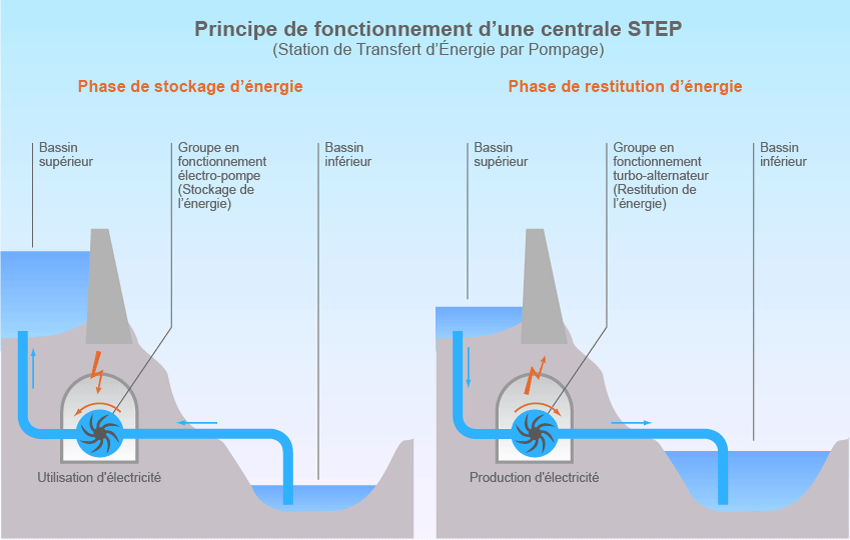
In order to raise water into one of the basins, the WWTP draws it at off-peak hours from a lower basin so that the reservoir, also called an altitude lake, is filled up upstream. The water is then Turbinated during peak hours.
The electricity then harvested will be served during a peak period, i.e. when the demand for energy is very high. This STEP makes it possible to regulate electrical production and consumption on the electrical network. During peak consumption, production costs are also reduced.
In terms of the technique used for stationary storage, it is the transfer of energy by pumping hydraulic which is the most popular. Because of its energy-consuming nature, a pumped storage station is not recognized as producing energy from renewable source.
A pumped energy transfer station is located between two basins used as water reservoirs. When consumption is low, part of the electricity is taken from the electrical network in order to pump water from the lower basin to the high-altitude lake.
This restraint will allow store energy which can thus be used in periods of high demand. During hours of very high consumption, the water retained in the upper basin makes it possible to Make an alternator and a turbine turn in order to distribute electricity on the grid.
You should know that this system is very energy-intensive since it consumes between 15 and 30% of energy, which is colossal. STEPs can be classified into two sub-categories:
Whether they have a daily or daily intake, STEPs are only used as a last resort in order to securing the electrical network. In a sense, it is therefore a question of additional electrical capacity in order to complete the network and to fill the gaps in wind and solar energies.
Source: Energy Encyclopedia
A STEP generates a lot of discussions, whether in terms economic or ecological.
While a WWTP previously had to be located in mountainous areas due to a significant difference in altitude and colossal volumes of water, new hydroelectric installations are beginning to be created, as in Haute-Normandie.
These projects are called STEP Marines. These installations must be located along the coastline with a coastal drop of about a hundred meters in height for the upper reservoir. The sea will then serve as the lower basin. Nor should the site be protected by coastal law, which protects the various coastal areas from abuses linked to real estate speculation.
These hydroelectric installations have a good lifespan. These installations can be counted on for forty years. However, due to increased demand on these stations, particular attention should be paid to the reliability of materials and the maintenance of these devices. In particular, the turbine must be the first part that requires special care.
Located between 70 and 85%, it is estimated that WWTPs have very good electrical efficiency. For example, France produces between 6 and 7 TWh per year. It is therefore important to pay particular attention between the moment when the water is pumped during periods of low consumption and the moment when the water is turbined.
For the electrical installation to be profitable, the purchase of electricity must be made at low cost and the sale must be carried out at high rates in order to cover operating costs and amortization.
Turbinage pump stations are very useful for smoothing prices at times of peak consumption. They also use excess energy from the grid if it is produced in too much quantity.
The least expensive technique is the energy storage by STEP. However, you should know that pumped energy transfer stations are obliged to pay the TURPE (Tariff for the Use of Public Electricity Networks) when they are final consumers of electricity.
By 2025 or 2030, the Multiannual Energy Programming (PPE) wants to see an increase of 1 to 2 GW in the production capacity of French WWTPs.
This shows how important energy storage is with these hydroelectric installations, both in France and around the world. In fact, these installations represent no less than 97% of energy storage capacities. In order to improve the performances of these turbinage pump stations, the IEA (International Energy Agency) suggested two innovations to be implemented by 2050:
Particular attention should also be paid to the cost of an installation, which can be an obstacle to the development of pumped energy transfer stations.
In any case, a STEP is a very useful device for energy storage. Many solutions need to be implemented in order to develop these installations.
Do not hesitate to consult our article to know The operation of a hydroelectric dam.
In a few clicks, organize an exchange with one of our experts.


weekly newsletter subscribers

4.9

.png)

In 2025, the supplier had a NPS (Net Promoter Score) of +16 and a note of 4,17/5.
Satisfaction is based on a “zero solicitation” model and 100% in-house customer service in Toulon, guaranteeing proximity and responsiveness that cannot be found with major historical suppliers.
One invoice consists of several elements: consumption, supplier share, taxes and contributions. The analysis of each line makes it possible to identify possible errors and to check the consistency with the signed contract.
The subscribed power must be calculated according to the consumption profile and uses (heating, industrial processes, tertiary equipment). One fine analysis makes it possible to ensure the adequacy between real need and contract.
This makes it possible to choose the right time to contract, secure your budgets and anticipate increases.
The industry is concerned by TICFE, TICGN and other contributions that may represent an important part of invoices. Sirenergies identifies cases of exemption and accompanies the procedures to benefit from them.
Le processus repose sur l'utilisation de la force de l'eau (énergie cinétique) issue des courants, des chutes d'eau ou des dénivelés. Le fonctionnement suit trois étapes clés :
Parce que la puissance souscrite en kVA détermine le prix de l'abonnement et que tout dépassement peut entraîner des surcoûts importants.
Le transport (RTE) correspond aux "autoroutes" de l’électricité. Il s’agit de transporter de très grandes quantités d'énergie sur de longues distances, depuis les centrales de production (nucléaires, barrages, parcs éoliens offshore) vers les régions de consommation.
La distribution (Enedis) s'apparente aux "routes départementales" et aux rues. Elle récupère l'électricité à la sortie du réseau de transport pour la livrer directement chez le client final, en abaissant la tension pour qu'elle soit utilisable par vos appareils.
These are signals sent by RTE during periods of tension on the electrical network. The Sirenergies tool informs you in real time to anticipate your uses.
The range E @sy is available in four pricing structures to adapt to each risk profile:
C'est l'indicateur d'efficacité d'un appareil électrique ; il représente le ratio entre la puissance active (utile) et la puissance apparente (totale).
Yes. The supplier guarantees an offer 100% renewable via the official Guarantees of Origin (GO) mechanism.
For the most demanding companies, the offer GREENVOLT+ ensures very low carbon intensity electricity, sourced exclusively from independent French producers (hydraulic, wind, solar).
Le kVA mesure la capacité maximale que votre compteur peut supporter à un instant T, tandis que le kWh mesure la quantité d'énergie consommée sur une durée.
Un appel d’offres permet de mettre en concurrence plusieurs fournisseurs d’électricité et de gaz afin d’obtenir des conditions contractuelles optimisées. C’est une démarche transparente qui permet de choisir l’offre la plus adaptée aux besoins budgétaires et techniques de l’organisation.
Oui, elle est considérée comme une énergie renouvelable à faibles émissions de gaz à effet de serre.
De plus, l'eau ne subit aucune transformation chimique durant le cycle de production et réintègre son milieu naturel en aval.
Cependant, la construction de barrages nécessite des mesures pour protéger les écosystèmes (débit minimum, passes à poissons).
Farms are subject to taxes such as TICFE or TICGN. Sirenergies verifies their application, identifies cases of exemption and accompanies the procedures to reduce the tax burden.
The €/MWh is a price unit used in wholesale markets, while kWh is the unit visible on your bills.
Tertiary companies are concerned by taxes such as TICFE or TICGN. Sirenergies checks the accuracy of invoices, identifies possible exemptions, and helps correct errors to sustainably reduce costs.
Le dispositif ARENH a laissé place au VNU (Versement Nucléaire Universel).
Ce changement structurel expose davantage les entreprises aux prix de gros, rendant la gestion des risques plus complexe qu'auparavant.
Il devient alors indispensable de définir une stratégie d'achat d'électricité avec Sirenergies pour lisser l'impact de la volatilité des marchés sur votre budget.
Sourcing consists in identifying and analysing the offers of several electricity and gas suppliers. This approach makes it possible to obtain contracts adapted to the consumption profile and budgetary constraints of the company.
Among the taxes include TICFE, TICGN, CTA, CJA and TURPE. They represent a significant part of the bill and vary according to consumption profiles. Understanding them well is essential to optimize costs.
L'abondance de production française tire les prix du marché de gros vers le bas.
En vertu du mécanisme de l'Ordre de Mérite (Merit Order), les centrales les moins coûteuses (nucléaire, renouvelables) couvrent la demande plus souvent, évinçant les centrales à gaz ou charbon plus onéreuses.
Cela multiplie les épisodes de prix bas, voire négatifs, sur le marché spot.
Ce record de 92,3 TWh s'explique par la conjonction de trois facteurs :
Some businesses may obtain a partial or total exemption from the TICFE or the TICGN, depending on their activity and energy intensity. The support of an expert makes it possible to identify the eligibility criteria and to put together the file.
Communities are subject to taxes such as TICFE or TICGN. Sirenergies analyzes invoices, identifies exemption possibilities and fixes possible errors to reduce the tax burden.
En 2025, la France a atteint un solde exportateur net de 92,3 TWh, battant le précédent record de 2024 (89 TWh).
Exceeding capacity leads to financial penalties and can impact the size of the contract. Adjust the correctly subscribed power makes it possible to avoid these additional costs.
Tertiary companies must manage their energy costs while guaranteeing the comfort of users (offices, shops, services). Consumption is often linked to heating, air conditioning and lighting, which requires precise monitoring to avoid budgetary excesses.
C'est le levier le plus rapide pour obtenir des résultats visibles. L'éclairage représente environ 40 % de la consommation d'électricité d'une commune.
Passer au LED avec pilotage intelligent permet de réduire la facture de 50 à 80 %, avec un retour sur investissement (ROI) rapide, souvent estimé à 2 ou 3 ans.