


Summarize with AI

March 6, 2026
5
Min reading

At a time of energy transition, it is essential to carefully explore each alternative production method. The development of biofuels is crucial in the face of the drying up of fossil fuels.
Indeed, our energy needs are not going to be drastically reduced despite the efforts ofee. In order to reduce our CO₂ emissions, it is always interesting to explore all possible options. Biofuels are fuels produced from vegetable materials such as rapeseed, beets or cereals.
The fact that they can be produced from agricultural products makes them very advantageous. However, as we often see in our articles, in the world of energy: nothing is simple!
The transport sector alone is responsible for a quarter of our CO₂ emissions. This sector is supplied almost exclusively by petroleum products. The fact of being able to substitute these fuels from the oil industry with a new ecological fuel gives the public authorities an additional advantage.
As we will see, biofuels have already appeared on the French landscape. Their democratization remains essential in order to turn the page of fossil fuels.
Biofuels represent 8.4% of primary renewable energy production in France, making it the fifth largest renewable energy source.
Most of the conventional heat engines that we know burn fuels in order to be able to function. The transport sector operates mainly thanks to petroleum products.
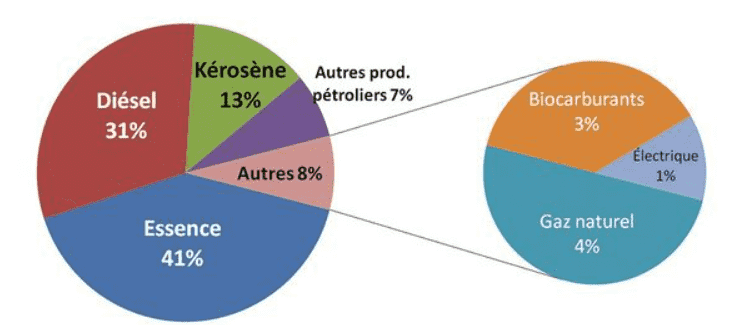
As can be seen below, biofuels still represent a tiny part of the transport energy mix today.
Source: AFIS.org
Biofuels have the particularity of being products derived from processing of vegetable matter and therefore natural. Their advantages are that they can be mixed directly into conventional gasoline. without adaptation (or other products).
It should also be remembered that today many products used in gasoline-powered cars, for example, contain biofuels in varying proportions.
There are currently two main types of biofuels: biodiesel And the bioethanol. This is explained by the two main types of engines that are currently widespread: the gasoline engine and the diesel engine.
First of all, when it comes to the diesel engine, plants that contain oil (rapeseed, sunflower, soybeans, etc.) are used and mixed with ethanol in order to make it react. We then get vegetable oil methyl ester, in other words biodiesel.
Source: IFP Energies Nouvelles
This product is similar to fuel from the oil industry and can be mixed with it. Today, we obtain products that contain up to 10% biofuel, which is far from negligible considering the size of this sector. The European Commission can, and does so regularly, on these subjects by changing the proportions in particular.
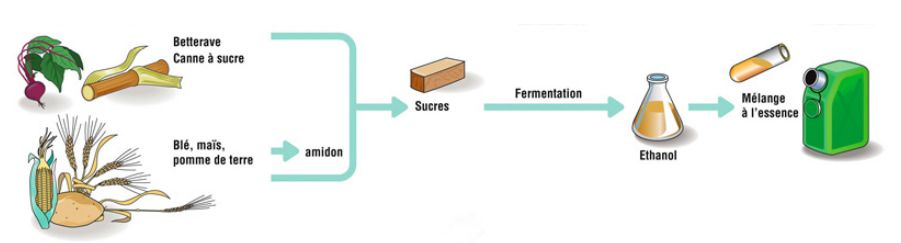
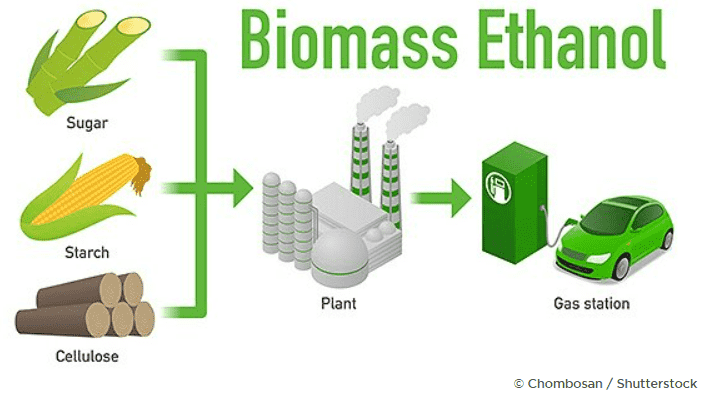
As far as gasoline engines are concerned, bioethanol is obtained otherwise. Materials from industrial production (such as beets or sugar cane) are mainly used. To obtain bioethanol, the sugar contained in these agricultural materials is fermented, then an alcohol is extracted from this process. It should be noted that this process is carried out with the help of a petroleum product: isobutene.
The main advantage of biofuels lies in the way they are produced. Like other renewable production sources, this process does not use fossil resources.
There is another, more advanced biofuel category. Unlike conventional biofuels, these biogas and biokerosenes come from raw materials such as agricultural residues, forest remains, etc.
This raw material has new advantages:
Some countries have an abundance of raw materials and can therefore take advantage of them to produce this type of fuel in accordance with our goals to reduce greenhouse gas emissions.
Source: Futurbles
Like any process, to assess its impact on the environment, it is necessary to take into account its entire life cycle.
This depends heavily on the agricultural facility that supplies the raw material and on the processing processes. Today, as long as the processes do not use coal or heavy treatment, the results are largely positive.
Most of the agricultural installations concerned in France obtain interesting results with significant gains in terms of greenhouse gas reduction (of the order of 70%).
In view of the qualities mentioned above, it is obvious that biofuels can find interesting outlets.
First of all The transport sector. Decarbonizing this sector is essential to achieving our goals to reduce our CO₂ emissions. Indeed, electricity production in France is mostly carbon-free (More than 70% nuclear power generation). The transport sector, on the other hand, remains mostly oil and an interesting development target.
We can also mention The aviation sector, which is seeing the arrival of new synthetic fuels such as biokerosene. Air traffic now accounts for more than 10% of global fuel use. The advantage of this technology is that it allows more biofuel to be incorporated than in automotive fuels.
Technological developments are always dependent on their economic realities. A technical solution may be viable in the laboratory, but if its large-scale use is a financial abyss, it will never see the light of day.
The energy sector is essentially capitalistic and the amounts in terms of investments are often colossal.
In our case, the total price will essentially depend on the cost of raw material as well as on the cost of labor. Some countries, such as Brazil, have relatively low costs. In the United States, new processes are able to approach the production prices of petroleum products, which is encouraging.
It is therefore obvious that biofuels have a role to play in The energy transition. Their future depends on public authorities: biofuel projects must now be included in their investment plans. By reducing costs, this will encourage private investors to develop this activity, just like what can happen on Hydrogen today.
However, it should be noted that changes in crop prices (maize, sugar, etc.) will automatically generate potential shortages. Some countries will inevitably have famine problems so that others can drive organically.
Do not hesitate to read our article: Can CO₂ be transformed into fuel?
In a few clicks, organize an exchange with one of our experts.


weekly newsletter subscribers

4.9