


Summarize with AI

March 6, 2026
8
Min reading
The electrification of uses is accelerating. It is putting increasing pressure on electrical networks. Safe, reliable, flexible and resilient are the key words of tomorrow's energy system. Diversified and intermittent, renewable energies pose a new challenge: maintaining a balance between unpredictable production and fluctuating consumption. Storing electricity is key. It adjusts supply and demand in real time, guarantees supply and supports the energy transition.
What are the challenges of electricity storage? What are the main storage technologies? Where is France today? How is artificial intelligence revolutionizing storage? Sirenergies invites you to dive into the heart of storage.
Storing energy is the process of keeping some of the electricity produced for later use. Storage ensures a balance between supply and demand, reduces electricity losses and optimizes costs.
Energy storage solves the main limitation of renewable energies: their intermittency.
Non-controllable, production photovoltaics and aeolian varies according to weather conditions. This intermittency results in a decorrelation between production and consumption. For example, in the evening in winter, when domestic consumption is at its peak, photovoltaic power plants no longer produce.
Storage captures excess production and feeds it back into the grid at the right time. It brings flexibility to renewables, facilitates their integration into the energy system and supports the transition towards carbon-free electricity.
💡
Optimize your energy strategy with Sirenergies.Cost reduction, transition to renewable energies,... We support you at each stage of your project.
Do you need tailor-made support?
Talk with a dedicated expert to identify the best energy strategy for your business:
We call you back
Storage guarantees the availability of electricity, regardless of production at any given time. By allowingAdjust supply and demand in real time, it ensures the balance of the energy system and the maintenance of affordable prices.
Storage also limits losses in case of overproduction. He is there key to a flexible, resilient and secure energy supply.
Because of its too low energy density, electricity cannot be stored on a large scale in its own form. To be stored, it must be converted into another form of energy.
The electrochemical battery is the most common storage solution. Les stationary batteries store excess renewable energy production in order toself-consumption.
💡
Reduce the ecological impact and energy dependence of your company with our photovoltaic self-consumption solutions. We support you from the selection of partners to the final validation of your project.
Discover our photovoltaic self-consumption solutions!
Allies in our daily lives, embedded batteries charge electric cars, smartphones and laptops.
With its high energy density, low weight, longevity and very short recharge time, the Lithium-ion battery dominates the market. But other types of batteries electrochemical batteries exist, such as sulfur-sodium, lead-acid, nickel-cadmium batteries, etc.
Efficient and fast, the electrochemical battery is emerging as a key element of decentralized energy systems.
The flywheel stores electricity in the form of kinetic energy. Electricity makes a heavy flywheel rotate at high speed in a sturdy cylinder. The energy created by the movement is converted back into electricity by a motor.
This storage system is suitable for powers up to 500 kW. This solution is not lacking in advantages between competitive price, long lifespan, minimal maintenance, high efficiency, great durability and very fast charging.
However, this technology does not stores electricity only for a short period of time. It is therefore adapted to specific and immediate needs.
La converting electricity into gas is a promising storage solution, the subject of numerous experiments.
The storage of electricity in the form of hydrogen particularly appeals to the energy sector. Through electrolysis, electricity is transformed into hydrogen from water. Hydrogen is then consumed directly by industry or heavy transport (Power-to-Gas). It can also be transformed back into electricity via a fuel cell (Power-to-Power).
This system offers very high storage capacities, in the medium and long term.
Storing electricity in the form of air is One of the oldest storage systems.
This method uses compressors that are powered by electricity. Compressed air is stored in underground cavities at a pressure of 70 to 100 bar. During peak consumption, stored air is released. Its pressure activates turbines that produce electricity.
The CAES (Compressed Air Energy Storage) store large quantities of electricity over several weeks. However, their high energy consumption limits their use.
Hydroelectricity is the mechanical storage system the most efficient. It is based on impressive hydroelectric power plants and a multitude of STEP (Pumped Energy Transformation Stations).
The STEP represent 99% of the world's electricity storage capacity. Elles use the mechanical energy of water. Two pools, arranged at different heights, work in tandem. When electrical demand is low, the motor pumps water from the lower basin to the upper basin.
During peak consumption, stored water is released into the lower basin. It then activates turbines that produce clean electricity.
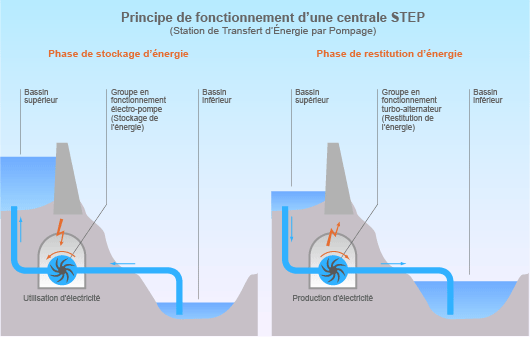
Inexpensive and effective, STEP systems offer a attractive yield for medium term storage.
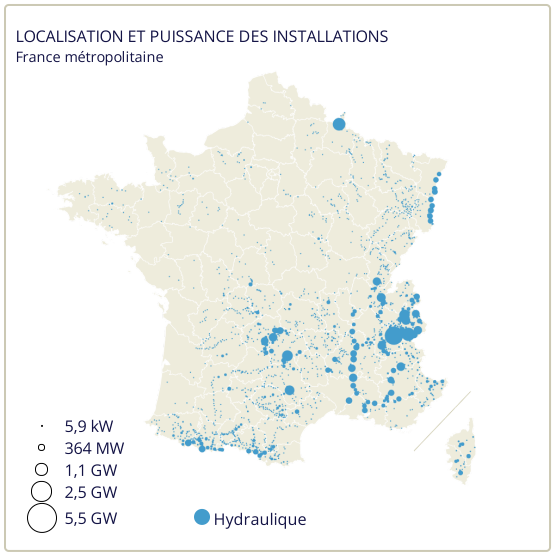
Hydroelectricity dominates electricity storage in France. But its capacities will not be enough to meet the growing needs associated with the development of renewable energies. In his Scenario 2050, the transmission system operator RTE expects photovoltaic and wind power production of 180 to 345 GW (compared to 32 GW in 2021). This evolution requires the development of new ways of flexibility..
France can count on its natural water resources to regulate its electrical production. The French park counts over 2,500 installations, more than 90% of which are run-of-river power plants.
A mature technology, in 2023, the STEP will have a power of 5 GWh for a total annual storage capacity of 200 GWh per year according to RTE.
Of storage technologies innovative are inspired by the way in which STEP systems work.
La gravity battery reproduces the mechanical energy of water. Excess electricity is used to lift heavy blocks. During peak consumption, these blocks are released. Their fall activates an alternator that generates electricity.
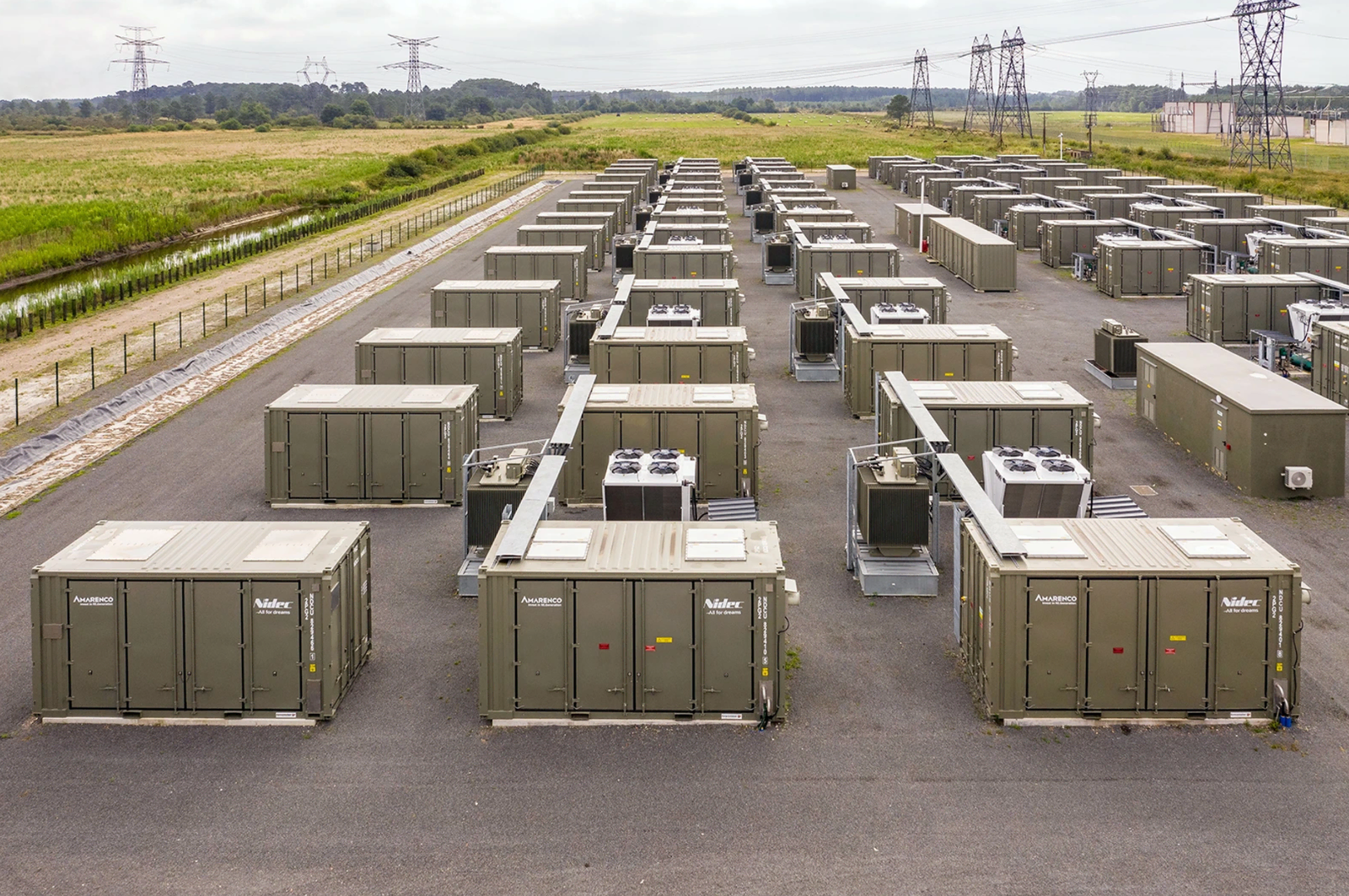
France is relying on electrochemical batteries to meet its growing needs for electricity storage. Despite lagging behind its European neighbors, France is accelerating its trajectory.
In July 2024, the stationary battery park reached 917 MW, which is the power of a nuclear reactor. The Commission for Energy Regulation (CRE) plans to double this capacity in 2025, with 1,200 MW connected.
The largest electricity storage installation is located in Saucats in Gironde, with a capacity of 105 MWh. It should be surpassed in 2025 by a new battery park in Nantes with a storage capacity of 200 MWh.
France is also aiming for European leadership on embedded electric batteries. The France 2030 plan sets an ambitious objective: to reach a battery production capacity of 120 GWh in 2030.

Instead, in July 2024, the CRE announced a capacity of 917 MW. Figure that probably takes into account other storage capacities not connected to the grid or connected to networks other than Enedis.
Hydrogen is “the most serious candidate to meet long-term needs ” declares RTE. Pioneering state in this field, France has chosen hydrogen obtained by the electrolysis of water from low-carbon or renewable electricity.
The objective: to install 6.5 GW of electrolysis by 2030 to strengthen storage capacities and reduce greenhouse gas emissions.
Led by NaTran (formerly GRTgaz), the Jupiter 1000 Project is the first French industrial Power-to-Gas demonstrator. This project stores excess renewable electricity in the form of gas. Commissioned in 2020, Jupiter 1000 is testing electrolysis and methanation on an industrial scale to produce a carbon-neutral gas that can be injected into the gas network.
Experts have high hopes in artificial intelligence to optimize energy storage. AI offers the promise of a more reliable, flexible, and sustainable energy system.
Artificial intelligence is transforming the management of electricity storage. Thanks to the real-time analysis of a multitude of data (production, consumption, weather forecasts...) and to advanced algorithms, AI anticipate overproduction and consumption peaks.
These forecasts allowfinely and instantly adjust electricity supply and demand. They optimize the use of various energy resources and storage capacities.
THEartificial intelligence improves the maintenance of storage systems. Using sensors and connected objects, AI Anticipates and detects anomalies. This real-time and continuous predictive maintenance limits malfunctions and corrective maintenance costs.
AI also extends the life of stationary batteries. It optimizes charge and discharge cycles to ensure maximum performance.
Artificial intelligence reinforces the integration of renewable energies into the electrical network. Elle guarantees stable and sustainable energy, by adapting solar or wind production according to weather and demand. It can direct the electricity produced to the network or to the storage according to needs.
Artificial intelligence is also accelerating the development of smart grids. Thanks to AI, these smart electrical networks balance supply and demand, while promoting the integration of small local producers and decentralized storage solutions.
To conclude...
Energy storage is a lever for the energy transition. Faced with fluctuating demand and the development of renewable energies, storage technologies are diversifying and gaining in performance. Electrochemical batteries, hydrogen, STEP, mechanical storage: each solution plays a key role in building a more flexible, resilient and carbon-free energy network.
But the race is far from over. Artificial intelligence is already paving the way for finer and more predictive storage management. Innovation and research continue to push the limits and invent ever more sustainable, accessible and efficient storage methods.
In a few clicks, organize an exchange with one of our experts.


weekly newsletter subscribers

4.9