


Summarize with AI

March 6, 2026
5
Min reading
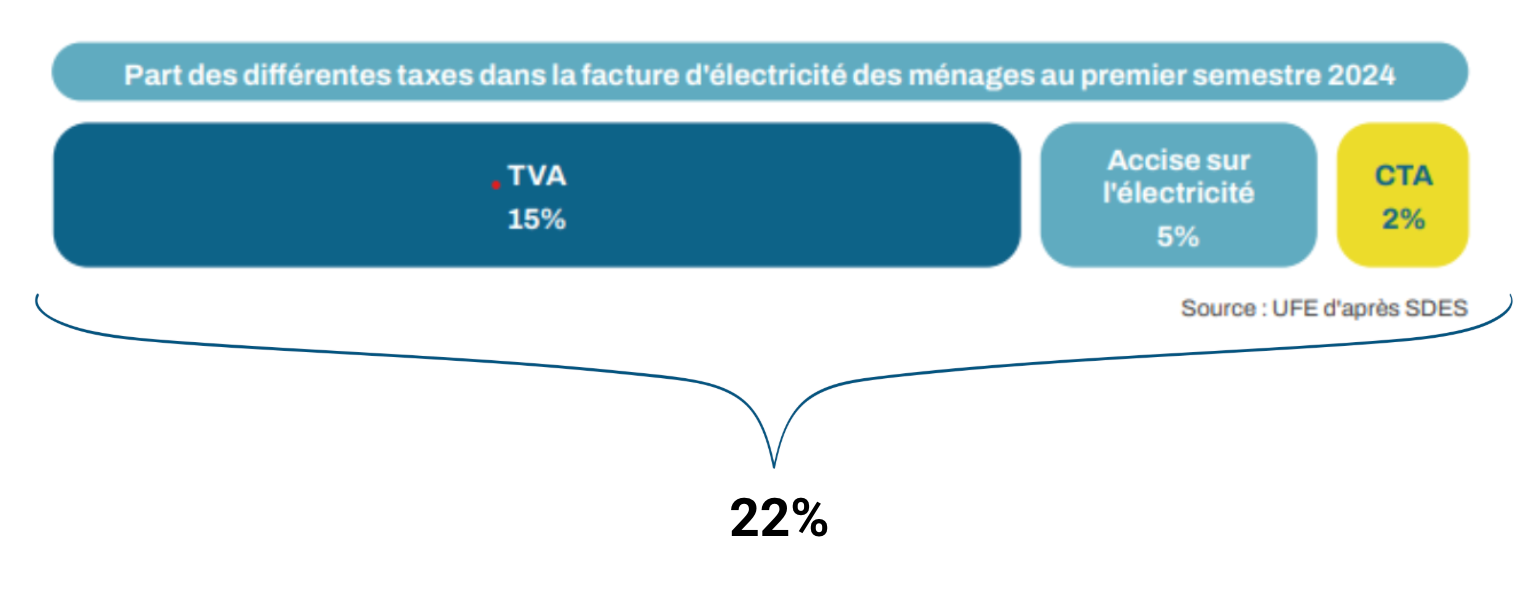
In 2024, almost a quarter of the electricity bill is made up of taxes. This burden weighs heavily on the energy budget of households, businesses and communities. Electricity taxes, which number three, have continued to fluctuate in recent years, in line with the state's budgetary, energy and environmental priorities.
The latest fiscal measures of 2025 raise questions: is a new fiscal strategy taking shape before our eyes? What are its impacts on businesses? Decryption.
Source: Electrical Industry Observatory
Initially known as the contribution to the public electricity service (CSPE), the excise on electricity has evolved profoundly over the past 25 years. A fiscal tool at the service of national priorities, this tax reveals the difficulties of the State between economic, budgetary and environmental issues.
The excise duty on electricity has its origin in contribution to the public electricity service (CSPE). In 2016, the CSPE was replaced by the domestic tax on final consumption of electricity (TICFE). In 2022, this tax was called excise on electricity to comply with European requirements.
Excise duty on electricity finances national energy policy, solidarity and energy transition. Revenues are in particular invested in the development of renewable energies and the energy check system.
Since 2017, the excise on electricity has been paid directly into the general state budget, breaking with the logic of specific assignment.
Stable in the 2000s, the CSPE grew dramatically by 400% between 2010 and 2016. The reason? THEacceleration of public investments in renewable energies.
The CSPE then asserts itself as a tool for energy transition and for supporting green energy.
From 2016 to 2021, TICFE regained reassuring stability for consumers, with a fixed rate of €22.5/MWh.
The energy crisis is changing priorities. Faced with the sudden rise in electricity prices, consumer protection takes precedence over the environment. The excise tariff on electricity is falling drastically. Of the 1Er From February 2022 to January 31, 2024, it is reduced to €1/MWh for individuals and similar persons and to €0.5/MWh for businesses. France respects the minimum authorized by the European Energy Directive.
Thanks to this price shield, the increase in regulated sales rates (TRV) remains under control to 4%, instead of more than 40%.
The year 2024 marks the end of the fiscal lull for consumers. The rise in electricity prices is decelerating. Budgetary reality is essential. The State acts removal of the price shield and the gradual return to normal.
Between the 1Er February 2024 and on January 31, 2025, the excise duty is increased to 20.5 or 21 €/MWh depending on the power of the meter.
The 2025 finance law confirms the Increase in excise duties on electricity, which is reaching higher levels than before the energy crisis.
So, From the 1Er August 2025, new rates apply :
At these rates, is added an increase of €4.89/MWh, introduced by the 2025 Finance Act.
The objective: to finance the tariff equalisation in the ZNI or areas that are not interconnected (Corsica and overseas territories). This mechanism guarantees the uniformity of prices throughout France, despite higher production costs in these island regions.
Optimize your electricity taxes, is it possible?
Our experts study your profile to control your energy budget.
In 2024, value added tax (VAT) represents 75% of electricity taxation. The 2025 Finance Act increases this share by harmonizing VAT rates.
VAT applies on all components of the electricity bill : consumption, supply, transport, excise on electricity and CTA.
Historically, two VAT rates coexisted :
The 2025 finance law standardizes the VAT rates on the electricity bill. Starting on 1Er August 2025, a single rate of 20% applies.
This measure brings France into line with European law, which imposes uniform VAT rates for the same service.
Created in 2004, the transport tariff contribution (CTA) finances part of the specific pension plan employees in the electrical and gas industries (IEG). It compensates for the lack of provisions created by the State when these companies were still public establishments (EPIC).
The CTA is calculated on the fixed part of the delivery rate electricity (TURPE). In 2021, its rate was lowered by the CRE (Commission de Régulation de l'Énergie) to compensate for the increase in TURPE. In 2025, for the fifth year in a row, this rate remains stable at 21.93%.
A modest part of the electricity bill (2% in 2024), this tax contributes to the social regulation of the electricity sector.
To conclude...
Electricity taxation in France has undergone significant changes in recent years, in line with the evolution of national priorities. The 2025 finance law confirms a trend of increasing taxes. The latest measures are expected to increase household and business electricity bills by 6%.
Through these decisions, the State is sending contradictory signals to consumers. With a tax rate of 1,262 euros per ton of CO2 Although emitted, French electricity, which is mostly carbon-free, is taxed more heavily than fossil fuels. This fiscal paradox reveals a thorny dilemma: how to reconcile budgetary imperatives, energy transition and electricity accessibility? While the answer remains uncertain, taxation is at the heart of the equation.
Will the increase in taxation in 2025 take a toll on your energy budget?
You can take action to control your electricity bill.
SirEnergies, energy sourcing and consulting firm, builds for you expert and personalized solutions.
With our Pilott app, avoid unpleasant surprises!
✓ Daily monitoring of your consumption
✓ Real-time electricity and gas market prices
✓ Management of your contracts
✓ Purchase at the best time
✓ Reducing your bills
In a few clicks, organize an exchange with one of our experts.


weekly newsletter subscribers

4.9